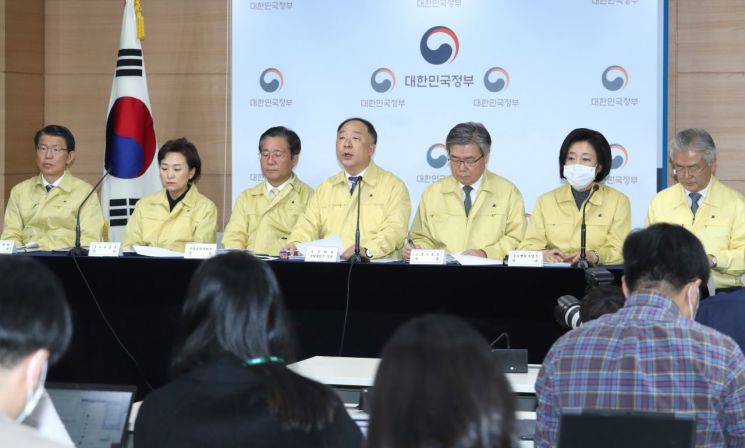
[Sejong=Asia Economy Reporters Kim Hyunjung and Jang Sehee] Hong Nam-ki, Deputy Prime Minister and Minister of Economy and Finance, announced that the supplementary budget related to the novel coronavirus infection (COVID-19) will be "more than 6.2 trillion won." The government plans to submit a supplementary budget bill to the National Assembly next week, reflecting a larger budget than during the Middle East Respiratory Syndrome (MERS) outbreak in 2015.
On the 28th, Deputy Prime Minister Hong made this announcement during a briefing on the "Comprehensive Measures for Minimizing the Impact of COVID-19 and Early Overcoming of Livelihood and Economy" at the Government Complex Seoul. He said, "It is difficult to specify the exact amount as we are currently discovering and reviewing supplementary budget projects," but added, "Considering the more severe situation compared to MERS, the principle is to allocate a larger expenditure scale than during MERS."
Regarding concerns that the increase in net expenditure from this supplementary budget will worsen national fiscal soundness, he argued, "When implementing a supplementary budget, it is inevitable to mobilize as much surplus funds as possible and cover the rest with deficit bonds." He added, "We judged that issuing deficit bonds to prepare measures, even if national debt increases by several trillion won, is necessary rather than doing nothing because of the increase in national debt."
On the same day, Deputy Prime Minister Hong also announced a 20 trillion won scale economic stimulus plan. In addition to the previously announced 4 trillion won support plan, he unveiled a comprehensive livelihood and economic plan worth 16 trillion won. Hong stated, "We will closely monitor future developments and livelihood and economic conditions and continuously devise additional measures in the 4th and 5th rounds."
Regarding growth rate forecasts related to COVID-19 and the supplementary budget, he said, "The government does not adjust growth rates according to issues like research institutes do, but will make adjustments in the economic policy direction for the second half of the year in July." He added, "Including the supplementary budget, the total support measures will exceed 26 trillion won, and we believe this can sustain the momentum for economic recovery."
On the same day, the Ministry of Economy and Finance also announced a goal to execute more than 75% of the planned supplementary budget within two months after its passage in the National Assembly. The supplementary budget plan focuses on ▲support for recovery of small and medium-sized enterprises and small business owners ▲advancement of the quarantine system ▲economic stimulus (domestic demand and regional economy), and aims to ensure that more than 75% of the budget is executed within two months after approval to promptly realize the effects of the supplementary budget.
In the first half of the year, central government finances will be executed early at a record high level of 62%, with more than 32% executed in the first quarter. In particular, job projects will be executed early at 66% in the first half and more than 37% in the first quarter.
Meanwhile, the briefing was attended by Deputy Prime Minister Hong Nam-ki, Minister of Trade, Industry and Energy Sung Yun-mo, Minister of Land, Infrastructure and Transport Kim Hyun-mi, Minister of SMEs and Startups Park Young-sun, and Financial Services Commission Chairman Eun Sung-soo.
© The Asia Business Daily(www.asiae.co.kr). All rights reserved.

















