1.4 Trillion Won Financial Support for COVID-Affected Companies Over 14 Business Days
Preferred Loans with Late 2% Interest Rates Also Doubled from 500 Billion to 1 Trillion Won
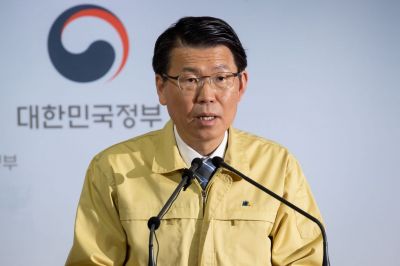 Eun Sung-soo, Chairman of the Financial Services Commission, is explaining the financial support measures for COVID-19 response at the Government Seoul Office Joint Briefing Room on the 28th.
[Asia Economy Reporter Jo Gang-wook] Financial authorities and the financial sector have decided to significantly strengthen financial support by tripling the amount of ultra-low interest loans for small business owners and small to medium-sized enterprises (SMEs) affected by the novel coronavirus disease (COVID-19) crisis compared to before.
According to the Financial Services Commission on the 28th, the scale of ultra-low interest loans for small business owners and self-employed individuals will be expanded from the existing 1.2 trillion KRW to 3.2 trillion KRW, a threefold increase. These loans will maintain an interest rate of about 1.4% for three years, after which market interest rates will apply from the fourth year onward. In particular, the guarantee fee rate will be reduced from 1.2% to 0.5% for one year, resulting in an approximate 3 percentage point reduction in interest and guarantee fee burdens compared to typical loans.
Preferential interest rate loans, which usually have rates in the high 2% range, will also be doubled from 500 billion KRW to 1 trillion KRW. Through an increase in the bank sector’s contribution rate (from 0.02% to 0.04%), the supply of regional credit guarantees for small business owners and self-employed individuals will be expanded by 500 billion KRW from 16.7 trillion KRW to 17.2 trillion KRW.
For SMEs and mid-sized companies experiencing temporary liquidity difficulties, the issuance scale of Primary Collateralized Bond Obligations (P-CBOs) in key industries such as automobiles and shipbuilding will be increased from 1.7 trillion KRW to 2.2 trillion KRW. The per-company inclusion limit will be raised from 15 billion KRW to 20 billion KRW for SMEs and from 25 billion KRW to 35 billion KRW for mid-sized companies. To reduce the burden of subordinated bond underwriting on companies, the underwriting ratio will be lowered from 3% to about 1.5% for a three-year maturity.
To support funds for facility investment by SMEs and mid-sized companies, 3 trillion KRW will be supplied this year for industrial structure advancement, and 4.5 trillion KRW for boosting facility investment.
The financial sector will also take the lead in resolving the immediate funding difficulties faced by SMEs and small business owners.
SMEs and small business owners experiencing temporary funding difficulties due to COVID-19 can extend the maturity of their existing bank loans for at least six months or until the situation stabilizes. Eligible companies are those that have suffered direct or indirect damage such as sales decline due to COVID-19, without defaults such as principal or interest arrears, capital erosion, or significantly low credit ratings.
Second-tier financial institutions such as savings banks, insurance companies, and card companies are also participating in support by extending maturities and deferring repayments of credit loans and business fund loans for COVID-19 affected companies for 3 to 12 months.
In particular, for special management areas such as Daegu and Gyeongbuk affected by COVID-19, non-face-to-face screening methods such as telephone applications will be actively utilized when extending loan maturities and providing financial support in the banking sector.
In addition to existing loans, SMEs and small business owners affected by COVID-19 can newly receive emergency management stabilization funds totaling 3.2 trillion KRW from banks. Preferential interest rates reduced by 1 to 1.5 percentage points compared to existing bank loans will be applied.
Korea Development Bank, Industrial Bank of Korea, and some other banks are deferring interest payments for affected SMEs and small business owners. For example, Korea Development Bank is currently implementing interest payment deferral until the end of the year upon borrower application and review at the time of maturity extension. Also, Insurance Company A provides up to six months of deferral for insurance premiums or insurance contract loan interest payments for customers who have suffered personal or property damage due to COVID-19, after review by the authorized decision-maker based on submitted support procedure documents.
Small business owners who have difficulty accessing formal financial institutions due to low credit or low income can receive support through microfinance and Sunshine Loans, which are financial products for low-income earners.
The Financial Services Commission plans to monitor the financial support status and the funding situation of SMEs and small business owners through financial situation review meetings and external risk monitoring financial sector task forces, and prepare necessary supplementary measures. In particular, next week, they will hold a breakfast meeting with the heads of the five major financial holding companies and financial sector associations to continuously cooperate so that the financial sector can take the lead in overcoming the current difficulties.
A Financial Services Commission official said, "We will closely monitor the situation and, in consultation with related ministries, continuously review the need for additional support measures and prepare necessary support plans."
Meanwhile, since the announcement of financial sector support measures for SMEs, mid-sized companies, and small business owners on the 7th, a total of 24,997 cases amounting to about 1.3914 trillion KRW (including about 460.6 billion KRW in new loans) have been supported through policy financial institutions, banks, and card companies over 14 business days.
About 379.6 billion KRW was newly supplied through policy financial institutions such as Korea Development Bank, Industrial Bank of Korea, and Korea Credit Guarantee Fund, and maturities of existing loans and guarantees were extended for a total of 13,125 cases (about 607.4 billion KRW). Commercial banks newly lent about 81 billion KRW and supported 191 cases (about 135.8 billion KRW) through maturity extensions and repayment deferrals, while card companies supported about 9.1 billion KRW (1,059 cases) through interest and overdue fee discounts.
© The Asia Business Daily(www.asiae.co.kr). All rights reserved.

















