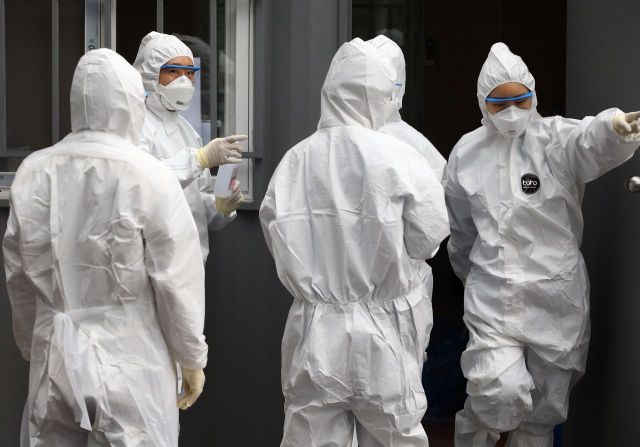
 On the 26th, medical staff at the Chilgok Kyungpook National University Hospital screening clinic in Buk-gu, Daegu, are preparing to test a suspected patient of the novel coronavirus infection (COVID-19). Photo by Yonhap News.
[Asia Economy Reporter Kim Ga-yeon] It has been reported that there is strong opposition from the medical community regarding the government's recommendation for medical staff collecting specimens for the novel coronavirus infection (COVID-19) to use gowns instead of full-body protective suits.
On the 26th, a post titled "I am a doctor. Please save me" was uploaded on an online community.
The author, who identified themselves as a doctor, revealed a public document from the Korea Disease Control and Prevention Agency Central Disaster and Safety Countermeasure Headquarters (CDSCH) and raised their voice, saying, "Is it reasonable not to provide protective suits to doctors collecting specimens? Aren't doctors also citizens?"
They said, "Doctors have to scrape inside the nose and the tonsils when collecting specimens, and during this process, the infection risk is highest for doctors, yet they are only given plastic gowns," expressing frustration, "There is money to send masks to China, but no intention to support protective suits for doctors?"
Earlier, on the 25th, the CDSCH sent a public document stating that due to difficulties in supplying full-body protective suits, "As the usage of full-body protective suits (Level D) increases, it is recommended to use gowns instead of full-body protective suits for specimen collection and similar cases."
According to the World Health Organization (WHO) standards, medical staff must wear personal protective equipment such as full-body protective suits (Level D) that cover the entire body during the COVID-19 specimen collection process.
However, according to the CDSCH recommendation, full-body protective suits are restricted to use only for quarantine, transport, disinfection of quarantine vehicles, and corpse transport.
Accordingly, medical staff must use four items?gown, N95 mask, goggles or face shield, and gloves?instead of full-body protective suits during the specimen collection process for suspected COVID-19 patients.
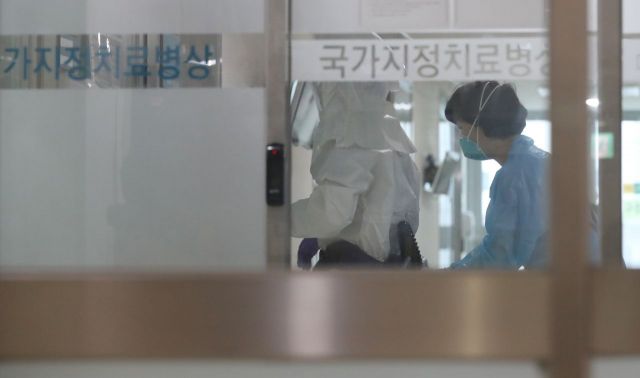 On the morning of the 25th, medical staff wearing protective suits are seen at the nationally designated treatment beds (negative pressure beds) for COVID-19 patients at Ulsan University Hospital.
 Photo by Yonhap News
As the controversy spread, the 'Lawyers Group Considering Medical Issues' (Uibyeon) issued a statement on the 26th, saying "There is a possibility of human rights violations" and urged, "The quarantine authorities should provide sufficient protective equipment such as protective suits and masks to public health doctors and medical personnel deployed to the quarantine sites."
Uibyeon emphasized, "It is fundamental to quarantine that medical staff wear protective gear that can protect themselves from infection and be deployed to the field," adding, "If medical staff stand on the front lines of quarantine wearing general gowns that cannot provide full protection instead of full-body protective suits during specimen collection, infection among medical staff is only a matter of time."
Regarding the controversy, Yeo Jun-seong, policy advisor at the Ministry of Health and Welfare, explained on his SNS that "It seems there was a miscommunication during the process of delivering the message to local governments."
Advisor Yeo stated, "The CDSCH consulted with the 'Pan-Academic Countermeasure Committee,' including the Korean Society of Infectious Diseases, and allowed the use of long-sleeved gowns for specimen collection," adding, "Level D suits are difficult to put on and take off, and experts agreed that wearing gowns that are easier to don and doff can also provide protection."
He continued, "The long-sleeved gowns refer to disposable waterproof gowns, which are changed after each specimen collection. The guidelines specify that the four items?mask, gloves, disposable gown, and protective goggles?must be equipped," and added, "I will contact the relevant local governments to have the guidelines corrected."
© The Asia Business Daily(www.asiae.co.kr). All rights reserved.
![Clutching a Stolen Dior Bag, Saying "I Hate Being Poor but Real"... The Grotesque Con of a "Human Knockoff" [Slate]](https://cwcontent.asiae.co.kr/asiaresize/183/2026021902243444107_1771435474.jpg)

















