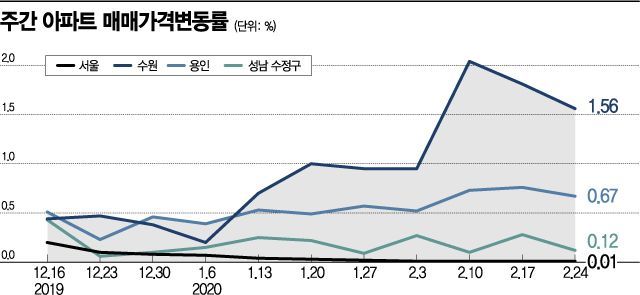
[Asia Economy Reporters Yuri Kim, Onyu Lim] After the 12.16 real estate measures, the upward trend in Seoul apartment prices, which had slowed down, is showing signs of expanding again in just over two months. The Gangnam 3 districts (Gangnam, Seocho, Songpa) have reduced their decline, and the 'balloon effect' is evident in non-Gangnam areas. The government's 2.20 real estate measures, aimed at curbing the rapid rise in apartment prices in the Suwon-Yongin-Seongnam (Suyongseong) area and other parts of the metropolitan area, are also causing a balloon effect in other regions such as Incheon and Hwaseong.
According to the weekly apartment price trend announced by the Korea Real Estate Board on the 27th, the nationwide weekly apartment sale price increase rate (as of the 24th) recorded 0.2%. This is the largest weekly increase since the weekly trend survey began on May 14, 2012.
Seoul, the main target of the government measures, is showing a slight but persistent increase, leading to analyses that the effect of the measures has virtually disappeared. After the 12.16 measures, Seoul apartment prices, which had stalled, have continued a weekly increase of 0.01% for four consecutive weeks. While high-priced apartments in Gangnam have shown weakness, apartments priced under 900 million KRW in non-Gangnam areas, which face relatively fewer loan restrictions, are showing an upward trend due to the balloon effect, preventing the overall upward trend from breaking.
Looking at this week's price fluctuations, the relative strength of non-Gangnam areas such as Gangbuk (0.09%), Nowon (0.09%), Dobong (0.08%), and Guro (0.08%) continues, while the decline in Gangnam, Seocho, and Songpa districts has narrowed by 0.02 percentage points, 0.01 percentage points, and 0.04 percentage points respectively compared to the previous week. This is attributed to most of the urgent sale properties in these areas being sold out and the price rebound influenced by some reconstruction complexes preparing for sales before the expiration of the private land price ceiling system waiver at the end of April. Mapo (0.05%), Yongsan (0.03%), and Seongdong (0.03%) also increased their rate of rise compared to the previous week.
In particular, apartments in the Gyeonggi region are leading the price increase trend. Apartment prices in Gyeonggi rose by 0.44%, surpassing the previous week's increase of 0.42%. This is also the highest increase since the survey began.
The newly designated adjusted areas in Suwon, such as Gwonseon-gu (1.56%), Yeongtong-gu (1.54%), and Manan-gu in Anyang (0.44%), showed a slight decrease in the rate of increase compared to the previous week but maintained an upward trend. Suwon Jangan-gu (1.36%) and Uiwang (0.51%) actually increased their rate of rise. The balloon effect is clearly evident in areas that avoided government regulations. Yongin Suji-gu (1.04%), which was excluded from the 2.20 measures despite expectations of being designated as a speculative overheating district due to its continued upward trend, also saw an increase in the rate of rise. The upward trend in the non-regulated areas of Ansan, Siheung, and Hwaseong (Ansi-seong) also expanded. Ansan's weekly increase rate rose by 0.10 percentage points to 0.43%, while Siheung (0.54%) and Hwaseong (1.07%) continued to increase their rates. Guri (0.97%) also maintained its upward trend.
Incheon rose to 0.40%, recording the highest increase rate ever. In Yeonsu-gu, home to Songdo International City, the rate of increase was 1.06%, supported by transportation benefits such as the metropolitan area express train (GTX)-B line and the effect of new apartment sales.
Daejeon, which was removed from the adjusted areas, also expanded its rate of increase from 0.53% to 0.75%. Sejong (1.52%) recorded the highest apartment price increase nationwide.
Experts say that this balloon effect may continue for some time. They point out that there are limits to further demand regulation measures to block this, and that supply measures that resonate with demanders and alternative investment destinations for liquidity are necessary. Yang Ji-young, director of Yang Ji-young R&C Research Institute, said, "There is also a learning effect that real estate prices will eventually rise," adding, "Unless fundamental supply measures, which are the root cause of the recent price increase, are implemented, other side effects such as balloon effects in other regions are inevitable."
© The Asia Business Daily(www.asiae.co.kr). All rights reserved.
![User Who Sold Erroneously Deposited Bitcoins to Repay Debt and Fund Entertainment... What Did the Supreme Court Decide in 2021? [Legal Issue Check]](https://cwcontent.asiae.co.kr/asiaresize/183/2026020910431234020_1770601391.png)
















