LCC 6 CEOs Submit Urgent Government Proposal
Request for Unsecured, Long-term Low-interest Funding, Airport Facility Fee Exemptions, and Expanded Employment Retention Support Funds
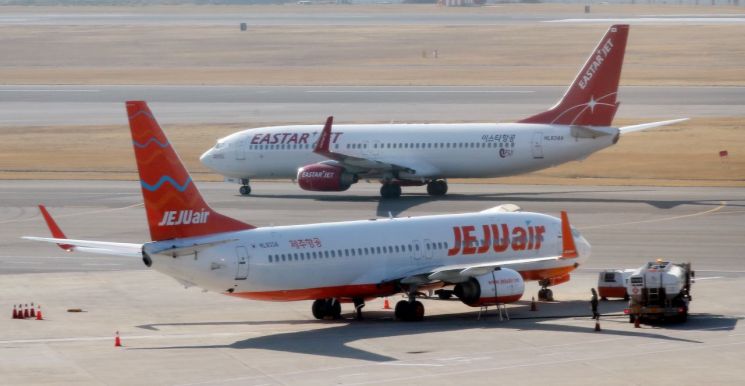
[Asia Economy Reporter Yoo Je-hoon] Domestic low-cost carriers (LCCs), pushed to the brink of collapse due to the novel coronavirus disease (COVID-19) crisis, have taken joint action demanding practical measures from the government. The LCCs stated, "The current situation is a crisis phase that is difficult to overcome with each company's self-help measures alone," and called for proactive measures such as unconditional emergency funding support and a temporary increase in the employment retention subsidy rate.
The CEOs of six LCCs?Jeju Air, Jin Air, T'way Air, Air Busan, Eastar Jet, and Air Seoul?issued a joint emergency appeal titled "LCC Joint Emergency Proposal to Overcome the COVID-19 Crisis," stating, "Airlines are sharing the pain of over 10,000 employees through wage reductions and unpaid leave alongside self-help efforts to overcome the crisis caused by COVID-19, but these efforts alone are insufficient."
The CEOs' plea stems from the recognition that the self-help plans prepared by each company and the government's "Emergency Support Measures for the Aviation Sector" announced on the 17th are grossly inadequate to overcome the current situation. The CEOs emphasized, "This is not a crisis of a specific airline but a crisis of the entire LCC sector," adding, "It is a critical juncture that could lead to the mutual destruction of the industry base."
Since the COVID-19 outbreak, most LCCs have drastically reduced flight routes and implemented unpaid leave and reduced working days and hours. Eastar Jet's situation has worsened to the point where it can only pay 40% of its employees' wages this month. However, as overseas countries strengthen entry restrictions due to the spread of COVID-19, each LCC faces the need to further suspend operations.
The government measures, which include up to 300 billion KRW in funding support and a three-month deferral of airport facility usage fees, are also considered insufficient. A senior industry official remarked, "To secure funds under the government's plan, stringent credit evaluations and collateral provision are required, but some companies with liquidity so deteriorated that they cannot even pay salaries immediately will find it difficult to endure," adding, "Various facility usage fees are deferred, not exempted, and the measures themselves fall short compared to those during the 2003 Severe Acute Respiratory Syndrome (SARS) outbreak."
Accordingly, the CEOs demanded three measures from the government: ▲ emergency management stabilization funds with no collateral and long-term low-interest conditions ▲ exemption of airport facility usage fees and parking fees, as well as support for various tax reductions (such as aircraft property tax and aviation fuel import duties) ▲ temporary increase in the employment retention subsidy rate (from the current half to two-thirds). These measures aim to lower barriers to fund procurement for a swift escape from the liquidity crisis and reduce fixed costs through exemptions of various facility fees and taxes. The expansion of the employment retention subsidy rate is interpreted as considering idle personnel due to future expanded flight suspensions.
The CEOs stated, "The aviation industry is a national key industry with significant ripple effects on the national economy, and direct and indirect employment reaches about 15,000 people, so a collapse at this point would be a huge national loss," and added, "We earnestly request once again proactive government support to wisely overcome the current crisis and leap forward as a first-class advanced aviation country in the future."
© The Asia Business Daily(www.asiae.co.kr). All rights reserved.

















