Suwon Gwonseon and Paldang Slow Down... Uiwang and Yongin Suji Rise↑
Regulations Strengthened in Adjustment Areas but Effects Limited
Seoul Similar to Last Week... Gangnam Continues to Decline
[Asia Economy Reporter Moon Jiwon] After the government strengthened regulations on adjusted areas with the '2·20 Real Estate Measures,' the rate of apartment price increases in some parts of Gyeonggi Province, such as Suwon, Yongin, and Anyang, has somewhat slowed. However, overall in Gyeonggi Province, the upward trend remains clear, leading to analyses that the 'balloon effect' of the 12·16 Real Estate Measures continues.
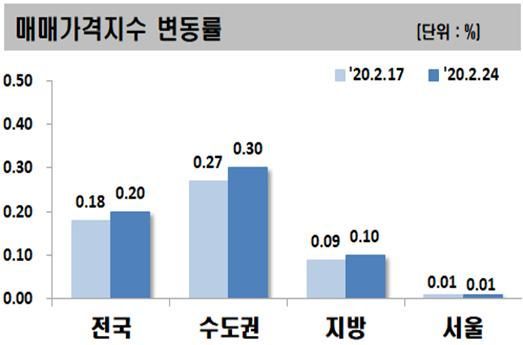
According to the Korea Real Estate Board's '4th Week of February Nationwide Housing Price Trend Survey' on the 27th, apartment prices in Suwon, Gyeonggi Province, rose by 1.56%, slightly narrowing the increase compared to the previous week (1.81%). Yongin (0.67%) and Anyang (0.41%) also showed a slight reduction in their rate of increase compared to the previous week, indicating a pause in the upward trend.
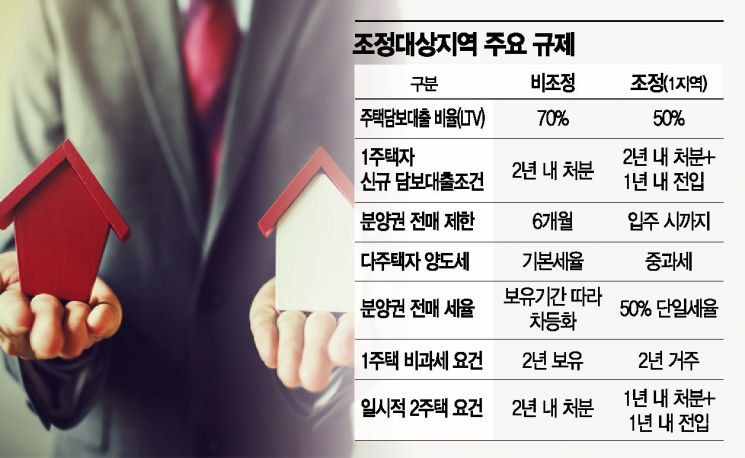
Earlier, the government designated Yeongtong, Gwonseon, and Jangan districts in Suwon, Manan district in Anyang, and Uiwang city as adjusted areas under the 2·20 measures. Through this measure, loan regulations for adjusted areas were further tightened. Previously, the loan-to-value ratio (LTV) was recognized up to 60%, but going forward, only 50% will apply to portions under 900 million KRW, and 30% to portions exceeding 900 million KRW.
The Korea Real Estate Board explained, "The survey period for this statistic was from the 18th to the 24th, so the impact of the government's real estate measures announced on the 20th was partially reflected in this survey result." In Suwon, Paldal (1.96%), Gwonseon (1.58%), and Yeongtong districts (1.54%) saw relatively high price increases due to transportation benefits such as the extension of the Shinbundang Line, but the rate of increase has decreased.
Anyang's Manan district, newly designated as an adjusted area, also saw prices rise by 0.44%, narrowing the increase compared to the previous week (0.46%). Additionally, areas like Guri (0.97%) and Goyang (0.09%), which had price increases over 1% the previous week, and Yongin's Giheung district (0.53%) also showed a slight slowdown in their upward trends.
However, despite the strengthened regulations, some areas showed an even greater increase in prices, leading to analyses that the effect is limited. In fact, Jangan district in Suwon (1.36%) saw a larger increase as prices rose mainly in Imok and Jowon-dong, which have good accessibility to Seoul.
Hwaseong city (1.07%) saw relatively high price increases mainly in areas with development expectations such as Dongtan New Town and GTX-A, while Uiwang city (0.51%) saw price rises mainly in Poil-dong, where transportation improvements are anticipated. Areas that escaped regulation this time, such as Gwangmyeong (0.45%), Hanam (0.28%), Namyangju (0.19%), and Suji district in Yongin (1.04%), also saw increased rates of price growth.
Incheon also rose by 0.4%, expanding the increase compared to the previous week (0.30%). Yeonsu district (1.06%) rose due to transportation benefits like GTX-B and expectations for new housing supply, while Bupyeong district (0.25%) rose mainly in Samsan and Sangok-dong.
Meanwhile, Seoul saw prices rise by only 0.01%, the same as the previous week. Although some rapid sales occurred in reconstruction complexes and inquiries from buyers decreased, continuing the downward trend, prices rose mainly in complexes that had small previous increases or have development benefits.
The Gangnam 3 districts (Gangnam, Seocho, Songpa) saw some complexes' asking prices rise after rapid sales, but most showed a wait-and-see attitude with decreased buyer inquiries. Gangdong district (0.02%) shifted to an upward trend mainly in small- and medium-sized complexes, and Guro district (0.08%) rose mainly in Gaebong and Gocheok-dong, which have price advantages. Conversely, Yangcheon district (-0.02%) continued its downward trend mainly in reconstruction and high-priced complexes.
© The Asia Business Daily(www.asiae.co.kr). All rights reserved.


















