Stock Prices Plunge Daily Since Early Year
ABS Recovery Rate Drops Due to Direct Impact of COVID-19
[Asia Economy Reporter Minji Lee] The aviation industry, which struggled last year due to trade conflicts with Japan and a global economic downturn, is now being directly hit by the novel coronavirus disease (COVID-19) this year. Concerns are rising that liquidity crises may occur as the recovery rate of airline fare-backed securities (ABS), which are directly linked to airline performance, is also declining.
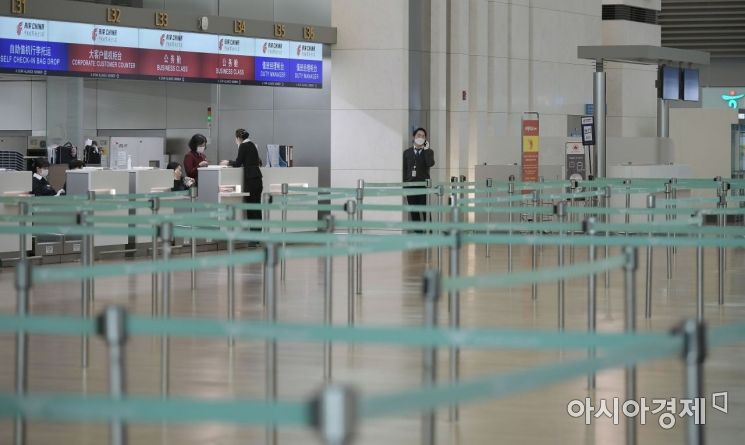 As the number of confirmed cases of the novel coronavirus infection (COVID-19) rapidly increases in South Korea, the counters of Chinese airlines at the departure hall of Terminal 1, Incheon International Airport, showed a quiet scene on the 24th.
 Yeongjongdo - Photo by Kim Hyunmin kimhyun81@
According to the Korea Exchange on the 27th, since the beginning of this year, Korean Air's stock price has fallen by about 20% as of the previous day. Asiana Airlines' stock price also dropped 19% during the same period. Large domestic airlines had raised expectations for improved performance this year due to increased cargo transportation following the first trade agreement between the U.S. and China, but investment sentiment has sharply contracted due to the impact of COVID-19. Low-cost carriers such as T'way Air (29%), Jeju Air (23%), and Air Busan (26%) also showed steep declines. Except for Hanjin KAL, which surged due to management disputes, major airline stocks have plummeted since the beginning of the year.
The aviation sector's outlook has significantly worsened compared to other industries due to the spread of COVID-19. The International Air Transport Association (IATA) forecasted that revenue passenger kilometers (RPK - calculated by multiplying the number of passengers by distance) in the Asia-Pacific region will decrease by 8.2% this year compared to the previous year. This is a 13 percentage point downward revision from the previous forecast of about a 4.8% increase at the end of last year. Global RPK is expected to decline by 0.6%, marking the first decrease since the global financial crisis.
Park Kwang-rae, a researcher at Shinhan Financial Investment, explained, "The revenue of Asia-Pacific airlines is expected to reach $244.9 billion, which is $27.8 billion lower than the previous forecast," adding, "This is largely due to the reduction of flights to and within China following the increase in confirmed COVID-19 cases in China." Demand in regions outside the Asia-Pacific is also decreasing, and global airline revenue this year is expected to be $832.5 billion, $29.3 billion less than estimated.
There are also concerns that airlines may face liquidity crises due to credit rating downgrades caused by declining performance. Airlines raise funds by issuing ABS backed by future airline fares, but due to reduced sales from the impact of COVID-19, the recovery performance of ABS is declining. Comparing the deposit and withdrawal details of trust collection accounts for seven ABS issued by Korean Air and Asiana Airlines with February's performance, the recovery rate has decreased by an average of about 30%.
Jo Byung-jun, a researcher at Korea Credit Rating, said, "If the credit rating is damaged due to the decline in ABS recovery performance, control mechanisms to protect investors may operate in the order of suspension of secondary income advances, additional trust requests, and early payment of primary income," adding, "If funds cannot be received from the trust until the ABS repayment is completed, the company may face burdens in liquidity management."
© The Asia Business Daily(www.asiae.co.kr). All rights reserved.
![Clutching a Stolen Dior Bag, Saying "I Hate Being Poor but Real"... The Grotesque Con of a "Human Knockoff" [Slate]](https://cwcontent.asiae.co.kr/asiaresize/183/2026021902243444107_1771435474.jpg)
















