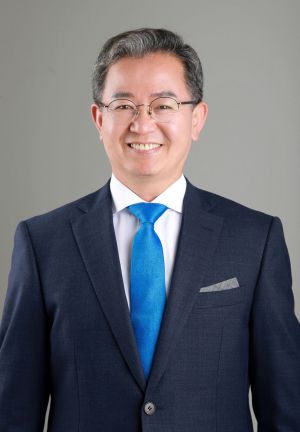
[Asia Economy Honam Reporting Headquarters Reporter Park Seon-gang] Lee Yong-bin, a preliminary candidate for the National Assembly from Gwangsan-gap, Gwangju Metropolitan City, representing the Democratic Party of Korea, stated on the 26th, "I will create a barrier-free city in Gwangsan-gu," adding, "We should not only look at the tilted playing field but also seriously consider the lives standing outside the field."
Candidate Lee said, "As of October 2019, the disabled population in Gwangsan-gu totals 17,604, with the disability population ratio by neighborhood as follows: Bonryang-dong and Samdo-dong at 18%, Usan-dong at 10%, Pyeong-dong at 9%, Songjeong 2-dong at 7%, and Songjeong 1-dong and Sinheung-dong at 6%," noting that "most are concentrated in the Gwangsan-gap electoral district."
He continued, "To create a happier Gwangsan-gu where social awareness and public discourse on disability improve, life conditions are equal, and justice is realized, I will definitely lead five projects: ▲expansion of barrier-free Gwangsan initiatives ▲operation of daycare centers dedicated to disabled children ▲relocation and expansion of the Disabled Welfare Center ▲deinstitutionalization integration and strengthening of community care systems ▲establishment of an integrated support hub for disability welfare, culture, and sports."
He also said, "Barrier-free Gwangsan is not only a project for the disabled but also necessary for the elderly and mothers using strollers," emphasizing, "The obligation to establish barrier-free public facilities should be enforced so that the public sector leads the way and promotes social settlement."
Furthermore, he stressed, "The issues faced by disabled children are not just individual problems but family problems, and beyond that, problems that society must solve together," adding, "Currently, there are three daycare centers dedicated to disabled children in Gwangsan; two are social welfare corporations, and one is public, located at the Gwangsan-gu Disabled Welfare Center, where expansion and relocation of facilities need to be considered."
He stated, "A foundation must be established for socially vulnerable groups, including the disabled, to live integrated with the local community," and added, "It is necessary to strengthen the social safety net by establishing community care and community-based care systems."
Additionally, he said, "We need to stop the idea of separating welfare, cultural, and sports facilities for the disabled and refer to Japan's International Exchange Center for Persons with Disabilities," but warned, "Although integration and community care exist on the path to a barrier-free city, without local infrastructure development and social awareness transformation reflecting that will, it risks being merely a show."
© The Asia Business Daily(www.asiae.co.kr). All rights reserved.

















