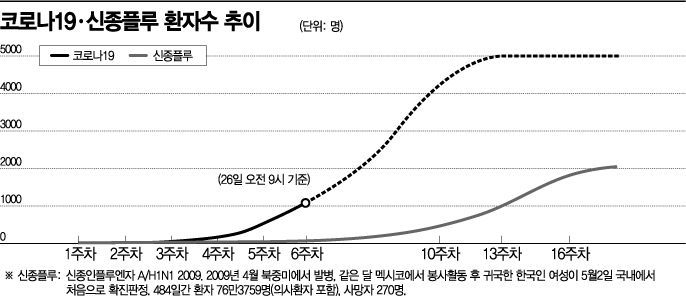
[Asia Economy reporters Choi Dae-yeol, Kim Heung-soon, Jo Hyun-ui] About five weeks after the first confirmed case of the novel coronavirus infection (COVID-19) in South Korea, the number of confirmed cases has surpassed 1,000, signaling a clear nationwide 'pandemic' trend. Due to the high transmissibility, the likelihood of sporadic cluster infections has increased. Experts analyze that the spread is faster compared to the 2009 novel influenza A/H1N1 (new flu) outbreak, which recorded over 760,000 patients and 270 deaths.
Already 1,146 Confirmed Cases in the 6th Week
Patient Increase Trend Similar to New Flu That Lasted Over a Year
According to the Central Disaster and Safety Countermeasures Headquarters on the 26th, as of 9 a.m., the total number of confirmed cases reached 1,146, an increase of over 1,100 compared to a week ago. Patients have rapidly increased mainly in the Daegu and Gyeongbuk regions, centered around the Shincheonji Church of Jesus and Cheongdo Daenam Hospital, with triple-digit new cases added daily since the 21st.
This patient increase trend resembles the pattern seen during the new flu outbreak that lasted over a year from May 2009. After the first patient was confirmed domestically, the increase was gradual for about a month. Although there was a cluster outbreak at a language institute in the metropolitan area, it did not spread nationwide as it does now. About a month after the first confirmed case, in early June, there were 39 patients. Another month later, in early July, the number exceeded 300, and by August it rose to 1,400. The first death was reported on August 15, 100 days after the first infectious disease patient was confirmed domestically. New patient numbers began to decline in December, and the outbreak ended domestically with one patient infected overseas who entered the country in August the following year.
The total period from the first to the last patient was 484 days. During this time, there were 763,759 patients (including suspected cases) and 270 deaths. For COVID-19, 11 deaths have occurred since the first death was reported about a month after the first confirmed case. Most of the deceased had underlying conditions, with the majority being patients from Daenam Hospital, one of the cluster outbreak sites.
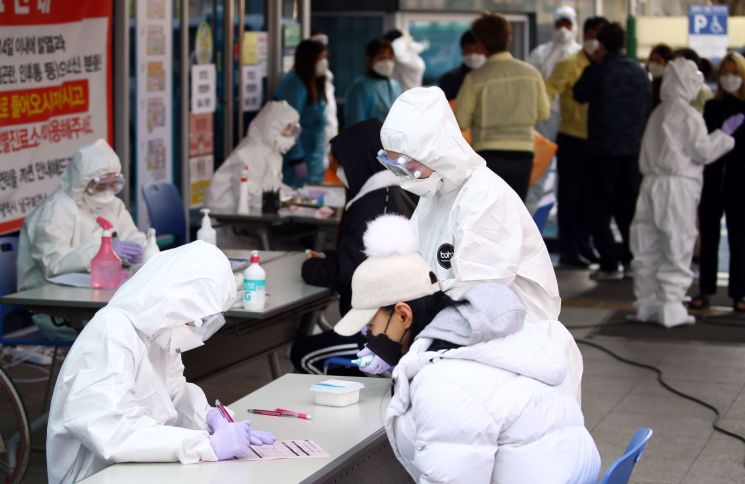 Suspected COVID-19 patients are being tested at the Nam-gu Public Health Center in Daegu. [Image source=Yonhap News]
Initial Symptoms Mild and Unnoticed
Possible Spread Like Seasonal Flu
Experts Advise "Prepare for a Long-Term Battle"
COVID-19 is known to release a large amount of virus externally from the early stage of infection, making it highly transmissible. Initial symptoms include fever and cough, respiratory symptoms, but some patients experience symptoms so mild they do not notice them. Kim Dong-hyun, president of the Korean Society of Epidemiology (professor at Hallym University College of Medicine, Department of Social Medicine), explained, "Because initial symptoms are mild, people do not realize they are infected and continue normal social activities," adding, "Virus transmission occurs heavily in the early infection stage, leading to rapid spread." Song Jun-young, professor of infectious diseases at Korea University Guro Hospital, said, "New flu symptoms were severe enough to prevent outside activities immediately after infection, but COVID-19 is not like that, which is problematic," and "The spread could be faster than new flu."
The fact that patients who passed through the Shincheonji Daegu Church have caused sporadic cluster infections nationwide is also interpreted as stemming from these characteristics. Initial infection sources such as Daenam Hospital, the Israel pilgrimage group, and Busan Oncheon Church are unidentified, but many people were exposed simultaneously and infected. Considering reports of asymptomatic infections and the difficulty of eradication, there are calls to prepare for a long-term battle. Similar to seasonal flu, efforts are underway to develop vaccines and treatments. Professor Kim Dong-hyun advised, "We are now at the nationwide spread stage, and the worst-case scenario is that patients could number in the millions. We must keep this in mind and find ways to induce an end accordingly."
© The Asia Business Daily(www.asiae.co.kr). All rights reserved.


















