[Asia Economy Reporter Jeong Hyunjin] The Japanese government has established basic COVID-19 response guidelines that require securing a medical system for severe patients in regions with a significant increase in novel coronavirus infections and encourage staggered commuting and telecommuting.
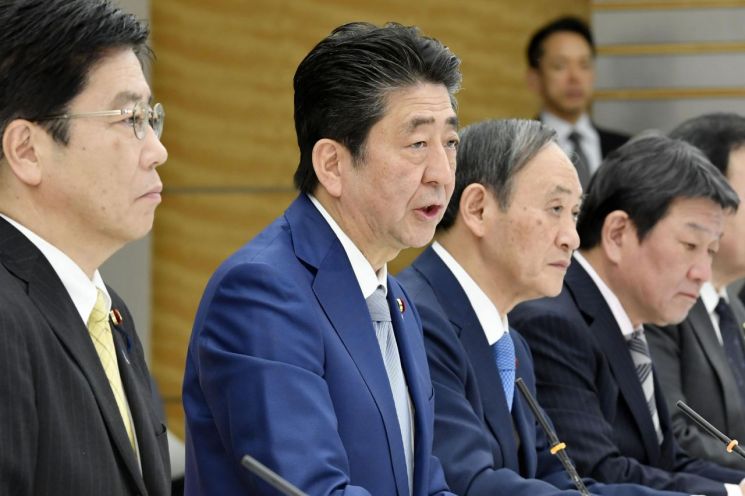
According to NHK and other sources on the 25th, the Japanese government held a COVID-19 task force meeting at Prime Minister Shinzo Abe's residence and set the basic policy for measures to prepare for the spread of infections. The government analyzed the current situation as "sporadic cases of patients with unclear infection routes occurring in various regions domestically, and small-scale cluster infections identified in some areas."
The government decided to focus on measures to prevent the spread of infection and suppress the rate of patient increase. If symptoms such as fever or cold appear, individuals are advised to take leave or refrain from going out, and companies are requested to promote staggered commuting and telecommuting. While the government does not uniformly request the cancellation of events, it demands a reconsideration of the necessity of holding events in light of infection spread and other factors.
Additionally, in regions where the number of patients has significantly increased, a dedicated medical system for severe patients will be secured, and it will be a principle for patients with mild symptoms to rest or recuperate at home. Furthermore, general medical institutions are required to implement infection prevention measures such as separating consultation hours or patient flow before accepting patients.
Prime Minister Abe emphasized, "It is important to suppress the rate of patient increase as much as possible and prevent domestic outbreaks," and added, "Depending on the situation of local governments, more aggressive policy responses should be taken to prevent the spread of regional infections." He also instructed related ministries to promptly implement measures, stating, "We will coordinate with local governments, medical institutions, and other stakeholders to properly organize the necessary medical provision system."
© The Asia Business Daily(www.asiae.co.kr). All rights reserved.

















