Daegu to Increase Beds to 604, but Dozens of Patients Expected, Still Insufficient
Claims for Designating Mild Cases to Facilities for Isolation... Kim Kang-rip Says "Not Yet Considered"
[Asia Economy Reporters Choi Dae-yeol, Kim Heung-soon, Jo Hyun-ui] As confirmed cases of the novel coronavirus infection (COVID-19) surge mainly in the Daegu and Gyeongbuk regions, the shortage of hospital beds to treat patients has become an urgent issue. While patients with mild symptoms are to be treated at designated hospitals instead of negative pressure rooms, most of the additional beds have already been occupied, and with thousands of people expected to undergo COVID-19 testing, the possibility of a continuous increase in patients is high, raising concerns. Although health authorities have planned to increase the number of beds nationwide to 10,000 considering a nationwide outbreak, there is also a need to overhaul the treatment system as during the past novel influenza outbreak, hundreds of thousands of patients appeared nationwide.
Daegu’s Newly Secured Beds Also Fully Occupied
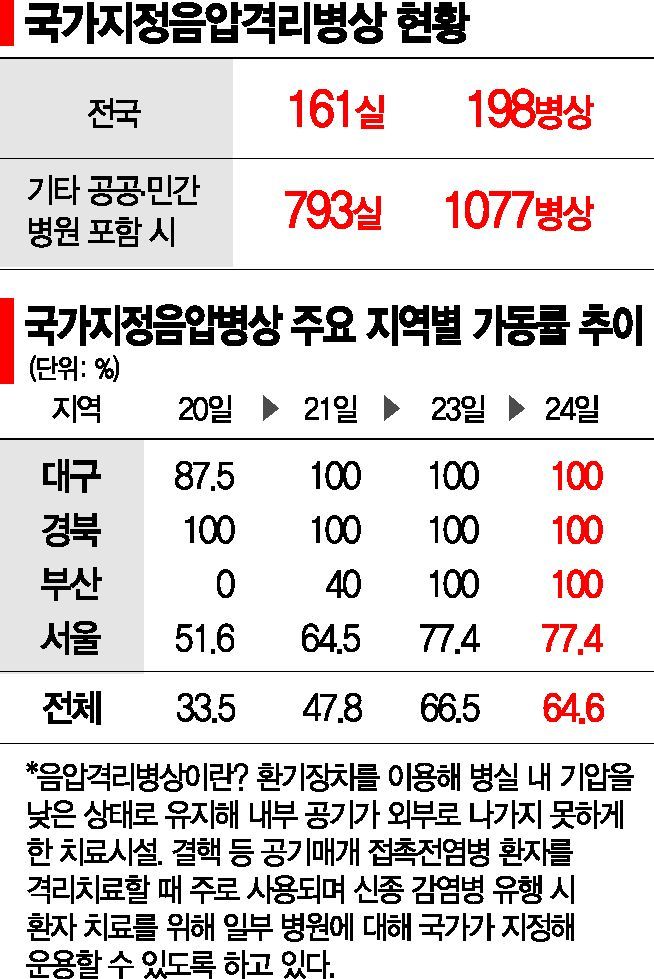
According to the Central Disease Control Headquarters on the 25th, the number of confirmed COVID-19 cases in Daegu reached 500 (as of 9 a.m., including 1 death). COVID-19 patients are treated in negative pressure isolation rooms, and Daegu has a total of 54 negative pressure beds, including 10 nationally designated ones.
As cases surged around the Shincheonji Church of Jesus in Daegu, a known cluster outbreak site, the number of patients exceeded the total number of negative pressure beds since the 21st. Daegu designated Daegu Medical Center and Keimyung University Daegu Dongsan Hospital as infectious disease dedicated hospitals to treat patients. Currently, about 520 beds have been prepared in these two hospitals. Health authorities plan to secure additional beds at Daegu Medical Center by the end of this month, increasing the total to 604.
The problem is that although the rate of increase has somewhat slowed, the number of patients is still expected to rise by dozens daily for the time being. Many symptomatic members of the Shincheonji Daegu Church cluster have been socially active before diagnosis, spreading the infection, and sporadic cluster outbreaks are evident throughout the community.
All individuals in Daegu with symptoms such as fever or cough will undergo virus diagnostic testing regardless of whether it is a cold or flu, but this concentrated demand may delay the identification of actual patients. Professor Lee Jae-gap of Hallym University College of Medicine’s Infectious Diseases Department said, "I recently visited a hospital in Daegu, and the rapid increase in patients over a short period has severely fatigued frontline medical staff, making the situation difficult."
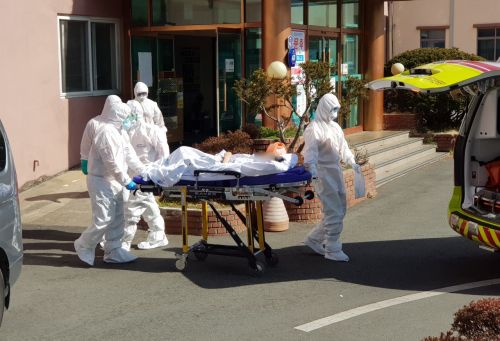 On the morning of the 24th, medical staff at Daenam Hospital in Cheongdo, Gyeongbuk, are transferring a patient to another location.
 "Consider Facility Isolation for Mild Patients"
Currently, the principle is to isolate and treat COVID-19 patients in negative pressure rooms. Negative pressure rooms create a pressure difference to prevent airborne viruses from escaping the room, thereby preventing hospital-acquired infections. Nationally designated negative pressure beds in Daegu and Gyeongbuk have been operating at 100% capacity for several days. Nationwide, about two-thirds of such beds are occupied.
Health authorities anticipate a sharp increase in COVID-19 patients and have established a procedure of "priority isolation in negative pressure beds, and designating dedicated hospitals when beds are insufficient." Due to regional disparities in negative pressure bed availability, patients are classified by severity, with mild cases admitted to general isolation rooms for treatment. Although there is a plan to secure up to 10,000 beds nationwide, considering the high transmissibility of the disease, if patient numbers rise to hundreds of thousands as during the novel flu outbreak, even this may be insufficient.
Kim Kang-rip, Deputy Head of the Central Disaster and Safety Countermeasure Headquarters, said at a briefing yesterday, "We have not yet considered self-isolation or facility isolation for mild patients and are focusing on designating dedicated hospitals by local governments as much as possible. Mild patients will maximize treatment capacity in dedicated hospitals in a short period, while severe patients will be treated by expanding negative pressure beds to enhance response capabilities."
Experts have pointed out the need to revise the current treatment system. Shin Hyung-sik, Director of the Infectious Disease Center at the National Medical Center, said, "In preparation for a rapid increase in patients, measures such as cohort isolation by dividing multi-bed rooms or certain areas within hospitals, and even requisitioning separate facilities like hotels to accommodate patients, as done in China, can be considered." Baek Kyung-ran, Chairperson of the Korean Society of Infectious Diseases, said, "Even mild patients cannot be properly isolated at home and inevitably have contact with others, so treatment should be done in medical institutions as a principle. Designating separate facilities for isolation is also possible."
© The Asia Business Daily(www.asiae.co.kr). All rights reserved.


















