
[Asia Economy Reporter Jeong Hyunjin] As the novel coronavirus infection (COVID-19) rapidly spreads in Italy, Europe's 'open borders' are once again put to the test. The Schengen Agreement, which was at the center of controversy in 2016 due to a surge in African immigration, is now raising concerns that it could accelerate the spread of the highly contagious COVID-19 within the freely moving Europe.
According to ANSA news agency and The Wall Street Journal (WSJ) as of 6:30 PM local time on the 24th, 6 people have died and 229 cases have been confirmed in Italy. Excluding Asian countries such as China, South Korea, and Iran, this is the largest scale of damage. The COVID-19 outbreak is centered in northern Italy. In the northern Lombardy region, where Milan is located, 172 confirmed cases have been concentrated. Residents of 11 villages within Lombardy are currently prohibited from traveling outside.
Northern Italy shares borders with France, Austria, Switzerland, and Slovenia. Italy and these countries usually allow easy movement without passports under the Schengen Agreement established in 1995. However, as COVID-19 has spread in Italy, neighboring countries have simultaneously strengthened quarantine measures, putting the Schengen Agreement under scrutiny. This COVID-19 situation is seen as a test of Europe's epidemic-related crisis management capabilities.
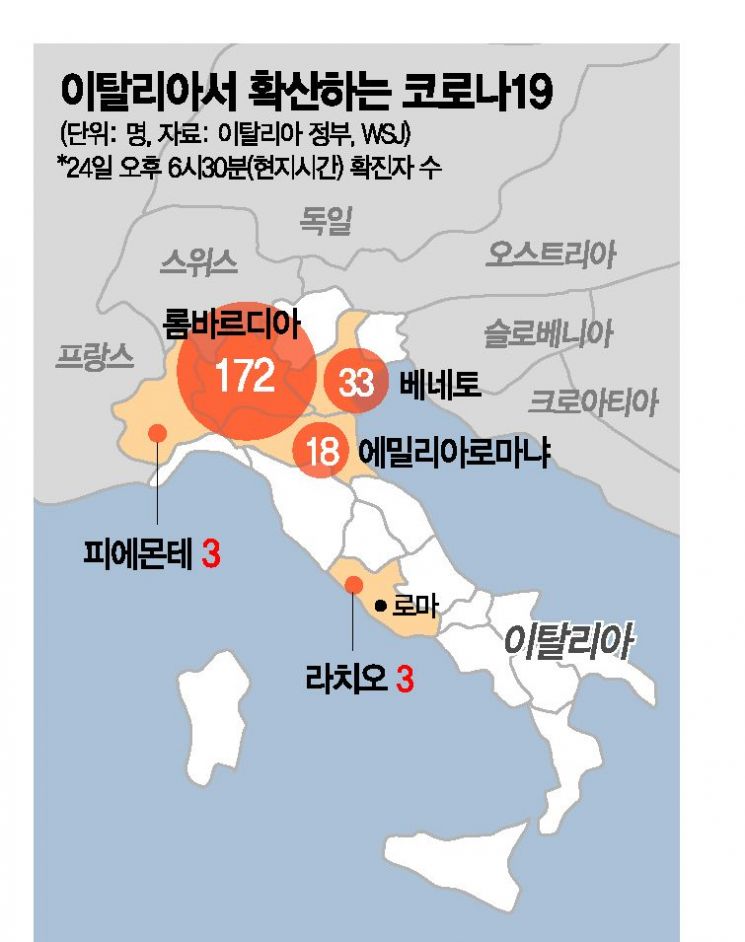
As the spread of COVID-19 in Italy was reported, Switzerland and Austria immediately decided to strengthen inspections at their borders with Italy. Switzerland announced it would enhance testing capacity, considering the worsening situation in Lombardy, Italy. Austria issued a travel advisory for areas under the influence of Lombardy and Veneto in northern Italy. It is also considering suspending train operations crossing the Italian border, but due to significant economic exchanges between the two countries, it is reluctant to do so. The Guardian daily quoted an Austrian diplomat saying that such measures would be considered if confirmed cases occur.
The basis for these countries strengthening quarantine is a provision in the Schengen Agreement that allows reintroduction of border controls if there is a serious threat to public policy or internal security. Foreign media and WSJ analyzed that most authority over health matters lies with individual governments, and the European Union (EU) has limited experience collaborating to prevent major infectious diseases.
Nevertheless, despite these measures, the EU has stated it will not close borders for now. Janez Lenar?i?, EU Commissioner for Crisis Management, said at a press conference held in Brussels, Belgium, "We are preparing various emergency measures," but added that there are no plans to amend the Schengen Agreement, which guarantees free movement among member states. Stella Kyriakides, Commissioner for Health and Food Safety, also emphasized that travel restrictions should be based on scientific evidence, stating, "The World Health Organization (WHO) has not recommended travel or trade restrictions."
France, which shares a border with Italy, announced it will not immediately block movement from Italy. A French government official said, "Since the virus does not spread along administrative borders, closing borders is meaningless." However, French authorities quarantined a bus suspected of carrying a COVID-19 patient that had entered France from Italy on the same day. Germany, close to Italy, also stated it will not close its borders but advised updating travel information and exercising caution. The European Commission decided to invest 232 million euros (approximately 304.5 billion KRW) to help member states prevent the spread of COVID-19.
© The Asia Business Daily(www.asiae.co.kr). All rights reserved.


















