As COVID-19 Cases Rise, Mask and Sanitizer Prices Fluctuate Again... Enforcement Mocked
Shipping Fee Tricks and Sales Scams Surge... Shopping Mall Headquarters Must Strengthen Seller Regulation
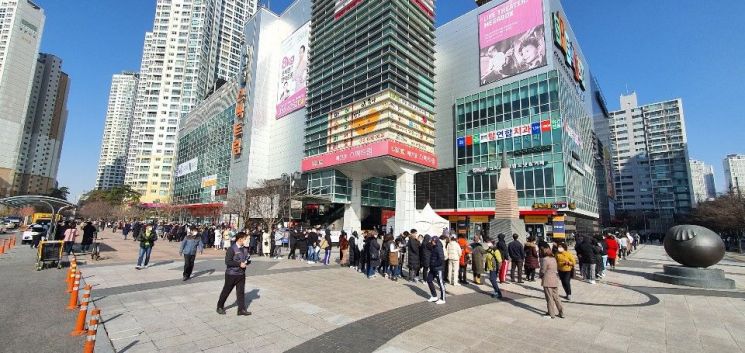 On the morning of the 24th, citizens are lined up to buy masks at E-Mart Chilseong Branch in Buk-gu, Daegu.
 [Image source=Yonhap News]
[Asia Economy Reporter Lee Seon-ae] As the number of confirmed cases of the novel coronavirus infection (COVID-19) increases exponentially, unscrupulous sales tactics involving masks and disinfectants are rampant. Despite government crackdowns on illegal hoarding and sales practices, product prices have nearly doubled, and some sellers are even raising shipping fees instead of product prices as a sneaky tactic.
On the 25th, Mr. A, who checked prices to purchase a multi-purpose sterilizing disinfectant on an online shopping mall, was stunned to see the price jump in just two days. The product, which was sold at 30,000 KRW per 4 liters, increased by about 30,000 KRW amid the surge in COVID-19 cases, reaching 59,000 KRW. Consumers who checked the prices lamented, "Business ethics have collapsed due to COVID-19, and unscrupulous sales tactics are rampant."
Although the government's crackdown on illegal hoarding sellers has reduced profiteering sales, such practices are still widespread in many places.
Tricks have also emerged. Mr. B was furious when ordering masks. He ordered several masks priced at 1,300 KRW each, but on the payment screen, the shipping fee was a staggering 70,000 KRW. A shipping fee of 2,500 KRW per mask was charged. He sighed, "Due to this unexpected shipping fee trick, I ultimately had to cancel the order." Mr. C ordered 40 masks, but the sales condition changed to charge 4,000 KRW shipping fee for every 10 masks, so he ended up paying 16,000 KRW in shipping fees. He said, "The product comes in one box, so I don't understand why they charge shipping fees for every 10 masks," and raised his voice, "Currently, many products on online shopping malls excessively charge shipping fees, so regulation is needed."
Sales scams are also ongoing. Mr. D was scammed after dealing with a seller on an internet cafe who sold masks at 1,500 KRW each. He ordered masks via KakaoTalk and transferred money, but the seller deleted the KakaoTalk account and cut off contact. Posts about being scammed are flooding online communities. They are coping by sharing fake seller names, phone numbers, and account numbers online. One netizen said, "It's a difficult time for everyone, and it's heartbreaking that consumers searching for masks are being hurt twice," and urged, "The government should strengthen crackdowns, and open market platforms and online shopping mall headquarters should properly monitor sellers."
Open market companies explain that they are strengthening monitoring of profiteering or unethical sellers, but in reality, they cannot monitor all sellers in real time. Open markets allow sellers to upload products directly in real time without going through the intermediary platform headquarters, making it difficult to filter out all malicious sellers. An industry official explained, "While products are suddenly posted and removed, causing harm to consumers, it is difficult to crack down on such cases," adding, "Moreover, there is no basis to determine standard prices for each product, and the criteria for judging unfair sales are ambiguous."
© The Asia Business Daily(www.asiae.co.kr). All rights reserved.
![Clutching a Stolen Dior Bag, Saying "I Hate Being Poor but Real"... The Grotesque Con of a "Human Knockoff" [Slate]](https://cwcontent.asiae.co.kr/asiaresize/183/2026021902243444107_1771435474.jpg)











