South Korean Government Mobilizes to Prevent Spread and Treat Confirmed Cases... Complies with WHO Recommendations and Cooperates Closely with Other Countries
Minister Kang: "Striving to Restore Dignity and Honor of Japanese Military Comfort Women Victims"
"North Korea Must Respond to South Korea's Call to Resolve Separated Families Issue" Urged
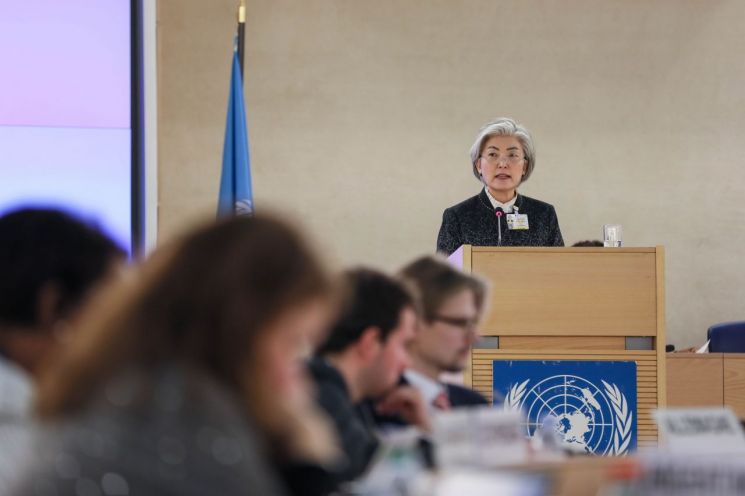
[Asia Economy Reporter Lim Cheol-young] "We deeply regret the recent incidents of hate and discrimination against individuals from countries affected by the novel coronavirus infection (COVID-19), discriminatory immigration control measures, and arbitrary repatriations."
At the 43rd United Nations (UN) Human Rights Council held in Geneva, Switzerland on the 24th (local time), Foreign Minister Kang Kyung-wha emphasized this in her keynote speech, stating that South Korea will actively respond to issues of inequality, discrimination, and hate, and will actively participate in international efforts to address new challenges affecting human rights, including emerging infectious diseases, climate change, and digital technology.
Minister Kang explained, "Like many other countries, South Korea is making every effort to prevent the spread of COVID-19 and treat confirmed patients," adding, "The number of confirmed cases surged over several days, centered around a specific religious group that held gatherings with many people densely packed, and in response to this surge, the government raised the infectious disease crisis alert to the highest level, 'serious.'"
She particularly emphasized that South Korea has maintained a human-centered approach while closely consulting with the World Health Organization (WHO) to respond to the new disease. Minister Kang said, "The Korean government complies with WHO recommendations on international public health emergencies and shares information and cooperates closely with the WHO and other affected countries," adding, "From the early stages, we have adhered to a human-centered approach and have disclosed information about all progress and government measures as transparently as possible."
She also expressed concern about hate and discriminatory incidents against people from countries where the infection has occurred, including discriminatory immigration controls. This is interpreted as pointing out the increasing number of countries unilaterally imposing entry restrictions on countries classified as high-risk without prior consultation as COVID-19 spreads.
Minister Kang stated, "We are deeply concerned about hate and discriminatory incidents against people from infected countries, discriminatory immigration control measures, and arbitrary repatriations," emphasizing, "As the number of countries with disease outbreaks increases, it is important for governments to take measures based on scientific evidence rather than actions that provoke public panic, and to unite in global efforts to prevent and end such incidents."
Furthermore, in her keynote speech, Minister Kang announced South Korea's active participation in international efforts to address new challenges discussed at the Human Rights Council level, such as new technologies and human rights, climate change, and local governments and human rights.
Minister Kang said, "A human rights-centered approach remains important in the digital technology era, and based on the adoption of 'New Technologies and Human Rights' led by South Korea last June, we will actively contribute to expanding related discussions at the Human Rights Council," adding, "In actively responding to the challenge of climate change, we hope that the 'P4G (Partnering for Green Growth and the Global Goals 2030)' summit hosted by our government this June will lay the foundation for COP26 and serve as an opportunity to raise the international community’s climate change response goals."
She also conveyed that the Korean government continues its efforts to restore the dignity and honor of victims of the Japanese military sexual slavery and to leave historical lessons for future generations.
Minister Kang said, "This year marks the 25th anniversary of the Beijing Declaration and Platform for Action and the 20th anniversary of UN Security Council Resolution 1325. While significant achievements have been made in advancing women's rights, sexual violence continues to be used as a weapon of war in conflict zones," adding, "As emphasized by UN treaty bodies, a victim- and survivor-centered approach must be applied."
She continued, "The Korean government continues its efforts to restore the dignity and honor of victims of the Japanese military sexual slavery and to leave historical lessons for current and future generations," adding, "Through last year's 'Peace with Women' initiative, we supported Rohingya and Syrian women refugees and victims of sexual violence in Afghanistan and the Central African Republic, and this year we are preparing a second meeting with a greater focus on a victim-centered approach."
She also mentioned close consultations with the Special Rapporteur on North Korean human rights and the North Korean Human Rights Seoul Office to resolve the issue of separated families between the two Koreas. North Korea underwent its third Universal Periodic Review (UPR) last year.
Minister Kang said, "We hope North Korea will faithfully implement the recommendations it accepted," adding, "South Korea emphasized the urgent humanitarian issue and human rights problem of separated families during the UPR, and we urge North Korea to respond to our request to fundamentally resolve this tragedy."
© The Asia Business Daily(www.asiae.co.kr). All rights reserved.
![Clutching a Stolen Dior Bag, Saying "I Hate Being Poor but Real"... The Grotesque Con of a "Human Knockoff" [Slate]](https://cwcontent.asiae.co.kr/asiaresize/183/2026021902243444107_1771435474.jpg)
















