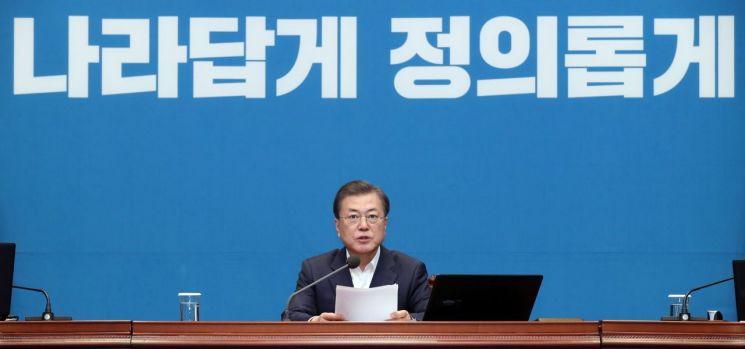
 President Moon Jae-in is speaking at the Senior Secretary and Aide Meeting held at the Blue House on the afternoon of the 24th. [Image source=Yonhap News]
[Asia Economy Reporter Son Sun-hee] On the 24th, President Moon Jae-in held a senior secretaries and aides meeting at the Blue House and conducted a 'Roundtable with Experts from the Pan-Medical Community' regarding the novel coronavirus infection (COVID-19). Normally, the meeting attended by key aides is held every Monday, but given the COVID-19 crisis alert level at 'serious,' the meeting was conducted in a format to hear experts' opinions. The experts expressed that efforts to prevent the spread should be accompanied by a focus on 'minimizing damage.'
Kang Min-seok, spokesperson for the Blue House, stated in a written briefing that "President Moon presided over the senior secretaries and aides meeting from 2:00 PM to 4:03 PM," adding, "To prepare for the regional spread of COVID-19, the meeting was held in the form of a roundtable with invited experts from the pan-medical community. President Moon moderated the discussion, and the meeting exceeded the scheduled time by 33 minutes, reflecting the seriousness of the dialogue."
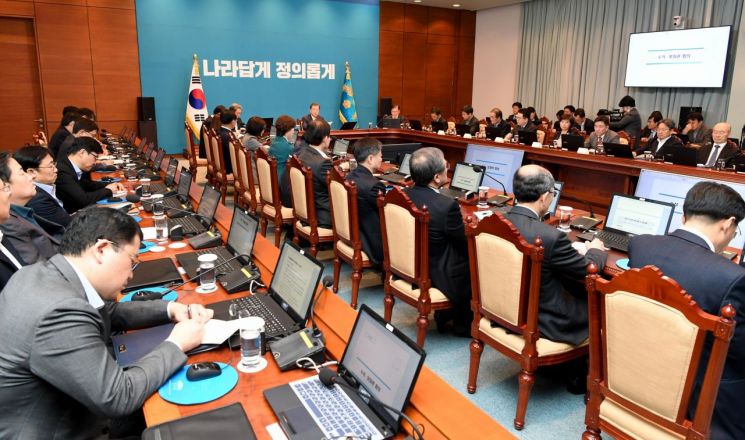 President Moon Jae-in is speaking at the Senior Secretary and Aide Meeting held at the Blue House on the afternoon of the 24th. [Image source=Yonhap News]
At the meeting, 10 experts participated, including Baek Kyung-ran, Chairperson of the Korean Society of Infectious Diseases, who is also part of the Pan-Medical Community COVID-19 Countermeasures Committee (Pan-Committee).
Chairperson Baek said, "The infection has occurred on a scale beyond imagination in one region," and emphasized, "We must promptly initiate a 'mitigation policy' to minimize damage." She particularly stressed, "The mitigation policy should be expanded to include the Daegu-Gyeongbuk region and the Busan-Gyeongnam region." Since community transmission has already progressed significantly, she advised that instead of blocking infections through lockdowns, policies should focus on minimizing deaths and severe cases.
Um Jung-sik, Policy Director of the Korean Society for Healthcare-Associated Infection Control (Professor at Gachon University Gil Medical Center), also said, "The important thing now is how much we can reduce severe cases and deaths," adding, "To do so, the burden on medical institutions must be minimized, so extraordinary measures are needed for treating mild cases. We must abandon the idea that patients must be treated in hospitals unconditionally." Considering the realistic medical situation such as limited negative pressure rooms, medical staff capacity should be concentrated on severe cases and deaths.
Policy Director Um warned, "Mild patients can be self-quarantined in specific facilities like the repatriated citizens from Wuhan, where medical staff visit to provide treatment, which can secure hospital beds," adding, "This is a completely different approach that can also reduce hospital-acquired infections. If hospital burdens increase, a single severe patient could infect an entire hospital, as happened at Cheongdo Daenam Hospital."
Jung Hee-jin, Vice President of the Korean Society of Antimicrobial Therapy (Professor at Korea University College of Medicine), also agreed, stating, "It is necessary for local governments to quickly designate hospitals for treating severe confirmed patients and implement a treatment strategy."
Heo Tak, Chairperson of the Korean Society of Emergency Medicine (Professor at Chonnam National University Medical School), said, "When transferring severe COVID-19 patients to higher-level institutions in the community, some hospitals hesitated to accept transfers to protect themselves, causing some severe patients to wander without finding beds," and suggested, "While it is preferable to manage COVID-19 patients within the region, in cases like Daegu-Gyeongbuk where patients need to move to other regions, utilizing a central transfer coordination center could resolve the issue."
Additionally, Choi Eun-hwa, Vice President of the Korean Society of Pediatric Infectious Diseases (Professor at Seoul National University College of Medicine), expressed concern about the timing before school reopening, saying, "If infection spreads in the community, children could further transmit it," and requested, "Although school reopening was postponed by a week, many children are cared for by grandparents who are vulnerable to COVID-19. Please work to introduce paid leave at workplaces so parents can care for their children at home."
Choi Young-jun, Secretary of the Pan-Medical Community COVID-19 Countermeasures Committee (Assistant Professor at Hallym University), said, "I have been in contact with experts from China and Japan, but recently communication has stopped as the situations in those countries have worsened," adding, "If information can be obtained at the national level, we will be able to respond accordingly."
After listening to the diverse opinions of the experts, President Moon said, "I ask the experts to actively fill the gaps of the Korea Centers for Disease Control and Prevention (KCDC) and to play a role in leading and communicating," and added, "Local governments also face situations they cannot handle alone due to differences in the capabilities of public medical institutions, so I hope the Pan-Committee will fulfill its role."
Furthermore, he expressed concern, saying, "Early detection remains crucial in prevention," and explained, "Cases detected early respond well to treatment, but if detection is delayed and infection has progressed significantly, the fatality rate increases." He continued, "The Pan-Committee, KCDC, local governments, private medical institutions, and even the public must unite with the mindset that each is a prevention agent and work together," and requested, "I ask the Pan-Committee, composed of experts, to serve as a bridge between the government and the private sector until the situation is resolved."
© The Asia Business Daily(www.asiae.co.kr). All rights reserved.
![User Who Sold Erroneously Deposited Bitcoins to Repay Debt and Fund Entertainment... What Did the Supreme Court Decide in 2021? [Legal Issue Check]](https://cwcontent.asiae.co.kr/asiaresize/183/2026020910431234020_1770601391.png)

















