Chan "We must also block entry from Japan and Hong Kong"
Ban "More domestic infection sources"
Government maintains skeptical stance
Japan also does not block entry from China
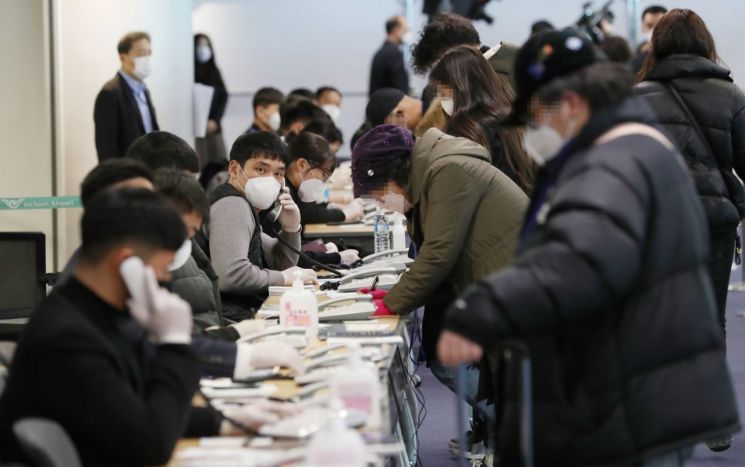
[Asia Economy Reporter Hyun-ui Cho] As the number of confirmed cases of the novel coronavirus infection (COVID-19) rapidly increases, calls are being made to strengthen the ban on entry of Chinese nationals. Since China is the outbreak region of COVID-19, it is argued that the entry ban, which is currently limited to Hubei Province, should be expanded to cover the entire country for stronger quarantine measures. However, despite raising the crisis alert level to the highest stage, 'serious,' the government remains skeptical about banning Chinese nationals from entering.
◆ "Entry Ban Should Be Implemented Even Now" = The call to expand the ban on Chinese nationals entering the country is strongly voiced by the medical community and others. Park In-sook, a former president of the Korean Women Doctors Association and a member of the Future United Party, stated, "We must immediately ban Chinese nationals from entering," adding, "Countries like Singapore and others that proactively banned Chinese entry have far fewer patients than we do." Jeon Byung-yul, a professor of preventive medicine at CHA University and former director of the Korea Centers for Disease Control and Prevention, said in an interview with Asia Economy, "The best way to prevent the spread of COVID-19 is to block people entering the country." Professor Jeon added, "The fewer people coming from epidemic countries, the longer it takes for the virus to spread in the community," and "This time, because there were many entrants from China and controls were not enforced, community infections appeared within four weeks after the first confirmed case."
There are also opinions that entry restrictions should be applied not only to China but also to neighboring countries with many confirmed cases. Professor Chun Eun-mi of the Respiratory Medicine Department at Ewha Mokdong Hospital suggested, "COVID-19 symptoms are milder than Middle East Respiratory Syndrome (MERS), but its infectivity is as high as Severe Acute Respiratory Syndrome (SARS). Entry restrictions should be imposed for one to two months on countries with many confirmed cases such as China, Japan, and Hong Kong."
◆ 'Preemptive Measures' but Italy Also Sees Rapid Increase in Cases = The government views the ban on Chinese nationals entering as having low effectiveness in terms of quarantine. Park Neung-hoo, Minister of Health and Welfare, said, "There are cases where tourists from China cause infections, but there are more cases where Koreans who have been to China act as infection sources." Seoul Mayor Park Won-soon also clearly opposed the ban, saying, "Banning Chinese nationals from entering could cause problems in various ways." Some question the effectiveness of the ban based on the rapid increase in confirmed cases in countries that have implemented it. In fact, Italy and Iran, which suspended all flights to and from China the day after the World Health Organization (WHO) declared a public health emergency on January 31, currently have 152 and 43 confirmed cases respectively, with death tolls of 3 and 8. Singapore, which has also implemented strict entry restrictions, has 89 confirmed cases.
Meanwhile, Japan has not imposed a ban on entry from China like South Korea. Both South Korea and Japan, which only ban foreigners who have visited Hubei Province, currently have rapidly increasing confirmed cases of 763 and 838 respectively, ranking among the top three countries with the highest number of patients along with China.
© The Asia Business Daily(www.asiae.co.kr). All rights reserved.
![User Who Sold Erroneously Deposited Bitcoins to Repay Debt and Fund Entertainment... What Did the Supreme Court Decide in 2021? [Legal Issue Check]](https://cwcontent.asiae.co.kr/asiaresize/183/2026020910431234020_1770601391.png)
















