'Comprehensive Sports Measures Package' Scheduled for Announcement on the 28th
Rapid Progress in Ruling Party-Government-Blue House Discussions... Variables Including the General Election
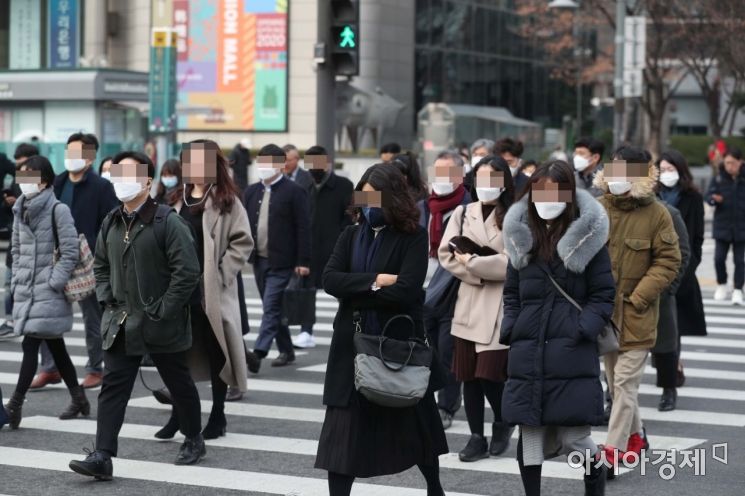 On the 24th, as concerns over the spread of COVID-19 grow, citizens wearing masks are commuting at the Gwanghwamun intersection in Seoul. Photo by Mun Ho-nam munonam@
[Sejong=Asia Economy Reporters Kim Hyun-jung and Jang Se-hee] The government is taking urgent steps to draft a supplementary budget (Chugyeong) to minimize the social and economic losses caused by the novel coronavirus infection (COVID-19). As the number of confirmed cases rapidly increases nationwide, demands from the political sphere?usually seen as a signal for drafting a supplementary budget?are also intensifying. If related discussions proceed rapidly, there is a possibility that a 'first-quarter supplementary budget' could be drafted for the first time in 11 years since the 2009 global financial crisis.
According to the ruling party, government, and related ministries on the 24th, the government has reached a consensus on the urgent need to draft a supplementary budget to end COVID-19 early and minimize economic fallout, and is discussing whether to draft it and its scale. Although specific directions and schedules have not been finalized, inside and outside the political sphere suggest that the 'Comprehensive Economic Measures Package' to be announced on the 28th may include reductions in individual consumption tax on passenger cars (Gaesose), issuance of consumption coupons, and support for small business owners. The government's official stance on drafting a supplementary budget has also shifted. Until recently, the government repeatedly expressed negative views, saying it had 'not reviewed it' and that mentioning it was 'inappropriate' since the early spread of COVID-19 at the end of last month. However, recently, it has begun to acknowledge the supplementary budget as a possible option, stating it is 'keeping it in mind.'
The key issue is the scale of the supplementary budget. If implemented, the question is whether it will be a 'super supplementary budget' exceeding 10 trillion won. On the 23rd, the government raised the COVID-19 crisis alert to 'serious,' increasing the likelihood of this. The 'serious' crisis alert level was only issued once during the 2009 H1N1 flu outbreak. During the 2015 Middle East Respiratory Syndrome (MERS) outbreak, when a financial reinforcement of about 22 trillion won including an 11.6 trillion won supplementary budget was pushed, the alert was at the second level, 'caution.' During the 2003 Severe Acute Respiratory Syndrome (SARS) outbreak, a supplementary budget of 7.5 trillion won was drafted.
However, drafting the supplementary budget and reviewing related proposals takes more than a month, so it is uncertain whether it can be executed within the first quarter. Moreover, unless the April general election is postponed, political controversies related to the election may ignite, so coordination on the timing of the supplementary budget is expected to continue until the last minute.
The Ministry of Economy and Finance, the main ministry in charge, plans to first mobilize all available budgets, including this year's allocated budget, contingency funds, and changes in fund plans. The government’s available contingency funds total 3.4 trillion won (2 trillion won in purpose-specific contingency funds and 1.4 trillion won in general contingency funds). It plans to promptly execute 104 billion won from the central government’s purpose-specific contingency funds and about 108.2 billion won from local governments’ contingency funds and disaster management funds.
© The Asia Business Daily(www.asiae.co.kr). All rights reserved.
![User Who Sold Erroneously Deposited Bitcoins to Repay Debt and Fund Entertainment... What Did the Supreme Court Decide in 2021? [Legal Issue Check]](https://cwcontent.asiae.co.kr/asiaresize/183/2026020910431234020_1770601391.png)















