Balance of loans exceeds 70 trillion again
Increased pressure on stock price decline
Exchange rate expected to fluctuate sharply
Authorities may intervene
Speculation on base rate cut spreads
Steep decline in government bond yields
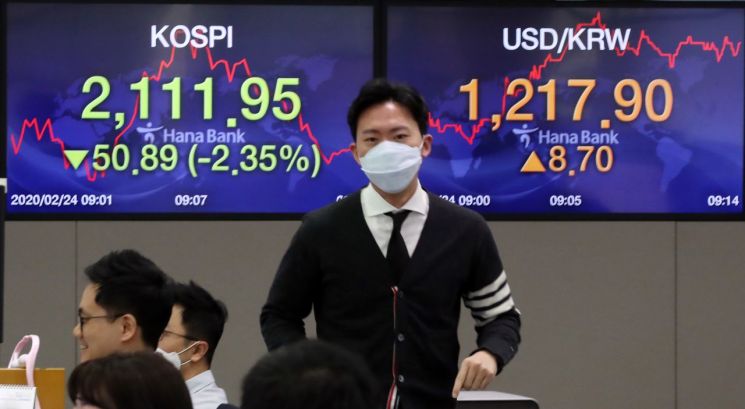
[Asia Economy Reporters Eunbyeol Kim, Minji Lee] As the number of confirmed cases of the novel coronavirus infection (COVID-19) surges, the prevailing outlook is that financial market volatility will remain high for the time being. In particular, with the stock market's loan balance exceeding 70 trillion won again, the pressure on stock prices to fall is expected to intensify. Due to increased preference for safe assets amid COVID-19 and growing expectations of interest rate cuts, government bond yields are showing a steep decline.
◆COVID-19 and Short Selling= According to the Korea Financial Investment Association on the 24th, as of the 21st, the loan balance stood at 70.8872 trillion won. The loan balance first rose above 70 trillion won this year on the 6th. Compared to last month's average loan balance (62.3583 trillion won), it is about 13% higher. The quantity of loan transactions reached 3.34285 billion shares, a record high.
The loan balance refers to funds borrowed through stock lending transactions that have not yet been repaid. It represents standby funds for short selling, where investors expecting a stock price decline borrow stocks to sell and then buy them back at a lower price to repay. Short selling is more detrimental when the stock market's growth potential is low.
Market experts observed that although the stock market rose slightly at the beginning of the year due to improved corporate earnings forecasts, the spread of COVID-19 likely increased the number of investors with a negative outlook on the market. Bongjoo Kang, a researcher at Meritz Securities, said, "Considering the recent increase in short selling transactions, there is a high possibility of a certain level of decline," adding, "When the market's fundamentals weaken and short selling increases, investors should avoid stocks that are likely to fall due to short selling."
In the financial market, the rapid spread of COVID-19 to major Asian regions such as Singapore and Japan is seen as a factor that could further increase market volatility. Songcheol Kang, a researcher at Shinhan Financial Investment, said, "The unexpectedly rapid spread of COVID-19 will be a critical point for whether this week's growth rate can reach 2%," adding, "If the US and China implement monetary easing policies and China launches massive fiscal stimulus measures, the real economy could recover quickly."
◆Pressure on Exchange Rate Rise and Interest Rate Cuts Increases= The exchange rate is also expected to fluctuate sharply depending on the COVID-19 situation and government responses. Foreign exchange market experts view the previous high of 1,222.2 won in August last year, when the Korea-Japan export regulation conflict peaked, as the first resistance level. However, depending on the extent of the COVID-19 spread, there is analysis that the previous high could be surpassed. If the COVID-19 situation worsens, experts predict the upper limit may need to be set around the 1,230 won level seen in February 2016, when concerns about a hard landing of the Chinese economy intensified. However, to prevent panic caused by a sharp rise in the exchange rate, intervention by financial authorities cannot be ruled out, which may limit the speed of the increase to some extent.
The fact that the 5-year government bond yield has fallen below the Bank of Korea's base rate (1.25% per annum), following the 3-year bond, appears to reflect expectations of an interest rate cut by the Bank of Korea. Initially, Governor Lee Ju-yeol of the Bank of Korea said, "Since there are side effects of additional rate cuts, it is necessary to carefully consider them," and "It is still too early to predict the domestic economic impact of the COVID-19 situation, and it needs to be confirmed through indicators." This was a hawkish (monetary tightening preference) statement.
However, as confirmed COVID-19 cases surge and the situation becomes urgent, there is speculation that Governor Lee may have changed his stance. He returned to Korea on the morning of the day, advancing his overseas business trip schedule to Saudi Arabia by one day.
© The Asia Business Daily(www.asiae.co.kr). All rights reserved.

















