[Asia Economy Reporter Kim Yuri] As fears of the spread of the novel coronavirus infection (COVID-19) grow, shadows are also falling over the construction industry. Experts are particularly concerned that with the entire country falling under the influence of COVID-19 ahead of the spring housing sales peak season, whether the situation worsens will have a considerable impact on the construction market in the first half of the year.
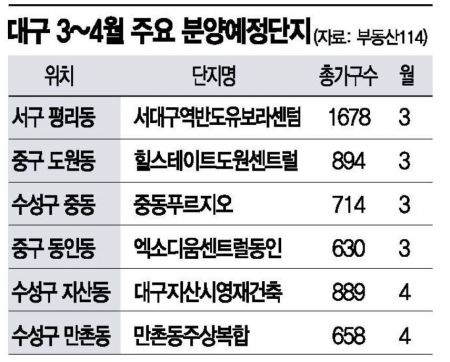
According to Real Estate 114 on the 24th, Daegu, which has been hit hard by COVID-19, has 12 complexes with a total of 7,346 households scheduled for sale in March and April. In Suseong-gu, considered a key area, 2,599 households are planned, including ▲Jungdong Prugio (714 households) ▲Hwanggeum-dong Mixed-use Complex (152 households) ▲Jisan Siyoung Reconstruction (889 households) ▲Manchong-dong Mixed-use Complex (658 households). Additionally, spring sales are being prepared in various parts of Daegu city such as Dalseo-gu, Seo-gu, Jung-gu, and Nam-gu. In Busan, sales are also waiting for March and April, including Sasang Deokpo Busan Deokpo 1 District Joongheung S Class (1,572 households) and Sasang Mora Busan Mora A1 (Happy Housing) with 390 households.
In Seoul, ahead of the private land price ceiling system scheduled for the end of April, a large number of 20,736 households are being prepared for sale. Including Dunchon Jugong in Gangdong-gu (12,032 households), 10 complexes have planned sales. To avoid the application of the price ceiling system, reconstruction projects in their final stages are accelerating their work, so the number of complexes planning sales during this period is expected to increase further.
The industry believes that while the volume of housing sales itself may not significantly decrease due to the COVID-19 situation, it could affect subscription sentiment in less popular areas such as small and medium-sized cities in the provinces. In fact, some construction companies have postponed the opening schedules of model houses, which carry a high risk of infection, or replaced them with cyber model houses to proceed with sales schedules.
In particular, the Korea Construction Industry Research Institute predicted that whether the COVID-19 situation spreads in March will determine not only the construction market in the first half of the year but also economic performance. Typically, respiratory patients increase during the seasonal change in March, and if confirmed COVID-19 cases increase by this time, it could affect the recovery of construction investment due to the concentrated volume of housing sales.
Park Cheolhan, a senior researcher at the Construction Industry Research Institute, said, "If the COVID-19 situation worsens, some sales may be postponed and construction starts delayed, which could delay the recovery of residential construction investment," adding, "Early budget execution for social overhead capital (SOC) by the government is necessary to resolve economic uncertainties."
© The Asia Business Daily(www.asiae.co.kr). All rights reserved.

















