Green Reading 'Accurately', Putter Grip 'Lightly', Chipping Contact 'Cleanly'
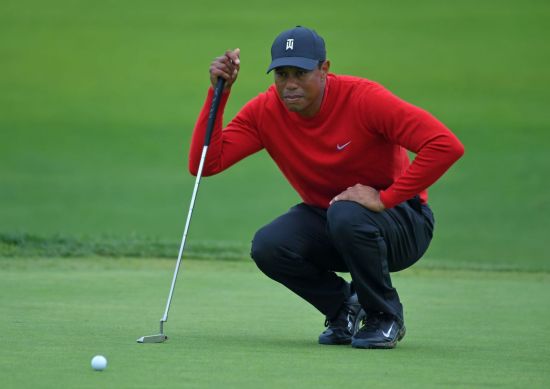 Tiger Woods reached the PGA Tour record for the most wins (82 victories) by showcasing his outstanding short game skills.
[Asia Economy Reporter Nowrae Noh] "Master of the short game."
'The resurrected golf emperor' Tiger Woods (USA) has created countless memorable moments since his professional debut in 1996, securing a total of 82 wins on the PGA Tour. He currently shares the record for the most PGA Tour wins with Sam Snead (USA). It is important to note that he delivers perfect play not only in the long game but also in the miraculous short game. Especially remarkable are his creative shots around the green. This is how to learn 'how to excel at the short game' from Woods.
Woods excels in green play first and foremost. His '4-putter double bogey' on the 13th hole (par 4) during the third day of last week's Genesis Invitational was an anomaly. In fact, from 2002 to 2005, out of 1,540 opportunities to putt from 1 meter, he missed only three times. His preparation is thorough. He carefully checks the green’s slope, speed, and grain. He emphasized, "I take notes on the hole location, break, and grain direction," adding, "This allows me to putt comfortably."
Consistency is key on the green. The correct posture and eye alignment are the starting points. It is problematic if you stand too far from the ball at address. Keep your upper body upright, and position the ball under your right eye. This allows your arms and shoulders to rotate naturally. This is why Woods stressed, "When struggling on the green, I first check my alignment." The grip should be held comfortably. The more pressure there is to make the putt, the lighter the stroke should be.
The head must move smoothly. This tip is even more necessary on fast greens. Woods explained, "If grip pressure is rated from 1 to 10, I hold it at a 5." The grip pressure remains the same on slow greens. Instead, he attaches lead tape to the bottom of the putter. He added, "This is the secret to a consistent stroke." Around the fringe, he prefers a running approach that rolls the ball. This reduces mistakes while sending the ball toward the hole.
It is interesting that Woods’ backswing is small, which lowers the chance of mishits. He narrows the distance between his feet to minimize upper body movement and places the ball toward his right foot to increase loft. He points his wrists upward to build confidence in the shot. The club head’s toe feels like it is pointing downward. This increases the consistency of chip shots. He introduced it as "a method to make solid contact" and said, "It is very helpful when doing bump and run shots."
Using the wrist during chip shots is prohibited. The right wrist naturally connects to the backswing. Woods advised, "When swinging, the hands and arms must act as one." The greenside rough is similar to bunker shots. Open the clubface and contact 1 to 2 inches behind the ball. The backswing angle is a bit steep. For short-distance greenside bunkers, open the clubface until it points toward the target. Maintaining speed through impact is key.
© The Asia Business Daily(www.asiae.co.kr). All rights reserved.

















