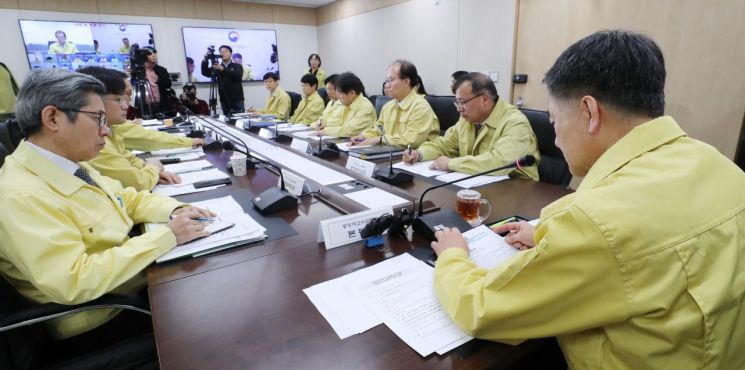
 Park Neung-hoo, Head of the Central Disaster and Safety Countermeasures Headquarters (Minister of Health and Welfare, right), is attending the video conference between Seoul and Sejong of the Central Disaster and Safety Countermeasures Headquarters chaired by Prime Minister Chung Sye-kyun to review the COVID-19 response situation at the Government Sejong Complex on the 19th, listening to the remarks of the Prime Minister along with related personnel. [Image source=Yonhap News]
[Asia Economy Reporter Kim Heung-soon] As the government raised the crisis alert level for the novel coronavirus infection (COVID-19) to 'Severe,' it established the Central Disaster and Safety Countermeasures Headquarters led by the Prime Minister. Centered on Daegu, where cluster infections occurred, 1,000 treatment beds have been secured, and alongside existing community infection prevention measures, strategies for the rapid recovery of confirmed patients will be pursued.
Park Neung-hoo, head of the COVID-19 Central Accident Response Headquarters (Minister of Health and Welfare), stated at a briefing held at the Government Seoul Office on the 23rd, "The government will elevate the existing Central Disease Control Headquarters (Korea Centers for Disease Control and Prevention)-centered quarantine operations and the Central Accident Response Headquarters (Ministry of Health and Welfare) system supporting it, maintaining consistency, to the Central Disaster and Safety Countermeasures Headquarters led by the Prime Minister."
Prime Minister Becomes First Head of Central Disaster and Safety Countermeasures Headquarters
Minister Park emphasized, "This is the first case where the Prime Minister directly assumes the role of the head." Under the head, two deputy heads are responsible for quarantine and intergovernmental countermeasure support. Minister Park serves as the first deputy head and head of the Central Accident Response Headquarters, overseeing quarantine operations. Jin Young, Minister of the Ministry of the Interior and Safety, serves as the second deputy head and head of the Intergovernmental Countermeasure Support Headquarters.
The Central Accident Response Headquarters stated, "We will strengthen cross-ministerial responses and support systems between the central government and local governments, and respond with unprecedented strong and swift measures without being bound by regulations."
On the same day, the government raised the crisis alert level to 'Severe' at the 'COVID-19 Intergovernmental Countermeasure Meeting' chaired by President Moon Jae-in. Currently, the infectious disease crisis alert in South Korea is divided into four levels: Interest, Caution, Alert, and Severe. The government raised the alert level from 'Interest' to 'Caution' on January 20, when the first domestic COVID-19 patient was confirmed. A week later, as confirmed cases increased to four, the alert level was raised to 'Alert,' and on this day, it was adjusted to the highest level again. The only previous case of raising the crisis alert to 'Severe' was during the 2009 H1N1 influenza pandemic.
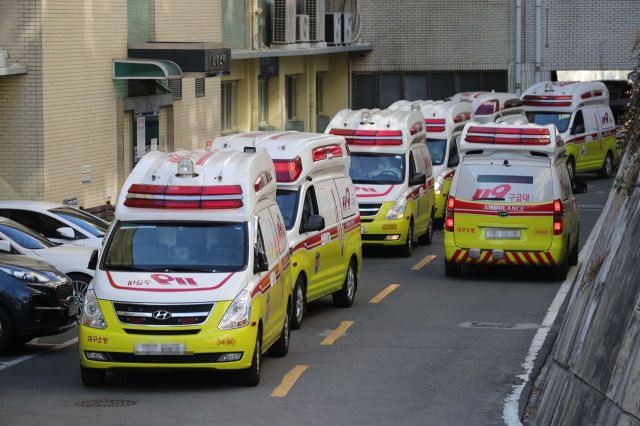 Ambulances carrying COVID-19 confirmed patients are lined up at Keimyung University Daegu Dongsan Hospital.
 [Image source=Yonhap News]
Parallel Strategies of 'Lockdown Policy and Damage Minimization'
1,000 Beds in Daegu and Additional 10,000 Treatment Beds Nationwide Secured
The number of confirmed COVID-19 cases in South Korea increased by 169 on this day alone, totaling 602. However, Minister Park emphasized, "Even though the crisis alert has been raised to Severe, the quarantine system will not change." He said, "Although the number of patients has increased significantly, confirmed cases are occurring mainly within a specific religious group," adding, "The lockdown policy, which blocks and isolates the area around that group to prevent regional spread, remains effective." He further stated, "We will also pursue a damage minimization strategy by treating detected patients early to ensure their rapid recovery."
The government requested Daegu, where cluster infections occurred, to voluntarily refrain from going out and limit movement for at least two weeks, and urged symptomatic individuals to undergo rapid testing at screening clinics. It also recommended that residents from other regions who visited Daegu refrain from going out and promptly get tested if symptomatic.
Plans are also underway to secure dedicated hospitals and beds for the rapid treatment of mild COVID-19 patients. Minister Park announced, "We will secure approximately 1,000 additional beds for confirmed patients in Daegu and about 10,000 treatment beds nationwide." Additionally, each province is requested to secure and prepare medical personnel through medical associations for early diagnosis, specimen collection, and treatment of mild respiratory patients with COVID-19.
Furthermore, the government advised refraining from events held in confined indoor spaces or crowded gatherings, and recommended that individuals with fever or respiratory symptoms avoid going out and rest. Employers were asked to cooperate by recognizing sick leave without requiring medical certificates. Minister Park also promised, "We will provide sufficient recognition and compensation for losses to medical personnel who cooperate in preventing the spread of infectious diseases."
© The Asia Business Daily(www.asiae.co.kr). All rights reserved.


















