President Moon Jae-in Raises Crisis Alert to 'Severe'
Israel Imposes 'Entry Ban' Without Prior Consultation...Foreign Ministry Strongly Protests
US, Taiwan Raise Travel Alerts to Level 2...Foreign Ministry "No Impact on Our Citizens' Entry"
Entry Bans and Movement Restrictions in 13 Countries

[Asia Economy Reporter Lim Cheol-young] As President Moon Jae-in raised the crisis alert level for the novel coronavirus infection (COVID-19) to the highest level of 'serious,' the number of countries upgrading travel advisories and imposing movement restrictions on foreigners, including Koreans, is increasing.
On the 23rd, President Moon elevated the COVID-19 crisis alert to the highest level of 'serious,' stating, "The COVID-19 situation has reached a critical turning point, and the next few days are a very important juncture," and added, "The government will significantly strengthen the response system by raising the crisis alert to the highest level of serious, following the recommendations of infectious disease experts."
As of 4 p.m. that day, the number of confirmed COVID-19 cases exceeded 600, reaching 602. The fifth death was also reported.
Accordingly, more countries are strengthening various measures against South Korea. On the 22nd (local time), the U.S. Department of State and the Centers for Disease Control and Prevention (CDC) raised travel advisories for South Korea and Japan. While these measures do not ban Americans from traveling to South Korea or Koreans from entering the U.S., they generally indicate a heightened level of caution.
◆U.S. raises Taiwan travel advisory to Level 2= The U.S. Department of State raised the travel advisory level for South Korea, where confirmed COVID-19 cases are increasing, to Level 2. The Department of State explained that although many confirmed cases had been linked to travel to mainland China or contact with travelers, ongoing community spread has been reported, prompting the upgrade of the travel advisory level.
Countries classified under Level 2 travel advisories related to COVID-19 now include Hong Kong, Macau, South Korea, and Japan. Over 70 countries, including the United Kingdom, Germany, France, Mexico, and the Philippines, are also listed at this level. China was classified as Level 4, the travel ban level, on the 2nd of this month.
The U.S. CDC also raised the travel notice level for South Korea to Level 2, the 'Alert level,' which is one step higher than the Level 1 'Watch level' assigned to Hong Kong. The Alert level means 'enhanced precautions,' and South Korea and Japan were designated simultaneously this time. China was classified as a Level 3 'Warning level' country on the 4th, indicating that unnecessary travel should be avoided.
The number of countries strengthening COVID-19-related travel advisories for South Korea is increasing. Earlier, Vietnam recommended refraining from travel on the 21st, and Taiwan raised its travel advisory level to 2 for South Korea and Japan following the U.S. Brazil has strengthened quarantine measures for travelers arriving from seven Asian countries, including South Korea, North Korea, Japan, Singapore, Vietnam, Thailand, and Cambodia.
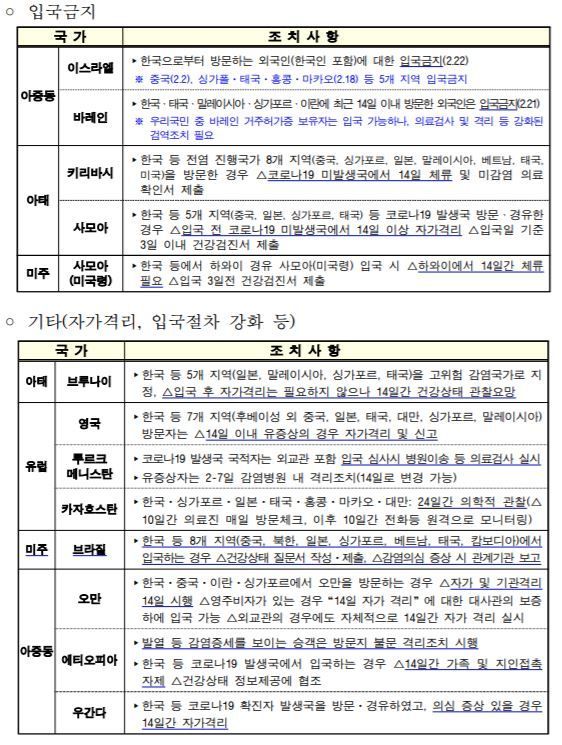
◆Countries imposing movement restrictions on foreigners including Koreans are increasing= The number of countries imposing movement restrictions on foreigners passing through South Korea, including Koreans, is also growing. Israel, for example, banned the entry of Koreans without prior consultation.
The Israeli government banned Korean tourists from entering starting on the 22nd (local time). As a result, about 130 Koreans who arrived at Ben Gurion International Airport in Tel Aviv, Israel, around 7:55 p.m. on the 22nd were denied entry. Those denied entry departed for Korea on the same flight around 9:50 p.m. This measure by Israel came after it was confirmed that Koreans who participated in a pilgrimage to Israeli holy sites were infected with COVID-19.
The Ministry of Foreign Affairs contacted the Israeli government and the Israeli Embassy in Korea to strongly protest, but received a response that the decision was unavoidable. The Ministry requested Israel to prevent recurrence and asked for close cooperation regarding COVID-19 response going forward. Israel is currently blocking entry of foreigners who have traveled through five countries, including China, Singapore, Thailand, Hong Kong, and Macau.
The Korean Embassy in Israel stated, "The Israeli side announced that everyone traveling from Korea and entering Israel will be quarantined for 14 days," and advised, "Please refrain from visiting Israel until the entry ban is lifted, keeping this in mind."
Bahrain, Kiribati, and Samoa have also imposed entry bans. Bahrain banned entry of foreigners who have visited certain infectious disease outbreak countries, including South Korea, within the last 14 days starting on the 21st. Kiribati requires travelers who have visited China, Japan, Singapore, or the U.S. to stay in a COVID-19-free country for 14 days and submit a medical certificate confirming no infection.
Countries that have strengthened self-quarantine and entry procedures include Brunei, the United Kingdom, Turkmenistan, Kazakhstan, Oman, Ethiopia, and others, totaling seven countries. Brunei designated Japan, Malaysia, and Singapore as high-risk infection countries and monitors health status for 14 days after entry. The U.K. requires visitors from South Korea, China, Japan, and others to self-quarantine and report if symptoms appear within 14 days. Kazakhstan has mandated medical observation for 24 days, and Oman enforces 14 days of facility and institutional quarantine.
© The Asia Business Daily(www.asiae.co.kr). All rights reserved.
![Clutching a Stolen Dior Bag, Saying "I Hate Being Poor but Real"... The Grotesque Con of a "Human Knockoff" [Slate]](https://cwcontent.asiae.co.kr/asiaresize/183/2026021902243444107_1771435474.jpg)


















