Yejeongcheo 'International Comparison and Implications of Youth Employment Status' Report
[Asia Economy Reporter Kim Hyunjung] South Korea's youth employment rate is lower than the average of the Organization for Economic Cooperation and Development (OECD), and the proportion of people in their late 20s and those with high educational attainment is high, highlighting the need to establish strategies tailored to these structural characteristics.
According to the report "International Comparison and Implications of Youth Employment Status" published by the National Assembly Budget Office on the 23rd, South Korea's youth employment rate was 42.7% in 2018, significantly below the OECD average of 53.5%. Based on youth unemployment rates, South Korea recorded 9.5%, higher than the OECD average of 9.2%, and more than twice that of Japan (3.8%).
In particular, the expanded unemployment rate, which reflects the employment situation perceived by the youth, is on the rise. The expanded unemployment rate last year included those classified as time-related underemployed and potential economically active population. Time-related underemployed refers to part-time workers working less than 36 hours per week who want reemployment or additional jobs, considered partial unemployed. The potential economically active population includes those who were not economically active but had job-seeking activities in the past four weeks but could not find employment, and those who did not seek jobs in the past four weeks but wished and were able to work during that period. This expanded unemployment rate reached 22.9%, the highest since the related statistics began in 2015. Although the number of employed youth has increased (employment rate from 41.2% in 2015 to 43.5% in 2019), the number of time-related underemployed (an increase of 16,000 from the previous year) and potential economically active population (an increase of 24,000 from the previous year) also rose.
Kim Seunghyun, Economic Analyst at the Population Strategy Analysis Division of the Economic Analysis Bureau, who authored the report, pointed out the particularly high proportion of highly educated youth NEETs (Not in Employment, Education, or Training). As of 2017, the NEET rate was 18.4%, higher than the OECD average of 13.4%. Especially, among NEETs, the proportion of university graduates or higher was 45% in Korea, compared to only 18% on average in the OECD. Kim explained, "This seems to reflect the reality that many participate in informal education such as private academies to prepare for employment after university graduation."
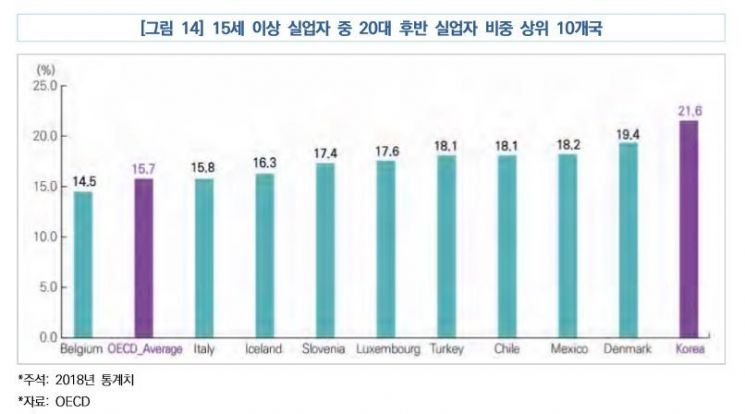
Furthermore, while the proportion of people in their late 20s among the population aged 15 and over in Korea is only 7.8%, the proportion of unemployed people in their late 20s was 21.6% as of 2018, the highest among the 36 OECD member countries. This record has continued for seven years since 2012.
Kim emphasized, "Although some employment indicators such as the employment rate have improved, youth employment and youth unemployment rates need improvement compared to OECD countries," adding, "It is necessary to continuously strive to improve related indicators through effectiveness analysis of youth employment policies and to improve the perceived employment situation through policies reflecting the demands of the youth." He further stressed, "It is necessary to establish strategies to resolve the education-job mismatch tailored to South Korea's characteristics, where the proportion of unemployed in their late 20s and highly educated youth NEETs is high."
© The Asia Business Daily(www.asiae.co.kr). All rights reserved.

















