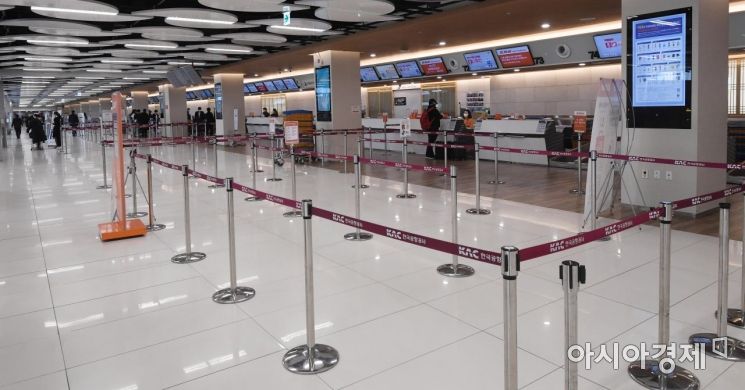
 On the 10th, amid ongoing concerns about the spread of the novel coronavirus infection, the domestic terminal at Gimpo Airport in Seoul appeared quiet. Photo by Hyunmin Kim kimhyun81@
[Asia Economy Reporter Yu Je-hoon] The damage to the aviation industry caused by the novel coronavirus infection (COVID-19) crisis is spreading day by day. Not only is the virus spreading in short-distance markets such as China and Japan, but the rapid increase in confirmed cases domestically is raising concerns about impacts on the inbound market as well.
According to the Ministry of Land, Infrastructure and Transport's Aviation Information Portal System, the number of air passengers using Incheon Airport from the 1st to the 21st of this month was tentatively counted at 2,673,846. This is only 62% compared to last year's 4,251,145 passengers.
This decline is interpreted as a combined effect of the reverse (易) miracle effect from last year's Lunar New Year holiday (February 1?10), the contraction in demand due to COVID-19, airline suspensions, and the boycott of travel to Japan. The demand contraction is directly hitting domestic airlines, whose main source of income is outbound passengers.
The problem is that the increase in confirmed cases domestically may also affect inbound demand. In fact, some overseas countries are increasingly restricting entry for Koreans. Kazakhstan, Turkmenistan, and Kiribati are representative examples.
Cases of travel advisories being issued are also increasing. On the 20th, Taiwan's Centers for Disease Control classified Korea as a Level 1 infectious disease travel alert area. Level 1 is the lowest level of measure, recommending adherence to local preventive guidelines. The U.S. Centers for Disease Control and Prevention (CDC) has not issued a travel alert for Korea but added it to the list of countries where community spread is considered to have occurred.
If this trend spreads, the aviation industry's woes, already suffering from a contraction in outbound demand, are expected to deepen. Due to the impact of COVID-19, even the domestic market, including key routes such as Gimpo~Jeju, which have been the backbone of domestic airlines, is freezing up.
Meanwhile, the International Air Transport Association (IATA) forecasted that airlines in the Asia-Pacific region will experience a revenue loss of $28.7 billion (approximately 33.5 trillion KRW) due to the COVID-19 crisis. This is based on an expected annual demand decrease of about 8%.
Alexandre de Juniac, Secretary General of IATA, diagnosed, "The sharp decline in demand due to COVID-19 will have a serious financial impact on airlines exposed to the Chinese market."
© The Asia Business Daily(www.asiae.co.kr). All rights reserved.

















