Various Illegal Activities Exploiting Public Anxiety Surge
Do Not Trust 'KakaoTalk' Messages
Verify Official Information... Also Use Private Websites
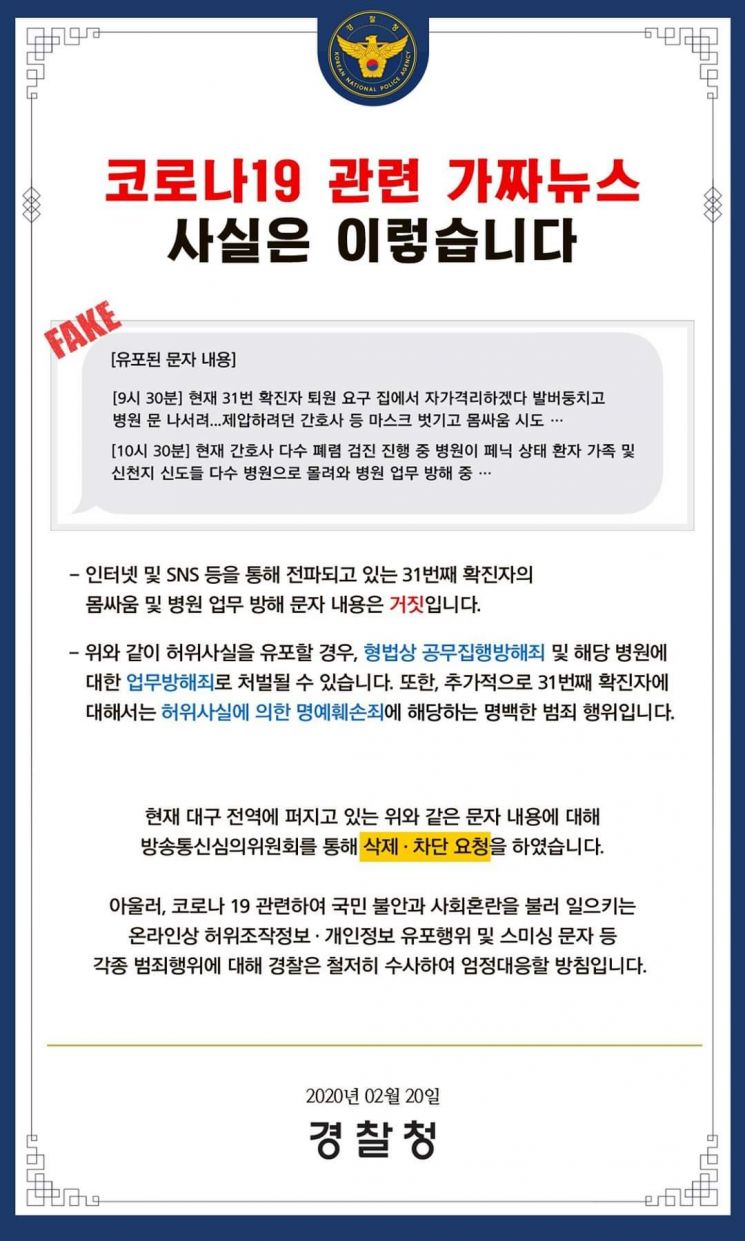
[Asia Economy Reporter Lee Gwan-ju] #1. Recently, two photos claiming to be of the 31st confirmed patient of the novel coronavirus infection (COVID-19), known to be a member of Shincheonji Church, were spread through social networking services (SNS) and messengers without a clear source. However, the person in the photos was not the 31st patient. It did not take long for the police's official announcement to confirm that the information was false and fabricated, but by then, the photos had already spread widely online.
#2. On the 19th, when the 46th patient was confirmed, various posts suddenly began circulating titled "Movement path of the 47th confirmed patient." These posts stated that the 47th patient was a 32-year-old male and detailed specific locations he had visited. However, the actual 47th patient was a 63-year-old female. Meanwhile, the neighborhoods mentioned in this false information were thrown into chaos.
Why COVID-19 'Fake News' Is a Problem
Why and who is creating and spreading COVID-19 fake news? According to the National Police Agency, as of the 20th, there are a total of 63 ongoing investigations related to false and fabricated information and personal data leaks. Among these, 49 individuals have been arrested in 36 cases after identifying the distributors.
Many acts of fake news and anxiety-inducing behavior are difficult to forgive because they are done simply to gain 'attention' or as a 'prank.' For example, A (27), who was caught by the police earlier this month for spreading fake news titled "Report of a suspected novel coronavirus infection case" via KakaoTalk, reportedly stated during police investigation that "it was done as a joke without much thought." Due to this fake news, the local health center was overwhelmed with phone calls to the point of paralysis. Fake news significantly hindered their primary quarantine work.
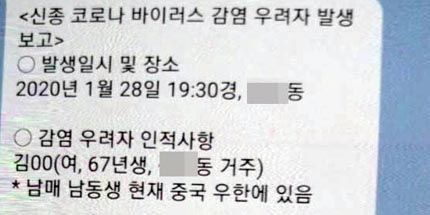
The main distribution channel for fake news was local 'mom cafes.' Among the cases the police cracked down on, 10 were spread through mom cafes. Since these cafes are gatherings of mothers raising children, the initial distributors seemed to target their sensitivity to COVID-19-related information. Moreover, there were eight cases where internal report photos taken by public officials or related personnel were leaked. In Seoul, three public officials were booked for leaking official documents from Seongbuk-gu Health Center containing confirmed patients' movement paths on SNS, and in Busan, a police officer was sent to the prosecution with a recommendation for indictment for leaking internal police station messages related to suspected infections on SNS.
The biggest problem with fake news is that it can paralyze local communities in a different sense. It can interfere with the work of frontline health authorities such as hospitals and health centers, and false movement paths can paralyze local businesses or cause unfair disadvantages. If hospitals that normally provide medical care face difficulties due to fake news, or if police and fire personnel are wasted because of it, the damage will ultimately fall on ordinary citizens.
How to Judge Fake News
To avoid being swayed by fake news, it is necessary to first 'doubt' posts spread on messengers like KakaoTalk or SNS. There are countless scams targeting texts and messengers, such as smishing and messenger phishing. Even messages sent by acquaintances cannot be trusted until their facts are verified, so unknown sources should be trusted even less.
First, messages without a source or those from government offices on KakaoTalk are almost certainly false information. Especially, information appearing under names like 'OO Manager' from police or fire department officials is 100% fake. Whether police, fire, or health centers, no staff member explains positions or facts under their personal names.
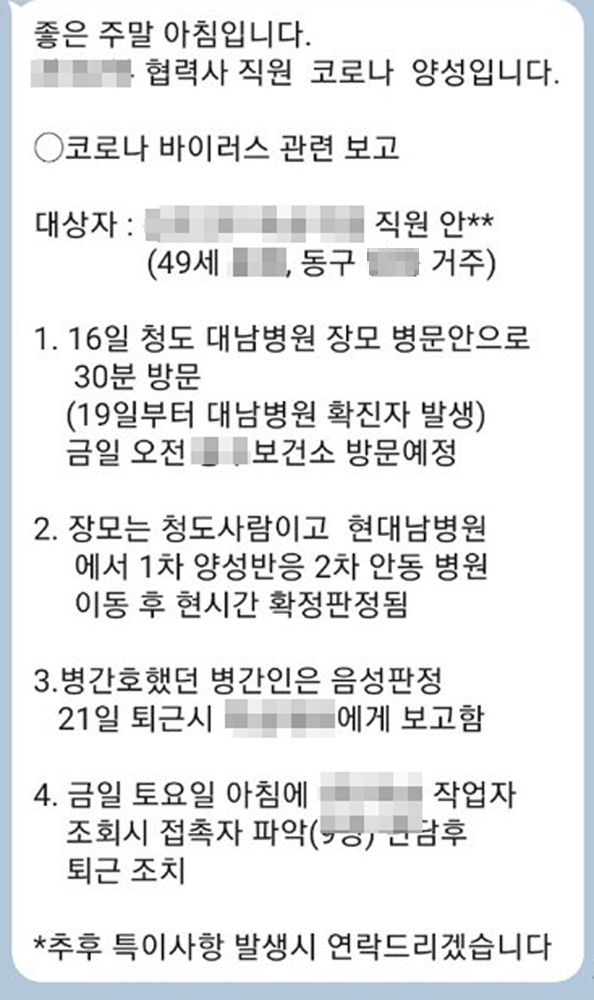 A fake news report claiming that an employee of a major corporation's partner company in Ulsan tested positive for COVID-19 spread on the 22nd, prompting the police to launch an internal investigation. The photo shows the content of the fake news. [Image source=Yonhap News]
If you are worried about confirmed patients' movement paths, it is faster to check the Korea Disease Control and Prevention Agency website or the websites, blogs, and SNS of local governments directly rather than relying on KakaoTalk messages. Local government heads also quickly share regional situations on their SNS or blogs. Since the largest portion of fake news involves confirmed patients' personal information or movement paths, it is more accurate to obtain this information through official channels.
If this is difficult, there are websites created and operated by private entities based on official information. Sites such as 'Corona Map,' which gained attention for being created by university students, 'COVID-19 Real-time Dashboard,' and 'CORONAITA' have attracted attention by appearing in real-time searches on major portal sites. These sites are considered somewhat reliable as they are based on official information.
If you receive COVID-19-related information from acquaintances, it is important to verify the facts before sharing it with others. Such sharing behavior can be a shortcut to spreading fake news. A National Police Agency official stated, "We will respond strictly and firmly by tracking and arresting not only the initial distributors but also intermediate distributors of false and fabricated information," and urged, "We ask for the public's special caution and cooperation." Although anxiety is growing due to the spread of local infections, this is a time when calm responses are needed without being swayed by fake news that stirs confusion.
© The Asia Business Daily(www.asiae.co.kr). All rights reserved.
![Clutching a Stolen Dior Bag, Saying "I Hate Being Poor but Real"... The Grotesque Con of a "Human Knockoff" [Slate]](https://cwcontent.asiae.co.kr/asiaresize/183/2026021902243444107_1771435474.jpg)













