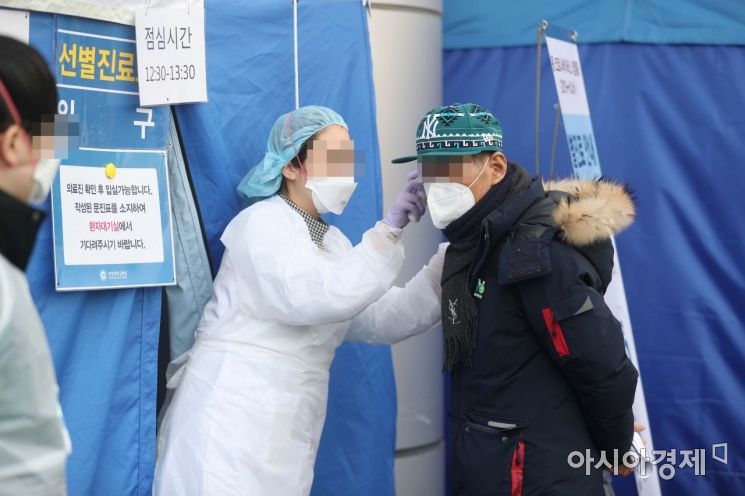
 On the 19th, at the screening clinic of Hanyang University Hospital in Seongdong-gu, Seoul, where a COVID-19 confirmed patient without overseas travel history was reported, medical staff are checking visitors for fever. / Photo by Moon Honam munonam@
[Asia Economy Reporters Choi Dae-yeol and Kim Heung-soon] To quickly identify patients infected with the novel coronavirus disease (COVID-19), health authorities will begin operating mobile clinics starting next month. Measures to designate hospitals that separately treat respiratory patients to prevent hospital-acquired infections are also being pursued.
On the 21st, the Central Disaster and Safety Countermeasures Headquarters for COVID-19 held a countermeasure meeting chaired by Prime Minister Chung Sye-kyun and announced strengthened quarantine measures including these plans. Accordingly, mobile clinics will be operated primarily in areas with a high likelihood of COVID-19 outbreaks, such as regions densely populated by foreign workers, where it is difficult to get tested due to the distance from screening clinics. These will be operational from early next month. Additionally, from the end of this month, mobile specimen collection will begin targeting individuals with limited mobility, such as those with severe disabilities or the elderly.
To prevent COVID-19 patients from visiting hospitals, pre-diagnostic testing will be strengthened. Pneumonia patients will be isolated and tested before admission, and hospitalization will only be allowed if the test is negative. Patients entering intensive care units will also undergo pre-diagnostic testing, and suspected patients such as those with respiratory symptoms or fever visiting emergency rooms will be tested first in a separate area before entry. If deemed safe by a physician, patients will be temporarily allowed to receive telephone consultations and prescriptions without visiting medical institutions directly.
A "National Safe Hospital" system will be established to separately identify and treat respiratory patients. This system separates respiratory patients from other patients throughout the entire process from hospital entry to admission. Depending on the medical institution's conditions, only outpatient routes may be separated, or screening clinics and inpatient rooms may also be separated and operated. This is to ensure that non-respiratory patients can receive treatment without infection concerns. These hospitals will receive health insurance fees such as infection prevention management fees.
In nursing hospitals, pneumonia patients with unknown causes among inpatients will be isolated and tested. Visits by outsiders showing fever or cough symptoms will be prohibited, and workers who have traveled abroad, including to China, will be excluded from work for 14 days. Facilities used by vulnerable groups, such as nursing facilities, will prohibit symptomatic individuals from entering and exclude them from work.
To prepare for situations where patient numbers surge, as in Daegu and Gyeongbuk, regional hospital beds will be secured as much as possible. "Infectious disease dedicated hospitals" will be prepared by clearing entire hospitals or wards to secure rooms for treating mild patients or isolating symptomatic individuals. Along with the National Medical Center and the Armed Forces Daejeon Hospital, military and public hospitals will be additionally secured if necessary. Local governments are preparing mainly around local medical centers.
To accelerate research on preventive vaccines and treatments, the existing Central Clinical Task Force, composed of attending physicians and others, has been expanded into the Central Clinical Committee. The Disaster and Safety Countermeasures Headquarters stated that compensation targets and scopes for losses will be prepared by next month to encourage active participation in infectious disease response at frontline hospitals and clinics, and partial compensation may be provided even before the current situation ends. Additionally, each metropolitan local government will form an Infectious Disease Management Support Group composed of private experts to support epidemiological investigations, health center and medical institution training, and on-site inspections of screening clinics in each city and province.
© The Asia Business Daily(www.asiae.co.kr). All rights reserved.

















