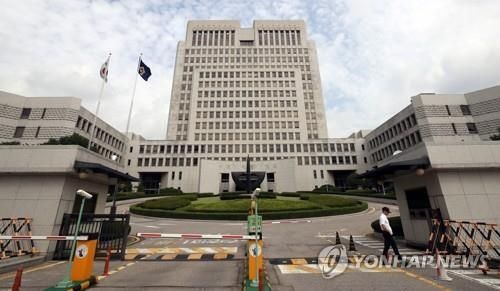
[Asia Economy Reporter Kim Hyung-min] The Supreme Court has upheld the guilty verdict for professional negligence resulting in death against a doctor and a radiologic technologist who administered contrast agents without properly verifying patients' adverse reactions during imaging diagnostic tests or procedures, leading to a patient's death after a CT scan.
The Supreme Court's Second Division (Presiding Justice Kim Sang-hwan) announced on the 21st that it affirmed the lower court's ruling, which imposed fines on Dr. A (53) and radiologic technologist B (35), both of whom were indicted for professional negligence resulting in death and violation of the Medical Service Act. Accordingly, Dr. A was fined 20 million KRW, and B was fined 3 million KRW. The university hospital where they worked was acquitted.
Dr. A, who worked as a surgery professor at a university hospital in Busan, recommended patient B to undergo a CT scan requiring contrast agent administration during a regular checkup in December 2013. Subsequently, radiologic technologist B administered the contrast agent and performed the CT scan on patient C one month later. Patient C died of multiple organ failure the day after the examination.
Previously, in November 2012, patient C had lost consciousness and collapsed due to anaphylactic shock caused by a contrast agent during a CT scan and received emergency treatment. This information was recorded in the hospital's medical information system and was accessible at any time; however, Dr. A and technologist B failed to verify this before administering the contrast agent to patient C, according to the investigation.
The prosecution charged Dr. A and technologist B with professional negligence resulting in death, citing their failure to fulfill their duty of care. Additionally, B was charged with violating the Medical Service Act for independently deciding the dosage and method of contrast agent administration before the CT scan without a medical license.
The first trial found all charges guilty, sentencing Dr. A to one year imprisonment with two years probation, technologist B to a fine of 5 million KRW, and the university hospital to a fine of 10 million KRW.
However, the appellate court upheld the professional negligence resulting in death charges against Dr. A and B but acquitted B of the Medical Service Act violation.
The court stated, "Dr. A bears heavy responsibility for neglecting to prepare measures against adverse reactions to contrast agents, which led to the victim's death."
Nonetheless, considering Dr. A's lack of prior criminal record and settlement with the bereaved family, the court deemed the first trial's sentence excessive and reduced it to a fine.
Regarding B's alleged violation of the Medical Service Act, the court found insufficient evidence and added, "B administered the contrast agent relying on the instructions of attending physician Dr. A, which is a mitigating circumstance." Consequently, B's fine was reduced from 5 million KRW to 3 million KRW.
© The Asia Business Daily(www.asiae.co.kr). All rights reserved.
![Clutching a Stolen Dior Bag, Saying "I Hate Being Poor but Real"... The Grotesque Con of a "Human Knockoff" [Slate]](https://cwcontent.asiae.co.kr/asiaresize/183/2026021902243444107_1771435474.jpg)
















