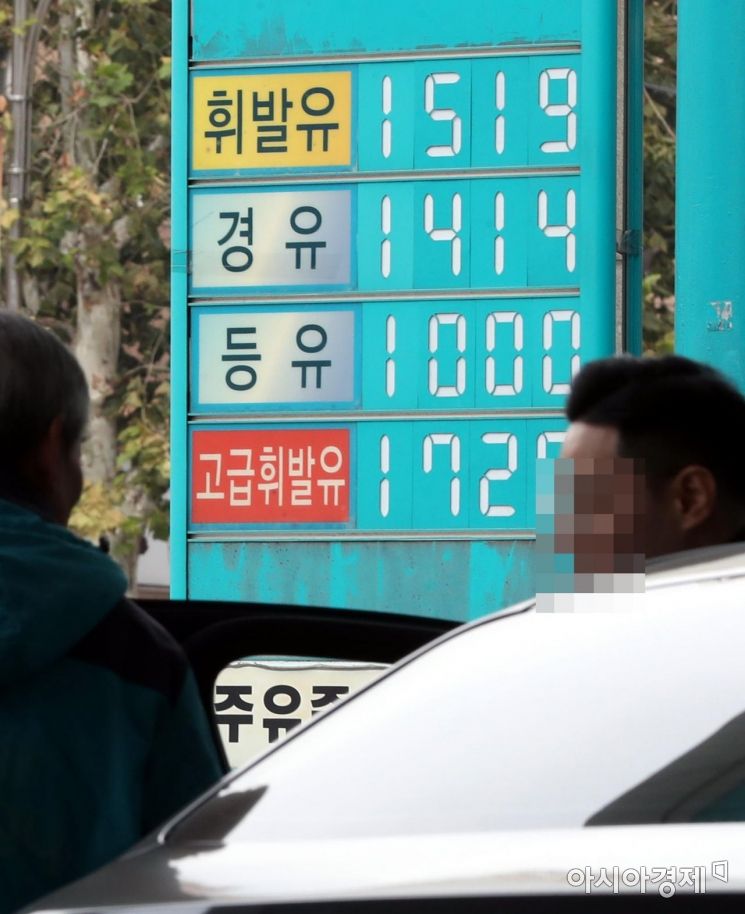
 On the 10th, the gasoline price at a gas station in Seoul city was pointing to the 1,500 won range as nationwide gasoline prices continued to decline for the fifth consecutive week. Photo by Dongju Yoon doso7@
[Asia Economy Reporter Park So-yeon] The number of gas stations, which once increased to over 13,000 due to government deregulation, has decreased by an average of 170 stations per year over the past decade. There are claims that a review of the policy is necessary as general gas stations, whose sales volume and profit margins have declined due to the government's budget gas station policy, are rapidly decreasing.
On the 20th, independent lawmaker Kang Gil-bu (Ulsan Ulju-gun) and the Korea Gas Station Association held a meeting titled "Mid- to Long-term Budget Gas Station Policy Direction for Fair Competition in the Petroleum Market" at the National Assembly Members' Office Building, Meeting Room 2.
Yoo Ki-joon, president of the Korea Gas Station Association, said, "Due to government deregulation such as the 'abolition of distance restrictions,' the number of gas stations, which had increased to 13,003 in 2010, has decreased by an average of 167 stations annually due to government competition-inducing policies like budget gas stations, falling to 11,502 as of 2019."
President Yoo stated, "The budget gas station policy is causing a decline in sales volume and profit margins for general gas stations, so a review of the budget gas station policy is necessary," and added, "Considering the reality that the gas station industry’s operating profit margin remains at around 1%, the government should refrain from market participation to enable fair competition and focus on its role as a market overseer and mediator."
There was also an opinion that the government should avoid direct market intervention. Yang Jin-hyung, executive director of the Petroleum Distribution Association, said, "Rather than direct market intervention by organizations like NongHyup and the Korea Expressway Corporation, the government's policy goals should focus on maintaining fair market order and strengthening the competitiveness of the petroleum industry."
In response, Jang Myung-ho, president of the Self-employed Budget Gas Station Association, countered, "The budget gas station policy has shown effects in improving the structure of Korea’s petroleum distribution market through promoting competition in the distribution market."
Dr. Yoon Sung-bok of the Korea Center for Social Conflict Resolution, who participated in the meeting, pointed out, "To ensure fairness among gas stations, a win-win consultative body should be formed, and when the government maintains the budget gas station policy, measures to protect general gas station operators need to be discussed."
© The Asia Business Daily(www.asiae.co.kr). All rights reserved.

















