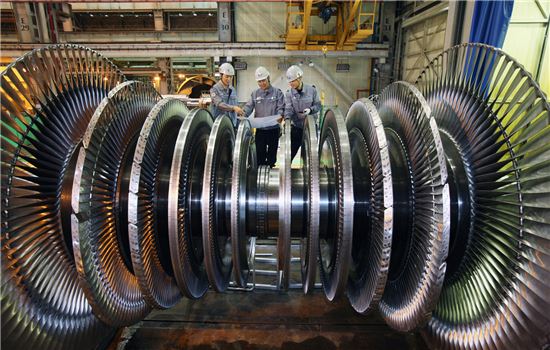
 Gas turbine manufactured at Doosan Heavy Industries & Construction Changwon plant
[Asia Economy Reporters Hyewon Kim and Seungjin Lee] As the domestic conglomerates trapped in a low-growth quagmire due to worsening internal and external business environments face the unexpected adverse impact of the novel coronavirus infection (COVID-19), the wave of layoffs is intensifying. Despite poor performance caused by the recession, companies that had postponed workforce restructuring amid internal resistance and a social atmosphere favoring job creation are now rushing to reorganize their personnel. The restructuring chill appears to be rapidly spreading across the industry, starting with sectors directly hit by the COVID-19 crisis such as aviation, automotive, and distribution.
According to the business community on the 20th, S-Oil is pushing for voluntary retirement for the first time since its founding in 1976. Recently, S-Oil held a session explaining a voluntary retirement plan to all department heads across the company, which includes severance pay ranging from 20 to 60 months of base salary depending on age. The scale and conditions of implementation are undecided, and currently, labor-management consultations are underway. The fact that S-Oil, known as a "dream workplace" due to its relatively good treatment and welfare, is considering voluntary retirement for the first time since its establishment has caused considerable shock in the industry. This move reflects a sense of crisis that the COVID-19 outbreak will accelerate the global economic downturn, including in China, and increase uncertainty, on top of the sluggish business conditions.
In the distribution sector, Lotte Shopping recently took drastic measures by closing about 200 offline stores. This is a large-scale restructuring affecting about 30% of its total 718 stores. As the number of stores decreases, physical layoffs are inevitable. A Lotte official said, "The basic principle for existing employees is reassignment to nearby stores, but downsizing without workforce restructuring is difficult, and since this is to resolve accumulated deficits, some layoffs including voluntary retirement are unavoidable." Emart is also restructuring by closing 59 stores and reorganizing its workforce.
There is also a sense that the COVID-19 shock is acting as a "trigger" for some companies that had delayed restructuring as long as possible. Doosan Heavy Industries is accepting voluntary retirement applications from about 2,000 employees aged 45 or older (born in 1975 or earlier), including technical and office workers, for two weeks from today until July 4. This is the first time in over five years since late 2014 that Doosan Heavy Industries is implementing artificial workforce restructuring. A Doosan official said, "Despite various self-help efforts, the management difficulties have worsened, and although we tried several times to accept retirement applications, we coordinated the timing based on internal decisions. Under the judgment that workforce restructuring has become inevitable, we decided to proceed with voluntary retirement considering up to a 30% reduction." Doosan Heavy Industries has been operating at a loss for six consecutive years since 2014.
Among telecommunications companies, LG Uplus is reportedly preparing a voluntary retirement plan and negotiating with the labor union. Except for the LG Dacom era, this is virtually the first voluntary retirement. Renault Samsung Motors switched to a continuous voluntary retirement system this year, and Korea Nissan also accepted voluntary retirements. Domestic airlines, hit hard by the combined effects of the Japanese boycott and COVID-19, including Korean Air and Asiana Airlines as well as low-cost carriers (LCCs), are all undergoing workforce restructuring to the extent that it is hard to find any that are not.
Choo Kwang-ho, Director of the Job Strategy Office at the Korea Economic Research Institute, said, "Corporate restructuring or layoffs are the last resort taken amid worsening business conditions," adding, "Each company is trying to minimize damage by adjusting layoffs or unpaid leave according to their circumstances while maintaining employment as much as possible."
© The Asia Business Daily(www.asiae.co.kr). All rights reserved.
![User Who Sold Erroneously Deposited Bitcoins to Repay Debt and Fund Entertainment... What Did the Supreme Court Decide in 2021? [Legal Issue Check]](https://cwcontent.asiae.co.kr/asiaresize/183/2026020910431234020_1770601391.png)