'Mandatory Employment of Youth Over 3% of Workforce Annually' Enters 7th Year
Different Work Nature and Structure Across Institutions... Uniform Standards
47 Public Institutions Fail to Comply... "Contradictory" Complaints
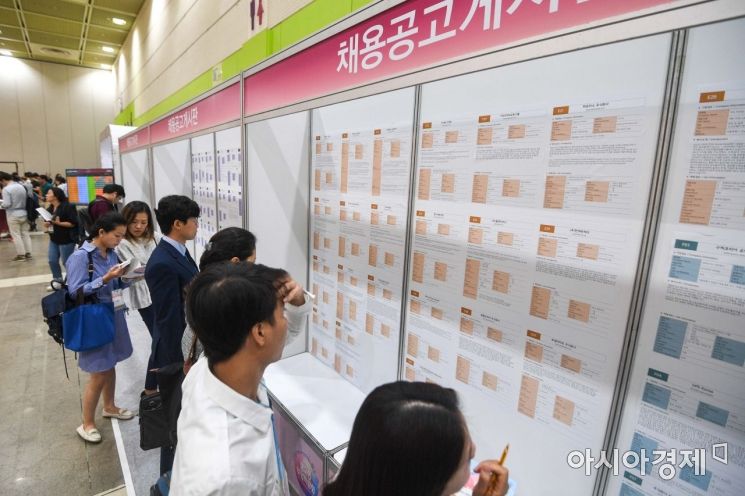
[Asia Economy Reporter Kim Bo-kyung] "How do you know if the final successful candidate is a youth when conducting 'blind recruitment' that does not consider the age of job seekers?"
The blind spot of the 'Public Institution Youth Employment Obligation System,' now in its seventh year, has been revealed. As institutions adopt blind recruitment methods that do not consider academic background, age, or alma mater, they are unable to meet the government's required quota for youth new hires. The government's policy to increase youth employment while ensuring fair recruitment is creating a contradictory situation.
On the 20th, the Ministry of Employment and Labor held a Youth Employment Promotion Special Committee meeting at the Korea Press Center in Seoul to review and approve the '2019 Public Institution Youth Employment Obligation System Implementation Status.' The system requires public institutions to hire at least 3% of their new recruits annually as youth (aged 15 to 34). Public institutions that fail to comply have their names disclosed and receive deductions in management evaluations. Last year, 98.4% (395 out of 442) of public institutions fulfilled the youth employment obligation, marking a record high. This was a 7.3 percentage point increase from the previous year, reflecting the government's strong policy to expand youth hiring in public institutions.
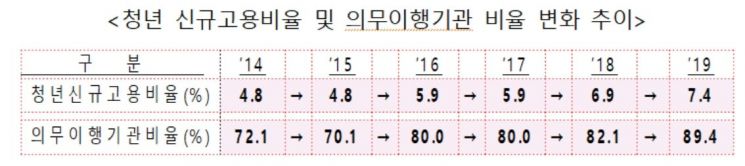
The 47 public institutions that failed to meet the youth employment obligation are disheartened. These include one public enterprise, four quasi-governmental institutions, 28 other public institutions, and 14 local public enterprises. Many of the non-compliant institutions argued that the full implementation of blind recruitment, which makes it impossible to know applicants' ages, prevented them from fulfilling the youth employment obligation. The National Research Council for Economics, Humanities and Social Sciences was listed as a non-compliant institution last year for hiring only one youth (regular employee). A representative from the council said, "We implement blind recruitment to select candidates as fairly as possible based on ability, so we cannot know the age," adding, "The final successful candidate may not be a youth, so it is essentially a matter of chance." They further noted, "Setting age limits to hire more youth could be considered reverse discrimination."
The Korea National Oil Corporation, the only public enterprise on the list, cited the blind recruitment method and budget constraints as reasons. To comply with the obligation, the Oil Corporation needed to hire 42 youth last year. However, the total number of new hires was only 22, so even if all new employees were youth, it was insufficient. A representative said, "Due to the nature of our work, we need to hire skilled technical personnel with experience and knowledge," and added, "Because of blind recruitment, many final successful candidates are not youth." They also said, "Entering an emergency management system, we reduced the organization and cut personnel budgets," explaining, "We have limited capacity to hire multiple new employees."
Problems also arose from applying uniform standards without considering the nature of each institution's work. A representative from the Korea Post Logistics Support Group said, "90% of our staff are field workers driving 11-ton large trucks," and lamented, "We cannot blindly hire youth, and these jobs are not preferred by young people." They also noted that since the postal industry itself is declining, they are only hiring essential personnel. In response, a Ministry of Employment and Labor official said, "It is difficult to accommodate all institutional circumstances," adding, "Public institutions undergoing unavoidable restructuring, such as reducing their workforce by more than 10% compared to the previous year, are designated as exempt from the youth employment obligation system."
© The Asia Business Daily(www.asiae.co.kr). All rights reserved.
![User Who Sold Erroneously Deposited Bitcoins to Repay Debt and Fund Entertainment... What Did the Supreme Court Decide in 2021? [Legal Issue Check]](https://cwcontent.asiae.co.kr/asiaresize/183/2026020910431234020_1770601391.png)