Statistics Korea Announces 2019 Q4 Household Income and Expenditure Survey Results
Lowest Quintile Earned Income Rebounds After 8 Quarters
Meanwhile, Total Business Income Declines for 5 Consecutive Quarters... Longest Period on Record
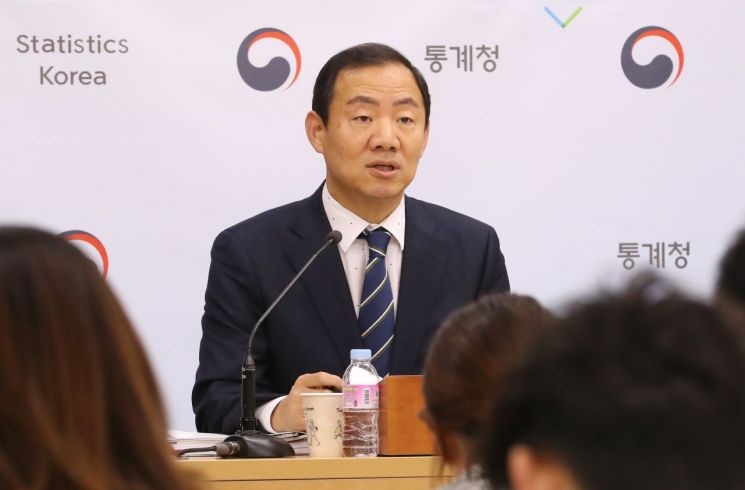 Eun Sunghyun, Director of the Social Statistics Bureau at Statistics Korea. (File photo) [Image source=Yonhap News]
[Sejong=Asia Economy Reporter Ju Sang-don] Due to increases in government job programs and cash welfare benefits such as child allowances and unemployment benefits, i.e., social transfer payments, the earned income of the bottom 20% income group (lowest quintile) recorded an upward trend for the first time in 8 quarters. Accordingly, the 'income quintile ratio,' one of the income distribution indicators, also showed slight improvement.
According to the '2019 Q4 Household Income and Expenditure Survey (Income Section)' released by Statistics Korea on the 20th, the average monthly income of the lowest quintile was 1,324,000 KRW, up 6.9% compared to the same period last year. In particular, earned income increased by 6.5% to 458,400 KRW. This is the first time in 8 quarters since Q4 2017 (+20.7%) that earned income in the lowest quintile has increased year-on-year.
Eun Soon-hyun, Director of the Social Statistics Bureau at Statistics Korea, explained, "The increase in income for the lowest quintile is a combined result of employment growth and various government social transfer payment policies," adding, "The most important factor appears to be the increase in earned income through government job programs."
In fact, the proportion of working households in the lowest quintile rose from 28.5% in Q4 2018 to 29.7% in Q4 last year. The number of employed household members also increased from 0.64 to 0.68 during the same period.
As income in the lowest quintile increased, the 'equivalized disposable income quintile ratio' decreased to 5.26 times. It was 5.47 times in Q4 2018 and 5.37 times in Q3 2019. This indicates a slight easing of income polarization. However, it remains at a high level above 5 times.
On the other hand, business income, which is the income of self-employed individuals, decreased by 2.2%, marking the fifth consecutive quarter of decline?the longest period on record. Director Eun stated, "This appears to reflect sluggish performance in wholesale and retail trade, personal services, and food and accommodation sectors."
In Q4 last year, the average monthly household income was 4,772,000 KRW, up 3.6% year-on-year (3.3% in real terms). Current income increased by 4.0%, earned income and transfer income rose by 5.8% and 3.7%, respectively. Average monthly non-consumption expenditure per household was 1,047,000 KRW, up 9.8%.
© The Asia Business Daily(www.asiae.co.kr). All rights reserved.
![User Who Sold Erroneously Deposited Bitcoins to Repay Debt and Fund Entertainment... What Did the Supreme Court Decide in 2021? [Legal Issue Check]](https://cwcontent.asiae.co.kr/asiaresize/183/2026020910431234020_1770601391.png)















