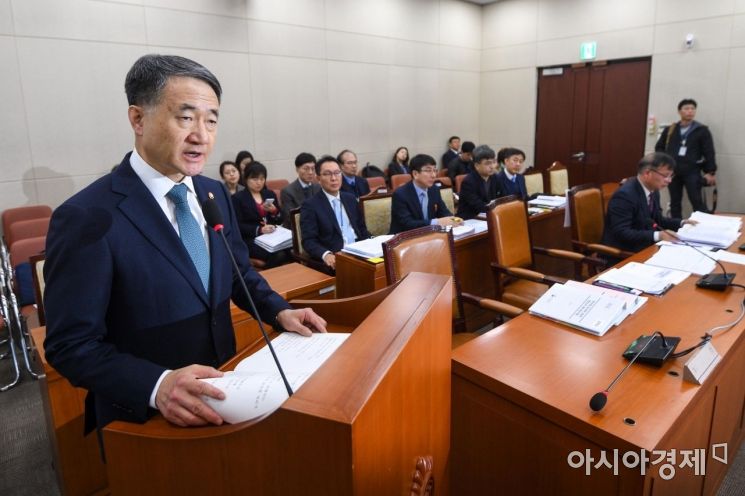
 Minister of Health and Welfare Park Neung-hoo is attending the 'Health and Welfare Committee Plenary Meeting' held at the National Assembly in Yeouido, Seoul on the 18th, reporting on COVID-19./Photo by Jinhyung Kang aymsdream@
[Asia Economy Reporter Wondara] The National Assembly is accelerating the passage of the so-called 'Corona 3 Acts' to respond to the novel coronavirus infection (COVID-19). However, proposals to classify COVID-19 as a first-class infectious disease and to provide emergency financial support to small business owners such as self-employed individuals showed differences between the ruling and opposition parties, so they decided to monitor the situation a bit longer.
The National Assembly's Health and Welfare Committee held a plenary meeting on the 20th to review the amendments to the Quarantine Act, Medical Service Act, and the Infectious Disease Prevention and Control Act, which were passed at the bill subcommittee the previous day. If these bills pass the plenary meeting, they are expected to be passed at the plenary session as early as the 27th. A committee official said, "Although some amendment bills can be submitted to the plenary session 15 days after being referred to the standing committee, considering the seriousness of the situation, the ruling and opposition party secretaries agreed to expedite the process as much as possible."
Since there are no disagreements regarding the Quarantine Act and Medical Service Act, they will be presented to the plenary meeting as originally proposed. The amendment to the Quarantine Act, proposed by Representative Won Yoo-chul of the United Future Party, allows the prohibition of entry and exit of foreigners from infection control areas or those who have passed through such areas. The amendment to the Medical Service Act, proposed by Representative Kim Sang-hee of the Democratic Party of Korea, establishes operational standards that medical institutions must comply with to prevent and block the spread of infectious diseases.
There were disagreements regarding the amendment to the Infectious Disease Act, proposed by Representative Ki Dong-min of the Democratic Party and several others. In particular, concerning compensation for losses, opinions were raised that compensating for losses solely based on the occurrence or passage of infectious disease patients is inappropriate, and that compensation should be limited to cases where the Ministry of Health and Welfare discloses facts such as the movement routes of infectious disease patients. The original proposal anticipated damage to exports, small and medium enterprises, and self-employed individuals due to the COVID-19 situation, so the amendment included compensation for workplaces, corporations, organizations, and nursing institutions.
A committee official said, "Regarding the classification of COVID-19 as a first-class infectious disease, we decided to observe the situation a bit longer, and concerning the compensation for losses, since the Ministry of Strategy and Finance pointed out that it would involve financial burdens, we agreed to monitor the situation and discuss it again later, so it will not be included in this plenary meeting."
However, bills mandating that epidemiological investigators be assigned to local governments, and proposals to grant local governments the authority to impose location tracking requirements?previously under the Minister of Health and Welfare's jurisdiction?passed the bill subcommittee without disagreement for prompt response. The bills also include provisions to temporarily ban the export of pharmaceuticals such as masks, hand sanitizers, and thermal cameras, which had experienced shortages.
© The Asia Business Daily(www.asiae.co.kr). All rights reserved.

















