Apartment Price Trends in the 3rd Week of February by Korea Real Estate Board
Price Rise in Suwon and Yongin Despite Regulatory Pressure
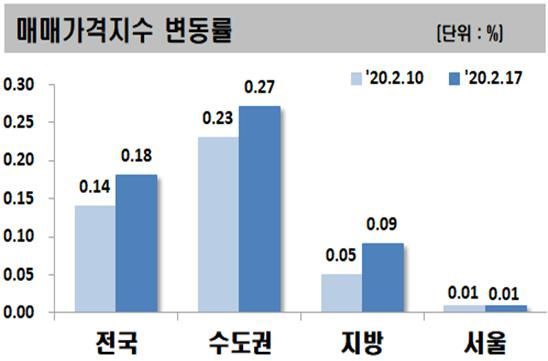
Seoul Prices Increase by Only 0.01% for 3 Consecutive Weeks
[Asia Economy Reporter Moon Jiwon] Apartment prices in the four Gangnam districts of Seoul (Gangnam, Seocho, Songpa, and Gangdong-gu) fell by 0.08% compared to the previous week, widening the decline. As the effects of the December 16 real estate measures take full effect, the government’s decision to introduce additional regulatory proposals is analyzed to be intensifying the downward trend.
On the other hand, in Gyeonggi Province, the upward trend continued mainly in Suwon and Yongin, where prices have recently surged. In particular, prices in Suwon’s Gwonseon-gu and Yeongtong-gu rose by more than 2%, and Guri by over 1%, indicating that the 'balloon effect' is becoming more pronounced despite government regulatory pressure.
According to the Korea Real Estate Board’s 'Weekly Apartment Price Trends for the 3rd Week of February 2020' released on the 20th, apartment prices in the four Gangnam districts fell by 0.08% this week following a 0.05% drop last week.
Songpa-gu saw the largest decline among Seoul’s 25 districts, with prices dropping 0.12%, followed by Gangnam-gu (-0.1%), Seocho-gu (-0.07%), and Yangcheon-gu (-0.02%). The Korea Real Estate Board analyzed, "As supply increased mainly in reconstruction and previously rapidly rising complexes, the decline widened due to the sale of urgent properties in some reconstruction areas (Gaepo Jugong 7, Jangmi complexes)."
Gangdong-gu (0.00%) maintained a stable trend with slight increases in mid-to-low price complexes despite new housing supply. The average apartment price in the 11 districts south of the Han River fell by 0.03%.
North of the Han River, prices rose in relatively affordable small apartments and areas with development prospects, such as Nowon-gu (0.09%) and Dobong-gu (0.06%). Dongdaemun-gu (0.05%) also saw increases mainly around Imun-dong near Jungnangcheon Stream due to development expectations like the undergrounding of Dongbu Expressway and the construction of a new station building at Sinimun Station. Gwangjin-gu (0.00%) mostly showed a wait-and-see stance, shifting from an upward trend to stability.
Seoul maintained a 0.01% increase for three consecutive weeks. With the announcement of institutional measures for housing market stabilization, such as prohibiting price collusion and strengthening investigations into funding sources, some mid-to-low price complexes with low increases rose. However, high-priced housing such as Gangnam area reconstruction complexes declined due to urgent sales, resulting in an overall maintenance of last week’s increase.
Meanwhile, Gyeonggi Province rose by 0.42%, expanding the increase from the previous week (0.39%).
Suwon (1.81%) saw strong upward factors such as being a non-regulated area and transportation benefits from the extension of the Shinbundang Line. Gwonseon-gu (2.46%) saw significant price increases mainly in Homaesil and Geumgok-dong, and Paldal-gu (2.13%) rose sharply mainly in mid-to-low price complexes in Hwaseo and Uman-dong. Yeongtong-gu (1.83%) also increased mainly in Mangpo and Gwanggyo districts.
Yongin (0.76%) saw price increases influenced by development benefits such as the Shinbundang Line, Indeogwon Line, GTX-A, and the SK Hynix industrial complex development. Suji-gu (0.87%) rose mainly in Seongbok and Sanghyeon-dong, and Giheung-gu (0.92%) expanded increases mainly in Sanggal-dong, benefiting from the Shinbundang Line.
Additionally, Hanam (0.23%), Goyang (0.11%), Namyangju (0.17%), and Guri (1.03%) also saw relatively large price increases.
Incheon rose by 0.30%, also expanding the increase from the previous week (0.11%). Prices rose mainly in areas with transportation benefits, good accessibility to Seoul, and high residential comfort. Yeonsu-gu (0.66%) increased mainly in Songdo-dong, Seo-gu (0.36%) in Gajeong-dong and Cheongna New Town, and Bupyeong-gu (0.35%) mainly in Samsan and Cheongcheon-dong.
© The Asia Business Daily(www.asiae.co.kr). All rights reserved.
![User Who Sold Erroneously Deposited Bitcoins to Repay Debt and Fund Entertainment... What Did the Supreme Court Decide in 2021? [Legal Issue Check]](https://cwcontent.asiae.co.kr/asiaresize/183/2026020910431234020_1770601391.png)