Department Stores, Duty-Free Shops, Marts, Hotels, etc.
Temporary Closure if Confirmed Case Visits
At Least 500 Billion KRW in Losses Due to Business Suspension
Massive Losses When Including Small Business Owners
Concerns Over Trillion-KRW Scale Damage in the First Half of the Year
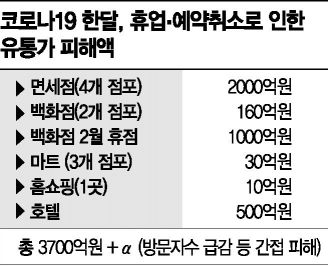
[Asia Economy Reporters Lim Hye-seon, Cha Min-young, Lee Seung-jin] As the novel coronavirus disease (COVID-19) crisis continues for an extended period, it is estimated that the monthly sales decline of domestic distribution companies has exceeded at least 500 billion KRW. Department stores, duty-free shops, marts, and hotels are temporarily closing to prevent further infections once a confirmed patient visit is identified. The sales loss caused by sudden business suspension alone exceeds 300 billion KRW. As people increasingly avoid crowded multi-use facilities and prefer online markets over marts, the total sales of offline distribution companies are estimated to have decreased by 10-50% compared to the same period last year. When adding the losses suffered by small business owners operating dining establishments, the scale of damage snowballs.
According to the distribution industry on the 20th, a total of 10 stores temporarily closed for a month following the first confirmed COVID-19 case in Korea on the 19th of last month. These include 4 duty-free shops, 2 department stores, 3 marts, and 1 hotel. These 10 stores suspended operations for periods ranging from one day to five days. The losses incurred from these closures amount to approximately 310 billion KRW. Particularly, the damage to duty-free shops, which recorded a record-high sales of 25 trillion KRW last year, is the largest. Korea’s top two duty-free shops, Lotte Duty Free and Shilla Duty Free, closed their main downtown stores and Jeju branches. The closure days were 8 days for Lotte Duty Free (3 days at the main store and 5 days at Jeju) and 10 days for Shilla Duty Free (5 days each at the main store and Jeju). Daily sales at Seoul downtown duty-free shops are about 15 to 20 billion KRW. The estimated losses from temporary closures at these duty-free shops are around 100 billion KRW each.
Department stores also suffered damage. Lotte Department Store’s main branch closed for three days starting from the 7th. Since the closure included a weekend, the estimated sales loss exceeds 15 billion KRW. AK Department Store also incurred losses exceeding 1 billion KRW. On the 10th, when all domestic department stores closed for disinfection, sales worth about 100 billion KRW disappeared. Department stores usually have no closure days in February. This year, all stores conducted disinfection for the safety of customers and employees due to the COVID-19 crisis.
Emart, which closed three stores, suffered losses of about 3 billion KRW over eight days. Emart’s daily average sales vary between 400 to 500 million KRW depending on store size. GS Home Shopping incurred losses of about 1 billion KRW over two days replaced by recorded broadcasts. President Hotel closed its accommodation and food and beverage operations for 10 days, resulting in losses of about 1 billion KRW. Lotte Hotel reported losses exceeding 10 billion KRW due to 28,000 room cancellations. The situation at other domestic luxury hotels is similar to Lotte Hotel. The hotel industry estimates that losses from room cancellations during this period exceed 50 billion KRW. Adding the losses of small business owners, the scale of damage is beyond imagination.
The problem lies ahead. As confirmed cases spread into local communities, the crisis is expected to prolong. Losses are expected to increase exponentially. The distribution industry fears that losses exceeding one trillion KRW will materialize in the first half of the year alone. A distribution industry official explained, "Sales at department stores, marts, and supermarkets have decreased by 15%, 10%, and 5%, respectively, compared to the same period last year," adding, "Duty-free shops have seen sales drop by more than 40-50%." He continued, "Domestic consumption is cooling, so sales damage in the first half of this year is inevitable."
Experts believe the economic impact will be greater than during the 2015 Middle East Respiratory Syndrome (MERS) outbreak. Professor Kim Sang-bong of Hansung University’s Department of Economics said, "Due to COVID-19, both private and government consumption have decreased, making the first quarter the worst situation," adding, "With travel restrictions, the service balance in the current account will also be severely affected, and combined, the annual economic growth rate could decrease by 0.25 percentage points." He further stated, "The duration of COVID-19’s spread is crucial. If it continues until April, the impact will extend into the second quarter, potentially causing greater economic damage than during MERS."
© The Asia Business Daily(www.asiae.co.kr). All rights reserved.