20% of All Smartphone Users Fall into the 'Risk Group' for Overdependence
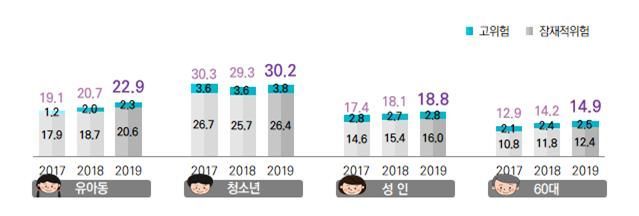
[Asia Economy Reporter Seulgina Jo] "Using a smartphone to soothe a crying child?" The 'smartphone overdependence' among children aged 3 to 9 is becoming increasingly serious. One in five smartphone users in South Korea is identified as being at risk of overdependence, experiencing physical, psychological, and social difficulties due to excessive use. Among young children, this proportion reached 22.9%.
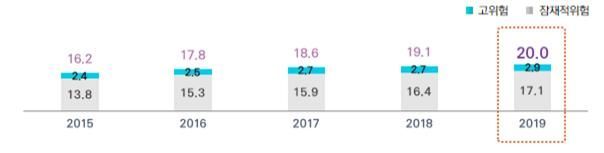
According to the '2019 Smartphone Overdependence Survey' released on the 20th by the Ministry of Science and ICT and the National Information Society Agency, the proportion of smartphone users in South Korea classified as at risk of overdependence (high-risk group + potential risk group) was 20.0%, an increase of 0.9 percentage points from the previous year. The overdependence risk group refers to a state where smartphones become the most prioritized activity in daily life, self-regulation decreases, and problems arise.
By age group, the overdependence risk among young children showed the largest increase, rising by 2.2 percentage points compared to the previous year. The risk groups among adults (ages 20-59) and those in their 60s also maintained an increasing trend at 18.8% and 14.9%, respectively. The proportion of overdependence risk among adolescents (ages 10-19), which had somewhat plateaued in 2018 at 30.2%, has also returned to an upward trend.
A Ministry of Science and ICT official explained, "The risk of overdependence among young children and adolescents was found to be relatively vulnerable when parents themselves are in the overdependence risk group or in dual-income households."
Additionally, 78.7% of survey respondents answered that the smartphone overdependence problem in our society is 'serious.' This has been a rising trend over the past three years. Notably, the overdependence risk group (83.9%) perceives the smartphone overdependence issue in society as more serious than general users (77.5%).
As solutions to resolve overdependence, 'alternative leisure activities' were ranked first when the problem-solving agent was 'individual,' 'guidance and warning messages about excessive use' when it was 'companies,' and 'education to resolve smartphone overdependence' when it was 'government.'
Furthermore, the rate of experience with smartphone overdependence prevention education was 18.7%, an increase of 0.9 percentage points from the previous year. Among those who experienced prevention education, the proportion who responded that it was 'helpful' also increased by 5.9 percentage points to 70.6%.
Based on the results of this survey, the Ministry of Science and ICT plans to strengthen prevention education, professional counseling, and public-private cooperation projects through 'Smart Sleep Centers' operating in 17 cities and provinces nationwide to prevent and resolve smartphone overdependence. In particular, considering the significant increase in the overdependence risk rate among young children, they plan to expand experiential prevention education targeting young children to help form proper smartphone usage habits early on.
Park Yoon-gyu, Director of Information and Communication Policy at the Ministry of Science and ICT, stated, "In the digital age, where exposure to various digital devices such as smartphones is increasing, it is necessary for us to reflect on whether we are excessively dependent on digital devices." He added, "The government will focus on supporting individuals to use smartphones beneficially without disrupting daily life by promoting tailored prevention education by life cycle, developing overdependence prevention content, and enhancing public-private cooperation awareness activities through multifaceted policies."
© The Asia Business Daily(www.asiae.co.kr). All rights reserved.
![Clutching a Stolen Dior Bag, Saying "I Hate Being Poor but Real"... The Grotesque Con of a "Human Knockoff" [Slate]](https://cwcontent.asiae.co.kr/asiaresize/183/2026021902243444107_1771435474.jpg)

















