Air Purification + Bacteria Blocking 'H Clean Alpha (Clean α) 2.0'
First Proposed in Hannam 3... Applied to All Hyundai Construction Apartments for Sale This Quarter
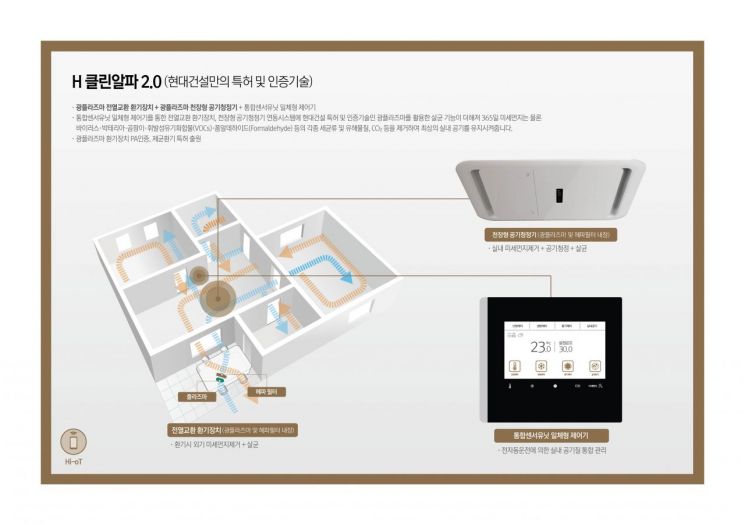
[Asia Economy Reporter Yuri Kim] Hyundai Engineering & Construction announced on the 20th that it has made the first proposal to apply the air purification and virus sterilization ventilation system, 'H Clean Alpha 2.0,' at 'Hannam 3 District' in Yongsan-gu, Seoul. This is a household ventilation system that combines air purification functions to reduce ultrafine dust with virus and bacteria removal technology, and Hyundai Engineering & Construction is the first in the world to develop it.
Hyundai Engineering & Construction stated, "We will enhance our technological competitiveness by making the first proposal of our patented technology, H Clean Alpha 2.0, at the Hannam 3 District redevelopment site," and added, "It will also be provided as a standard or paid option in future D.H., Hillstate complexes, officetels, and more."
Last year, Hyundai Engineering & Construction introduced 'H Clean Alpha,' which offers H Clean Entrance, H i-Soup, and harmful substance-absorbing wallpaper. The enhanced H Clean Alpha 2.0 system additionally removes ultrafine dust as well as viruses, bacteria, mold, volatile organic compounds (VOCs), and formaldehyde that cannot be removed by HEPA filters. It minimizes contamination inside ventilation systems and air conditioning equipment in commercial, medical, and complex facilities. It is also useful for improving indoor air quality and equipment performance.
It incorporates energy-saving proven photo plasma technology. Photo plasma technology rapidly decomposes various airborne bacteria, viruses, odors, and other pollutants in real time through chain reactions of hydroxide ions (OH-), oxygen ions, and others generated by photo plasma produced at room temperature by vacuum ultraviolet (VUV), ultraviolet germicidal irradiation (UVGI), and visible light (VR) wavelengths. According to test results from the Korea Testing Laboratory, removal performance was confirmed at 96.3% for airborne viruses, 99.2% for airborne bacteria, 82.3% for formaldehyde, and 90% for ammonia and acetic acid. According to the PA certification test results from the Korea Ozone Ultraviolet Association, the maximum detected ozone concentration was 0.003 PPM. This is lower than the ozone concentration in general atmospheric air and even lower than natural ozone concentrations in forests and coastal areas.
A Hyundai Engineering & Construction official said, "There is great national concern about the novel coronavirus infection (COVID-19) and ultrafine dust," and added, "We aim to provide a 'clean life' in all residential spaces offered by Hyundai Engineering & Construction." He continued, "We plan to continue developing and applying various technologies to reduce ultrafine dust and to sterilize and suppress the proliferation of microorganisms that can cause infectious diseases."
© The Asia Business Daily(www.asiae.co.kr). All rights reserved.
![Clutching a Stolen Dior Bag, Saying "I Hate Being Poor but Real"... The Grotesque Con of a "Human Knockoff" [Slate]](https://cwcontent.asiae.co.kr/asiaresize/183/2026021902243444107_1771435474.jpg)
















