Ministry of Oceans and Fisheries, 'Plan to Promote Smart Export-Import Logistics'
[Sejong=Asia Economy Reporter Joo Sang-don] The government has decided to elevate the competitiveness of import-export logistics into the top 10 worldwide by 2030 through the intelligence of applying IT-based 4th Industrial Revolution technologies across the entire import-export logistics process.
On the morning of the 20th, the government reviewed and finalized the Ministry of Oceans and Fisheries' "Import-Export Logistics Smartization Promotion Plan" at the 101st Government Policy Issue Inspection and Coordination Meeting held at the Government Seoul Office, chaired by Prime Minister Chung Sye-kyun.
Although South Korea's trade dependency rate reaches 70.4%, its import-export logistics competitiveness lags behind advanced countries due to inefficiencies in coordination between logistics entities and facilities and the lack of a logistics efficiency system based on logistics data collection and analysis. According to the World Bank, South Korea ranked only 25th out of 167 countries worldwide in import-export logistics competitiveness as of 2018. This is lower than countries such as the United Arab Emirates (11th), Spain (17th), Czech Republic (22nd), and Luxembourg (24th). Accordingly, the government aims to raise South Korea's import-export logistics competitiveness into the top 10 globally by 2030 by promoting ▲strengthening the linkage of import-export logistics infrastructure ▲data-driven logistics smartization ▲training smart logistics personnel and companies ▲leading the international digital logistics environment.
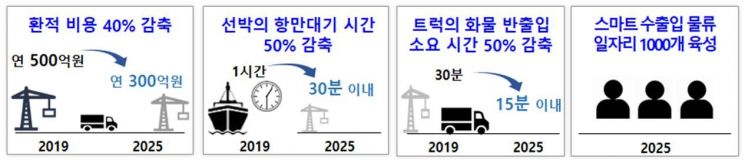
The core of this plan is strengthening logistics infrastructure. Park Jun-young, Director General of the Ministry of Oceans and Fisheries, stated, "The first criterion in evaluating import-export competitiveness is infrastructure," and explained, "Through revolutionary improvements in infrastructure, by 2025, we will reduce ship port waiting times and truck cargo loading/unloading times by half, cut transshipment costs by 40%, establish 300 logistics startups, and create 1,000 jobs."
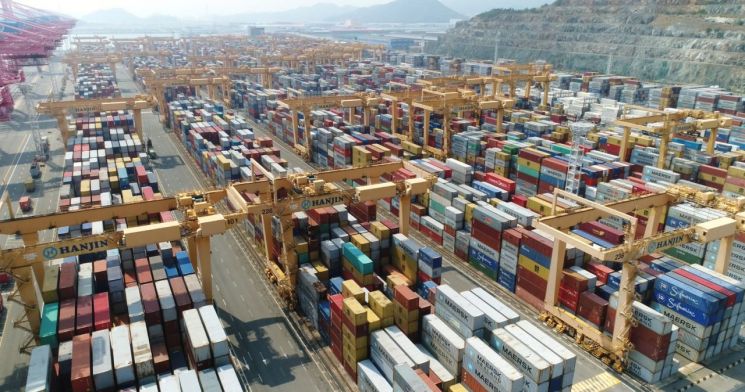
◆Creating 'Smart Ports' = First, the Ministry of Oceans and Fisheries will secure South Korea's technological capabilities by independently developing port automation technologies and promote their phased introduction. Additionally, it plans to support terminal operators in establishing optimal port operation plans by collecting and analyzing real-time location, status, and work information of port equipment such as cranes and yard tractors.
At Busan Port, a circular rail will be installed to transport transshipment cargo and empty containers between terminals, and the necessary paperwork will be handled through a blockchain platform as part of a terminal linkage efficiency project. This aims to reduce time, costs, and congestion related to transshipment. Furthermore, a shared empty container yard used jointly by terminal operators will be established, and a demand-supply matching platform will be provided to resolve mismatches in empty container supply and demand among operators.
Alongside this, the plan includes providing predictive information on port availability times and cargo handling completion times for ships and trucks to reduce port waiting times and improve operational efficiency. It will also promote the development of a linkage model between the port automated cargo handling system (Ministry of Oceans and Fisheries) and container shuttle rail (Ministry of Land, Infrastructure and Transport) to enhance connectivity between land and sea logistics.
◆Introducing an Integrated Port Information Platform = Data-driven logistics smartization will also be pursued. To this end, the Ministry of Oceans and Fisheries, Korea Customs Service, and terminal operators will improve the accuracy of port logistics data through cross-verification and data quality management. They will jointly review with related ministries the introduction of an "Integrated Port Information Platform" that shares real-time cargo handling status, quarantine, and customs clearance information within the port. Additionally, if the "Land Logistics Data Platform Project" (currently undergoing preliminary feasibility study) under review by the Ministry of Land, Infrastructure and Transport proceeds, it will be linked with the port logistics data platform.
In fact, the Port of Rotterdam in the Netherlands saves approximately 250 million euros annually by providing shipping companies, port authorities, and customs with cargo arrival and departure, cargo handling, and customs information through an integrated port information platform, sharing port operation status among port users and reducing costs related to 30 million phone calls and 100 million emails.
Moreover, the government plans to build a public-private linked logistics platform that combines public logistics data with private logistics data, laying the foundation for discovering new businesses based on logistics data.
◆Training Smart Logistics Personnel and Leading International Standards = In the future, as logistics infrastructure such as ships and ports becomes automated and intelligent, the government will identify the capabilities required for new logistics and seafarer personnel and consider introducing related educational programs and professional qualification systems. It will also operate a comprehensive support program for logistics startup creation, covering all stages from new startup item development to expert consulting, advanced technology development for promising business items, and promotion and market access support.
Customized support measures will be prepared to enable small-scale logistics companies without investment capacity for digitalization to manage data and use platform services, and a dedicated public-private corporate digital transformation task force (TF) will be formed and operated for this purpose.
The government plans to actively participate in discussions on the establishment and revision of international standards related to advanced equipment and logistics data, such as autonomous ships and intelligent maritime traffic systems. In particular, it will expand the scope of the international governance system related to e-Navigation, which South Korea is leading, to include autonomous ships, ports, and maritime services, and establish a testbed to demonstrate linked services in actual sea areas. Additionally, it will promote plans to build an international maritime digital cluster centered on a center responsible for international certification of various technical standards.
Minister of Oceans and Fisheries Moon Sung-hyuk said, "This import-export logistics smartization promotion plan is a strategy to secure import-export logistics competitiveness befitting South Korea's status as a global trading nation," and added, "If this plan is implemented smoothly, we expect not only improved import-export logistics competitiveness but also significant economic ripple effects."
© The Asia Business Daily(www.asiae.co.kr). All rights reserved.
![Clutching a Stolen Dior Bag, Saying "I Hate Being Poor but Real"... The Grotesque Con of a "Human Knockoff" [Slate]](https://cwcontent.asiae.co.kr/asiaresize/183/2026021902243444107_1771435474.jpg)

















