Announcement of 50 Local Livelihood Regulation Innovation Measures Including Regional Development, Daily Life Inconveniences, and Business Burdens
[Asia Economy Reporter Kwangho Lee] The government has decided to allow the establishment of agricultural and industrial complexes in forest protection zones in Yeonggwang-gun, Jeollanam-do. Additionally, agricultural machinery repair shops will be permitted to open in agricultural and forestry areas in Hongseong-gun, Chungcheongnam-do.
On the 20th, the government held a National Affairs Inspection and Coordination Meeting chaired by Prime Minister Jeong Seyeon at the Government Seoul Office, where it discussed and finalized 50 items of the "Regional Livelihood Regulation Innovation Plan," including these measures.
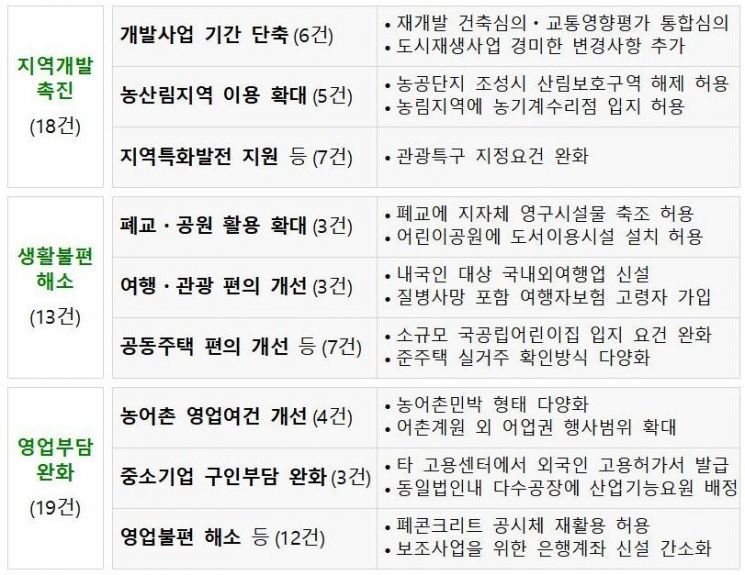
Through simplification of development project procedures and rationalization of agricultural and forestry area usage, 18 regulations that restrict regional development will be eased, and 13 regulations causing inconvenience in residents' daily lives will be improved. Furthermore, 19 business burden regulations that limit income and business activities of rural residents and small and medium enterprises will also be relaxed.
To implement these improvement tasks, 10 legal amendments, 24 revisions to enforcement decrees, enforcement rules, and administrative rules, 3 legal interpretations, and 13 administrative measures (internal guidelines, system improvements, etc.) are required. The government encouraged ministries to take legislative and administrative actions promptly to ensure swift implementation and tangible effects, and 18 of these follow-up measures have already been completed.
First, the establishment of agricultural and industrial complexes will be allowed in the forest protection zone of Muryang-myeon, Yeonggwang-gun, Jeollanam-do, covering an area of 210,000 square meters. In the future, the designation cancellation of forest protection zones will be included as a reason when establishing agricultural and industrial complexes to facilitate smooth project progress.
Additionally, agricultural machinery repair shops will be permitted to open in agricultural and forestry areas in Hongseong-gun, Chungcheongnam-do. Although repair shops need to be close to agricultural sites, they have been prohibited from opening in agricultural and forestry areas, causing inconvenience to both repair operators and farmers. Relevant laws will be revised to allow agricultural machinery repair shops to open throughout all agricultural and forestry areas.
Requirements for designating tourism special zones will also be relaxed. Yeosu City in Jeollanam-do had been pursuing designation of tourism special zones around the Expo site and Odongdo area, but designation was impossible because more than 10% of the area consisted of forest land and farmland due to regional characteristics. The system will be improved to allow forest land and farmland to be considered tourism land regardless of land category if actually used for tourism purposes, enabling designation as tourism special zones.
Along with this, the use of closed schools and parks will be expanded to alleviate daily inconveniences. Under the current Closed School Utilization Act, most uses are limited to existing buildings, making it difficult to install permanent facilities such as community sports facilities on closed school sites even for public purposes. Going forward, local governments and others will be allowed to install permanent facilities on closed school sites for public purposes. Therefore, the construction of community sports facilities on closed school sites promoted by Yongin City and the Gyeonggi Provincial Office of Education is expected to accelerate.
Moreover, a small-scale library facility will be established in Namoe-dong Children's Park in Jung-gu, Ulsan, which is being promoted at the request of parents. The government decided to permit this, judging that the existing regulations did not reflect the current leisure culture of children.
In addition, the system for travel agencies with restricted business scopes will be rationalized by establishing domestic and international travel agencies, and regulations related to travel insurance enrollment for the elderly will be eased. Location requirements for small-scale national and public daycare centers will be relaxed, and methods for verifying actual residence in officetels (quasi-housing) subject to rental business will be diversified. Regulations on rural homestay facility standards will also be eased.
A government official stated, "This year, we will focus on revitalizing the regional economy by discovering and improving regulations related to local pending projects by region," adding, "In addition to central government regulatory laws, we plan to simultaneously revise local government autonomous regulations (ordinances and rules) that excessively burden and inconvenience residents."
© The Asia Business Daily(www.asiae.co.kr). All rights reserved.

















