[Asia Economy Reporter Seungjin Lee] The popularity of small weddings is fading, and practical weddings are gaining attention once again.
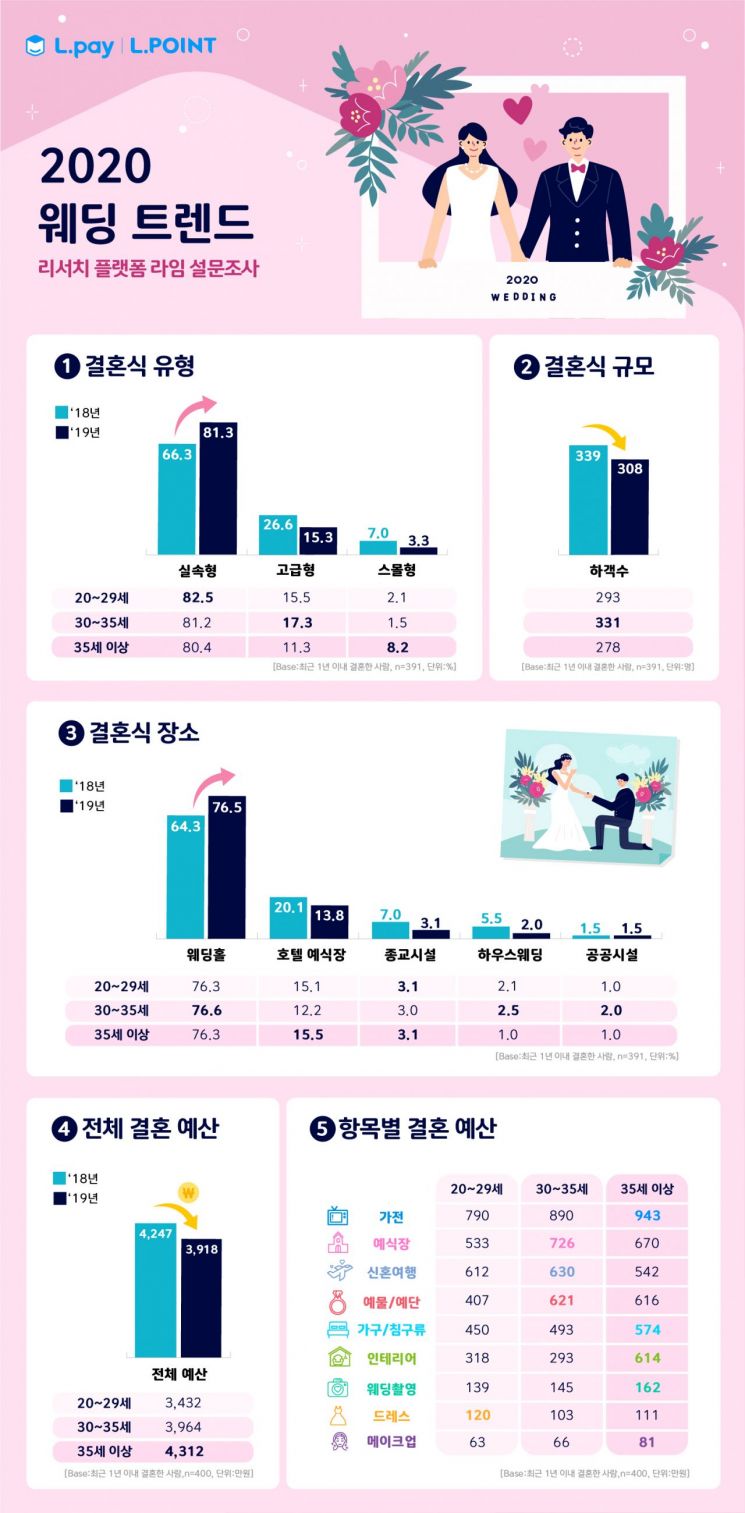
According to the '2020 Wedding Trends' survey conducted by Lotte Members' research platform Lime on 400 men and women in their 20s and 30s last year, 81.3% of those who got married last year chose practical weddings. This is a 15 percentage point increase compared to the previous year.
Luxury weddings accounted for 15.3%, and small weddings 3.3%, with response rates decreasing by 11.3 percentage points and 3.7 percentage points respectively compared to 2018. The average number of wedding guests also decreased from 339 in 2018 to 308 last year.
In the case of small weddings, rather than being conducted frugally, many are held as small but luxurious weddings through house wedding halls or hotel restaurant rentals, photographer snap shoots, and overseas direct purchases of dresses, which is analyzed to have caused a loss of popularity in terms of cost.
As practical weddings increased, the popularity of general wedding halls also rose again. Among respondents, the proportion choosing wedding halls increased by 12.2 percentage points from the previous year to 76.5%. During the same period, the use of hotel banquet halls (13.8%), religious facilities (3.1%), and house weddings (2.0%) all decreased. The average cost of wedding venues also dropped by 1.47 million KRW compared to 2018.
The overall wedding expenses were also surveyed to have decreased by about 3.29 million KRW compared to 2018, with an average spending of 39.18 million KRW. By category, the highest amount was spent on home appliances, averaging 8.78 million KRW. This was followed by wedding venues (6.63 million KRW), honeymoons (6.04 million KRW), wedding gifts and dowries (5.66 million KRW), furniture and bedding (5.02 million KRW), and interior design (3.79 million KRW).
The cost of purchasing home appliances for those who married last year increased by an average of 700,000 KRW compared to the previous year. On the other hand, expenses for wedding gifts and dowries decreased by 1.16 million KRW, furniture and bedding by 340,000 KRW, and interior design by 1.25 million KRW. This reflects a practical wedding trend focusing more on personal needs rather than the views or evaluations of others when preparing for marriage.
However, for the late marriage group aged 35 and older, the average wedding cost was about 4 million KRW higher than the average, at 43.12 million KRW. With relatively more financial leeway, they spent more than other age groups not only on home appliances (9.43 million KRW) but also on interior design (6.14 million KRW) and furniture and bedding (5.74 million KRW).
The increased proportion of home appliances in the wedding budget is also attributed to the popularity of new appliances that reduce household labor. According to last year's L.POINT transaction data analysis, among home appliances, new appliances that reduce household chores showed remarkable purchase growth rates: robot vacuum cleaners (219%), dishwashers (213%), dryers (157%), wet mop vacuum cleaners (61%), and clothing care devices (43%).
Hwang Yoon-hee, head of Lotte Members' Data Analytics Division, said, “The concept of the appropriate age for marriage is becoming increasingly ambiguous, and society is changing to one where individuals decide their own marriage status and timing.” She added, “Among those aged 35 and older, there is still demand for small and luxury weddings, and many start with their own homes, leading to more investment in interior design and premium home appliance purchases. It is expected that the polarization of consumption in the wedding market will become more pronounced in the future.”
© The Asia Business Daily(www.asiae.co.kr). All rights reserved.
![User Who Sold Erroneously Deposited Bitcoins to Repay Debt and Fund Entertainment... What Did the Supreme Court Decide in 2021? [Legal Issue Check]](https://cwcontent.asiae.co.kr/asiaresize/183/2026020910431234020_1770601391.png)















