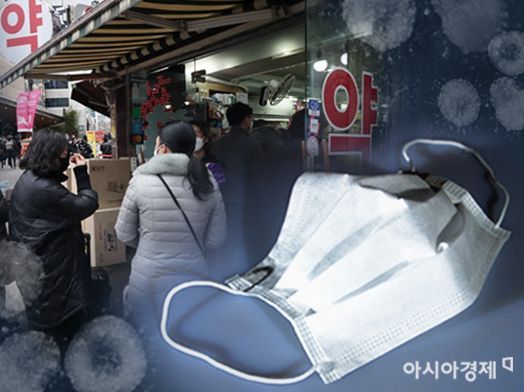
[Asia Economy Reporter Kim Heung-soon] The 31st confirmed domestic case of the novel coronavirus infection (COVID-19) in Daegu (born 1959, Korean female) is suspected to be a 'super-spreader' who infected multiple people alone. This suspicion arises because it was confirmed that she exhibited symptoms and visited multiple-use facilities such as medical institutions, hotels, and churches. On the 19th alone, up to 13 confirmed cases related to this patient occurred within the region. Although health authorities state that it is difficult to definitively identify the source of infection without an in-depth investigation, criticism is expected as it was reported that this patient refused the medical staff's recommendation for COVID-19 diagnostic tests twice, potentially accelerating the virus's spread.
Visited Church with Hundreds Twice, Possible Infection Source Emerges
According to Daegu city and health authorities as of 2 p.m. that day, out of 15 additional confirmed COVID-19 cases in Korea, 13 were from the Daegu and Gyeongbuk regions. Among them, 11 were confirmed to be related to patient 31, and the connection of 2 others is under investigation. Health authorities confirmed that this patient developed chills on the 7th and designated that day as the symptom onset date. According to related regulations, movements and contacts were primarily identified from the day before symptom onset, the 6th, until the quarantine date on the 17th.
Patient 31, who was first confirmed in the Yeongnam region the previous day, had a traffic accident and was admitted to Saeronan Korean Medicine Hospital in Beomeo-dong, Daegu, on the 7th. From then until her quarantine the day before, she moved extensively within the region, visiting churches and hotels. It was identified that she came into contact with hundreds of church members at the Shincheonji Daegu Church sanctuary on the 9th and 16th. Approximately 460 members attended the service on the 16th, while the number of attendees on the 9th is still being determined. The number of people gathered at the sanctuary on the 16th alone exceeds the number of contacts of previous COVID-19 patients. Until now, patient 16 (born 1977, Korean female) had the highest number of contacts at 450.
Since this patient attended services at a church where large numbers gathered and multiple confirmed cases emerged there, the number of contacts and confirmed cases is likely to increase. Health authorities stated, "Among the additional confirmed cases related to patient 31, 10 are Shincheonji church members, 1 is a hospital contact, and 2 are under investigation for connection."
Jung Eun-kyung, Director of the Korea Centers for Disease Control and Prevention, said, "Some of the church contacts currently show symptoms, and more patients may emerge. We are discussing plans with the special task force and Daegu city to conduct selective and diagnostic testing for church contacts and the entire church."
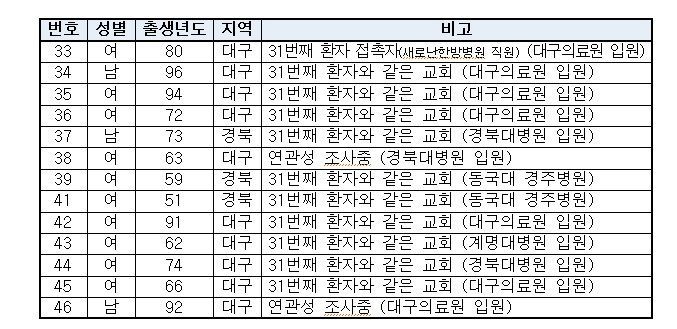 Isolation Status of Additional Confirmed Cases Related to Patient No. 31 [Data from the Central Disease Control Headquarters]
Refused Diagnostic Tests Twice, Why Was Enforcement Not Possible?
The issue is that large-scale contacts such as church visits could have been prevented in advance. Patient 31 reportedly showed fever symptoms on the 10th while hospitalized at the Korean medicine hospital. Although the flu test conducted by the attending medical staff showed no abnormalities, the fever persisted, and an additional test was conducted on the 14th, which confirmed pneumonia.
The medical staff, considering the possibility of COVID-19 infection, recommended twice that patient 31 be transferred to another hospital for diagnostic testing. However, the patient refused the tests, stating, "I have no history of overseas travel and have not been in contact with confirmed cases." The date she visited a screening clinic and underwent testing was the 17th, when the medical staff made their third recommendation. Meanwhile, she had already visited churches and hotels, significantly increasing the number of contacts and causing a rapid rise in additional confirmed cases.
According to Article 42 of the Infectious Disease Control and Prevention Act, for suspected patients of first-class infectious diseases or highly contagious infectious diseases, the Minister of Health and Welfare, provincial governors, or city/county/district heads may order investigations and examinations through responsible officials. If recognized as a patient, treatment and hospitalization can be enforced. If a suspected patient refuses such measures, a fine of up to 3 million KRW may be imposed. COVID-19 is currently managed as a first-class infectious disease by authorities, so this provision applies.
However, Director Jung stated, "Patient 31 had no history of travel to China or contact with confirmed patients, and symptoms were mild, so COVID-19 infection was not suspected." She added, "Enforcement under the compulsory disposition clause cannot be led by medical institutions but is authorized to mayors, county governors, or district heads," suggesting that it was difficult for medical institutions to enforce testing.
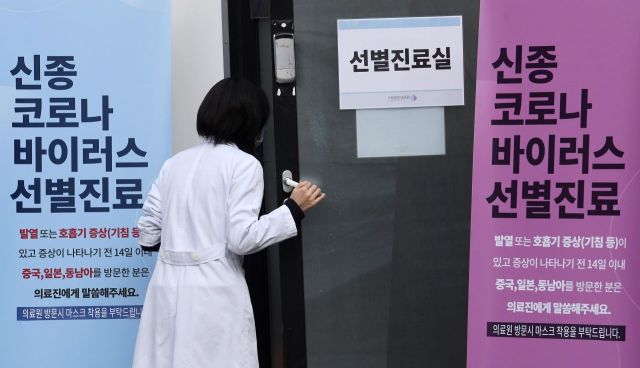 Medical staff are busy working at the screening clinic of the National Medical Center in Jung-gu, Seoul. Photo by Hyunmin Kim kimhyun81@
Cluster Outbreaks Confirmed Overseas as Well, What Are the Alternatives?
In Singapore, there was also a case where many people who attended church services together were infected with COVID-19. A total of 21 people, including a pastor, staff, and their families from a specific church, were confirmed positive. This accounts for more than a quarter of the total confirmed cases (81) in Singapore to date.
Director Jung said, "(The church patient 31 attended) was a densely packed environment where worship took place, so it is presumed that close contact occurred extensively," adding, "It is still difficult to definitively conclude that patient 31 is the source of infection." She further stated, "A broader investigation is needed to confirm the onset date and analyze the overall transmission pattern."
Health authorities also plan to revise the COVID-19 response guidelines (6th edition) to be applied from the 20th. Since the 7th, even without overseas travel history, doctors have been allowed discretion to conduct COVID-19 tests if symptoms are suspicious. The revised guidelines will include provisions to proactively hospitalize patients admitted with unexplained pneumonia in negative pressure rooms or single rooms and conduct COVID-19 testing. Director Jung explained, "We clarified the definition of 'patients with unexplained pneumonia requiring hospitalization based on a doctor's opinion' and proposed clearer measures for proactive isolation and testing."
Meanwhile, rumors spread online that patient 31 caused a disturbance demanding discharge from Daegu Medical Center, where she was quarantined, and that many church members flocked to the hospital. Police and health authorities stated, "Investigations revealed these were fake news," and confirmed, "Patient 31 is receiving proper treatment."
© The Asia Business Daily(www.asiae.co.kr). All rights reserved.
![User Who Sold Erroneously Deposited Bitcoins to Repay Debt and Fund Entertainment... What Did the Supreme Court Decide in 2021? [Legal Issue Check]](https://cwcontent.asiae.co.kr/asiaresize/183/2026020910431234020_1770601391.png)

















