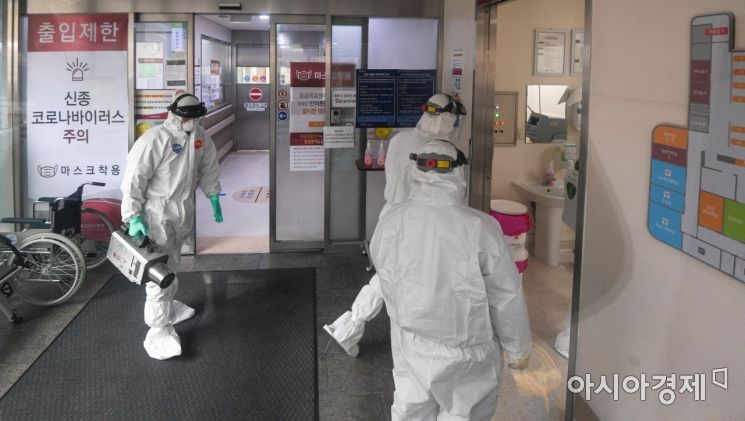
 On the 16th, after closing the emergency room of Korea University Hospital in Seongbuk-gu, Seoul, where the 29th COVID-19 patient had visited, disinfection measures were initiated. Photo by Jinhyung Kang aymsdream@
[Asia Economy Reporters Choi Dae-yeol and Kim Heung-soon] To assist frontline hospitals and clinics facing difficulties due to the novel coronavirus disease (COVID-19), the government has decided to promote an early payment plan for health insurance benefits.
On the 19th, the Central Disaster and Safety Countermeasures Headquarters announced that it had finalized support measures for medical institutions, including the implementation of a special early payment system for health insurance. This measure was prepared amid concerns that frontline small and medium-sized hospitals and clinics might experience a decrease in patients due to the spread of COVID-19, making it difficult to stably manage employee salaries and facility rental fees.
Accordingly, when frontline medical institutions submit claims for benefits, they will receive 90% of the benefit amount within 10 days after only the claim confirmation process is completed, before the full review is finished. After the review is completed, a post-settlement will be conducted reflecting the results. Typically, it takes up to 22 days (15 days for review and 7 days for payment) after a medical institution submits a claim, but with this special measure, the period will be reduced by more than half to about 10 days.
Additionally, measures are being promoted to allow care institutions to focus their capabilities on treating infected patients and preventing further spread. This involves improvements to the reporting system related to personnel and facilities under the differential fee system. The differential fee system is a system that applies differentiated health insurance fees based on the level of resource input such as medical personnel to improve the quality of medical services (e.g., differentiated nursing management fees for inpatient rooms, additional fees for dedicated specialists in intensive care units, infection prevention management fees, etc.). It was decided to allow the application of the personnel status reported for the fourth quarter of last year as is for the upcoming first quarter personnel status report this year.
Reporting of personnel changes, which must be done as needed, can also be exempted in cases related to COVID-19 response or medical staff quarantine. Furthermore, the intensive review period for brain and cerebrovascular magnetic resonance imaging (MRI), originally scheduled to begin next month, will be postponed. The Central Disaster and Safety Countermeasures Headquarters stated, "The intensive review, which could exacerbate difficulties in the medical field such as on-site inspections and claim amount adjustments, will be temporarily postponed, and for institutions showing abnormal claim trends, efforts to encourage voluntary improvement will be promoted through providing claim status information."
© The Asia Business Daily(www.asiae.co.kr). All rights reserved.
![User Who Sold Erroneously Deposited Bitcoins to Repay Debt and Fund Entertainment... What Did the Supreme Court Decide in 2021? [Legal Issue Check]](https://cwcontent.asiae.co.kr/asiaresize/183/2026020910431234020_1770601391.png)
















