Additional Investment Attraction and Full-Scale Business Expansion Possible
Attention on Tada Ban Law Passage in February Extraordinary National Assembly Ahead of General Election
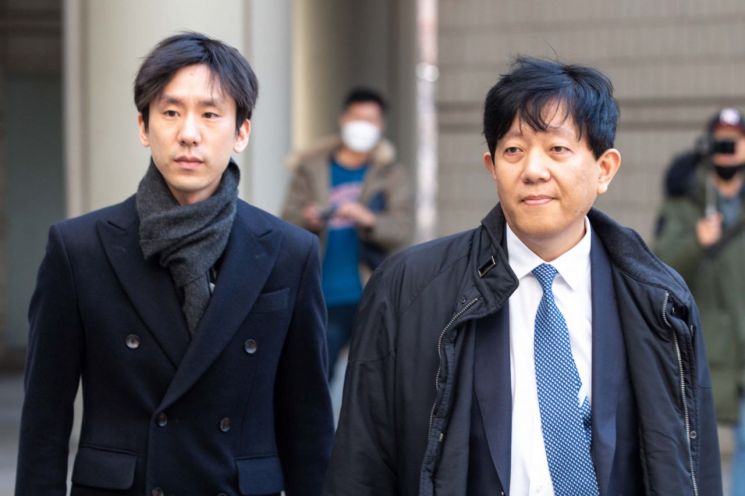 Lee Jae-woong, CEO of Socar (right), and Park Jae-wook, CEO of VCNC / Photo by Jin-hyung Kang aymsdream@
[Asia Economy Reporter Jin-gyu Lee] The court's acquittal of the van-hailing service 'Tada' has brought a sigh of relief to Lee Jae-woong, CEO of Socar. However, another upheaval seems inevitable as the amendment to the Passenger Transport Service Act, known as the 'Tada Ban Act,' is likely to be processed in the February extraordinary session of the National Assembly.
◆ A sigh of relief for additional investment attraction and business expansion = On the 19th, Judge Park Sang-gu of the Seoul Central District Court Criminal Division 18 acquitted Lee, the CEO, and Park Jae-wook, CEO of VCNC, who were indicted for violating the Passenger Transport Service Act. With this ruling, Tada has eased concerns as it can now attract additional investment and expand its business in earnest. However, since appeals and final court decisions are still pending, it is difficult to make a premature judgment. Kim Kyung-hwan, lead attorney at Minhoo Law Firm, explained, "This acquittal means there will be no disruption to Tada's management. However, we must wait for the Supreme Court's ruling on this case."
Nonetheless, apart from the judiciary's decision, Tada is also closely watching the February extraordinary session of the National Assembly. The fate of Tada is expected to hinge on whether the amendment to the Passenger Transport Service Act, proposed by Park Hong-geun of the Democratic Party of Korea in October last year, passes the plenary session. Currently pending at the National Assembly's Legislation and Judiciary Committee, this amendment stipulates that when renting a van with 11 to 15 seats, driver dispatch is only allowed if rented for six hours or more for tourism purposes or if the return location is an airport or port. If this amendment passes the plenary session, the current Tada service will become impossible in South Korea.
With less than two months until the April general election, lawmakers are inevitably sensitive to the taxi industry's votes, so the possibility of the bill being swiftly passed in the February extraordinary session cannot be ruled out. Especially, the taxi industry, which strongly opposes Tada, is expected to increase pressure to pass the Tada Ban Act following this acquittal. Since the February extraordinary session is effectively the last session of the 20th National Assembly, if the bill does not pass this time, it will be automatically discarded.
◆ A clash expected in the February extraordinary session = On the 7th, Representative Park stated, "The amendment to the Passenger Transport Service Act that I proposed is not the Tada Ban Act but a Taxi Innovation Act," emphasizing, "The Passenger Transport Service Act currently under review by the Legislation and Judiciary Committee must be passed during this extraordinary session." Independent lawmaker Kim Kyung-jin also argued, "The Passenger Transport Service Act completely prohibits dispatching drivers to those who rent rental cars," adding, "Its purpose is to ban reckless taxi operations using rental cars."
On the other hand, CEO Lee posted on his Facebook, "If the 'Park Hong-geun Act,' the Tada Ban Act, passes, Tada will have to close before even starting," urging, "The Ministry of Land, Infrastructure and Transport and the Democratic Party should acknowledge that this is a flawed bill, scrap this amendment, and create policies that promote new mobility and increase consumer choice." He also criticized, "What is the reason or justification for banning Tada for taxi innovation? Are they not interested in public convenience, innovative growth, job creation, or economic vitality, but only in expanding the interests of some large corporations or taxi operators?"
© The Asia Business Daily(www.asiae.co.kr). All rights reserved.
![User Who Sold Erroneously Deposited Bitcoins to Repay Debt and Fund Entertainment... What Did the Supreme Court Decide in 2021? [Legal Issue Check]](https://cwcontent.asiae.co.kr/asiaresize/183/2026020910431234020_1770601391.png)















