Increase in New SPAC Listings and SPAC Merger Listed Companies Since Early Year
Kyobo9 SPAC, Mirae Asset Daewoo SPAC4, and Others Hit Consecutive 52-Week Highs
[Asia Economy Reporter Song Hwajeong] Recently, with the continued mergers and listings of Special Purpose Acquisition Companies (SPACs), their stock prices have been showing strong performance. The advantage of being able to secure stable profits has highlighted their appeal, increasing investor interest.
According to the Korea Exchange on the 19th, Kyobo No.9 SPAC, Mirae Asset Daewoo SPAC No.4, Shinhan No.6 SPAC, IBK No.12 SPAC, and Hana Financial No.11 SPAC all recorded new 52-week intraday highs. Hana Financial No.11 SPAC, which had its trading suspended since the end of November last year due to a preliminary listing review, hit the daily upper limit on the day trading resumed on the 14th and saw a significant rise in its stock price over the following three days.
The strong stock performance of SPACs is interpreted as a result of recent mergers and subsequent listings. Hana Financial No.11 SPAC received approval from the Exchange on the 13th for the preliminary listing review of its merger with Kainosmed, a KONEX-listed company. Accordingly, it is scheduled to be listed on the KOSDAQ market on May 6. Kainosmed is a company developing new drugs for degenerative brain diseases, viral diseases, and cancer, recently focusing on the development of a Parkinson's disease treatment (KM-819).
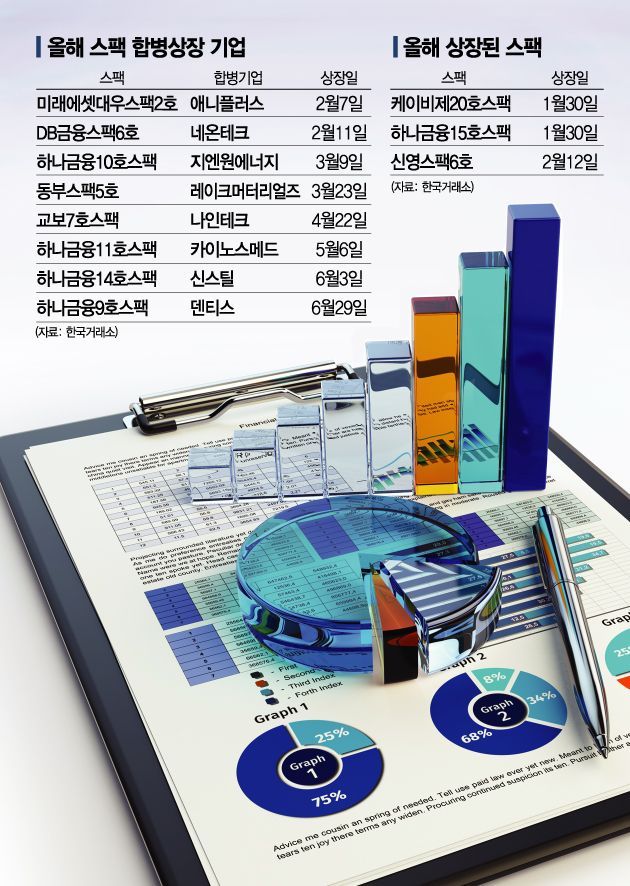
On the 7th, Mirae Asset Daewoo SPAC No.2 merged and listed with Aniplus, and on the 11th, DB Financial SPAC No.6 merged and listed with NeonTech. More SPAC merger listings are scheduled for next month. Hana Financial No.10 SPAC, merging with GN Energy, is set to list on the 9th, and Dongbu SPAC No.5, merging with Lake Materials, is scheduled for the 23rd.
New SPAC listings have also continued since the beginning of the year. Following the listings of KB No.20 SPAC and Hana Financial No.15 SPAC on the 30th of last month, Shin Young SPAC No.6 was listed on the 12th.
Introduced in 2009, SPACs are paper companies aimed at acquiring unlisted companies. They raise funds through public offerings by issuing new shares and must merge with an unlisted company or a KONEX-listed company within three years after listing. Investors indirectly participate in corporate acquisitions through trading SPAC shares, and the target companies can enter the stock market by merging with a listed SPAC. Generally, if a SPAC fails to merge with a company within three years, it undergoes liquidation procedures; however, even if the merger fails, investors can receive their principal back along with a certain interest, making SPACs a stable investment option. If a merger with a high-quality company is successful, investors can expect capital gains.
The number of SPAC listings decreased sharply from 45 in 2015 to 12 in 2016 but increased to 20 in both 2017 and 2018, and rose to 30 last year.
With the steady increase in new SPACs, it is expected that the number of companies listing through mergers with SPACs will also grow. Na Seungdu, a researcher at SK Securities, said, "This year, not only companies newly listing through the general public offering process but also those listing through mergers with SPACs will increase. For companies that are not large in scale, merging with a SPAC is easier than listing through a general public offering, and since SPAC mergers do not go through the process of determining the public offering price through demand forecasting, it is likely to be preferred because it allows for predictable fundraising."
© The Asia Business Daily(www.asiae.co.kr). All rights reserved.

















