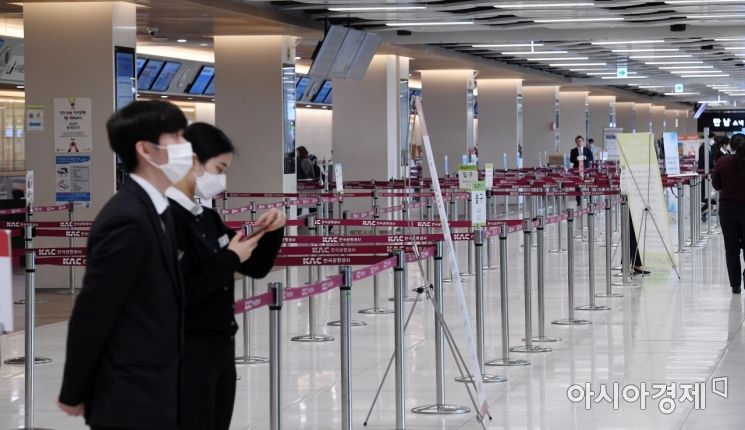
 On the 10th, amid ongoing concerns about the spread of the novel coronavirus infection, the domestic check-in counters at Gimpo Airport in Seoul showed a quiet scene. Photo by Hyunmin Kim kimhyun81@
[Asia Economy Reporter Yu Je-hoon] As the new coronavirus infection (COVID-19) crisis has rapidly frozen business conditions, national airlines are being swept up in a 'downsizing' trend. With air travel demand sharply shrinking, the aim is to overcome the crisis through cost reduction.
According to the aviation industry on the 19th, Eastar Jet, the fifth largest low-cost carrier (LCC) in Korea, announced an emergency management plan yesterday that includes partial salary cuts for executives and the introduction of a reduced working hours system for all employees except flight and cabin crew, starting from March for four months.
Accordingly, Eastar Jet's executives at the level of general manager and above will voluntarily return 30% of their salaries, and department heads below the executive level will voluntarily return their position allowances. Employees can apply monthly for one of the following: ▲3-day work week ▲4-day work week ▲4-hour workday. In addition, the existing unpaid leave system (minimum 15 days) will be maintained.
Eastar Jet is not the only one cutting costs. Jeju Air, the eldest LCC, already declared a crisis management system on the 12th and decided to implement a 30% salary cut for executives and reduced working hours. Jin Air, T'way Air, Air Busan, and Air Seoul are also conducting voluntary leave programs.
Full-service carrier (FSC) Asiana Airlines also had its executives submit collective resignations and decided to implement 10 days of unpaid leave for all employees, including general staff, flight crew, cabin crew, and maintenance staff.
The aviation industry’s tightening measures are interpreted as a response to the sharp decline in short-haul market demand due to last year’s boycott of travel to Japan and the massive suspension of China routes caused by the COVID-19 crisis, which resulted in a considerable amount of idle personnel. In fact, Asiana Airlines reduced its China routes by about 79% and Southeast Asia routes by about 25% after the COVID-19 outbreak. This means there are idle aircraft and personnel.
An industry official explained, "Not only has air transport demand significantly decreased, but many existing flight reservations have been canceled due to COVID-19, causing cash flow difficulties for airlines," adding, "This means they intend to pursue cost reductions such as labor costs while minimizing restructuring."
© The Asia Business Daily(www.asiae.co.kr). All rights reserved.