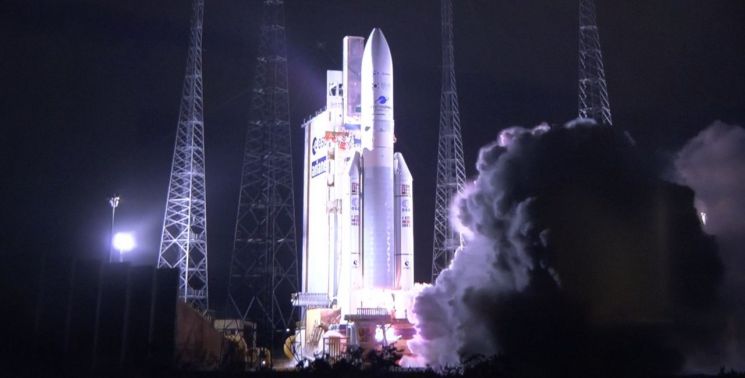
 The geostationary ocean and environmental satellite 'Cheollian 2B,' developed with domestic technology, was launched at 7:18 a.m. on the 19th from the Guiana Space Center. The Ariane 5 launch vehicle carrying Cheollian 2B. [Image source=Yonhap News]
[Asia Economy Reporter Joo Sang-don] The geostationary complex satellite 2B (Cheollian Satellite 2B) was successfully launched on the morning of the 19th, enabling the acquisition of various marine observation data such as sea fog and sea ice in the East Asia region, which had been unobservable until now.
According to the Ministry of Oceans and Fisheries, the Cheollian Satellite 2B is equipped with marine payloads with improved performance compared to Cheollian Satellite 1. The resolution is improved by 1 time, the output information by 2 times, and the data transmission speed by 18 times compared to the 1st satellite. Through this, it is expected to produce more diverse marine observation information such as sea fog, sea ice, fishery environment index, and low salinity water, which could not be observed by the 1st satellite.
Cheollian Satellite 2B, which was successfully launched around 7:18 a.m. at the Guiana Space Center in Kourou, French Guiana, South America, plans to approach a geostationary orbit at an altitude of 36,000 km after about five orbit transfers over two weeks. After several months of testing, marine information will be provided from October this year, and environmental information from 2021.
Cheollian Satellite 2B is the world's first geostationary satellite for fine dust observation. It will continuously monitor the East Asia region from Japan to northern Indonesia and southern Mongolia. Through this, it is expected to identify the generation and development areas of fine dust, its movement paths, its impact on Korea, and domestic high-concentration fine dust generation areas.
Moon Sung-hyuk, Minister of Oceans and Fisheries, said, "Based on the passion and dedication of many people, following the successful launches of Cheollian Satellite 1 and 2A, the launch of 2B has succeeded, enabling Korea to have world-class capabilities in developing geostationary marine observation satellites." He added, "Taking the successful launch of Cheollian Satellite 2B as an opportunity, we will actively support the expansion of satellite development capabilities to the private sector to help revitalize our economy."
© The Asia Business Daily(www.asiae.co.kr). All rights reserved.
![User Who Sold Erroneously Deposited Bitcoins to Repay Debt and Fund Entertainment... What Did the Supreme Court Decide in 2021? [Legal Issue Check]](https://cwcontent.asiae.co.kr/asiaresize/183/2026020910431234020_1770601391.png)















