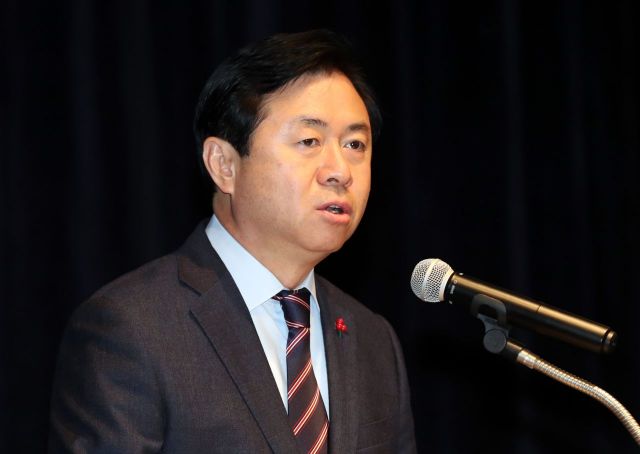
[Asia Economy Reporter Park Cheol-eung] Kim Young-chun, a member of the Democratic Party of Korea (Busanjin-gu Gap), announced on the 19th that he plans to emphasize the necessity of the "Korean-style Local Reinvestment Act" through a keynote presentation at the "Colloquium on Institutionalization and Revitalization of Local Reinvestment," jointly hosted by Busan Participation Solidarity and the Citizens' Policy Workshop.
In 2015, the Gross Regional Domestic Product (GRDP) of the Seoul metropolitan area surpassed that of local regions, and last year, for the first time in history, the population of the metropolitan area exceeded that of local areas. In particular, the growth rate of local GRDP has been accelerating its decline, dropping from 3.1% in 2014 to 1.7% in 2018.
For nationwide financial institutions such as deposit banks and savings banks, the ratio of local loans is only 34.6% and 17.2%, respectively. Representative Kim stated, "If we leave the vicious cycle of population decline and economic growth slowdown in local areas unchecked, local regions will inevitably disappear. To break this vicious cycle, the 'Korean-style Local Reinvestment Act,' which institutionalizes local reinvestment by financial institutions, must be firmly supported."
He explained that the United States has already mandated financial institutions' contributions to local communities through the enactment of the Community Reinvestment Act (CRA) in 1977 and the establishment of the Community Development Financial Institutions (CDFI) Fund in 1994, enhancing financial accessibility for underdeveloped areas and financially marginalized groups, thereby utilizing these measures for regional economic development and poverty alleviation.
In December of last year, Representative Kim proposed the "Local Reinvestment Act for Regional Economic Revitalization," which aims to build a virtuous cycle structure for regional economic activation through strengthened local financial support, along with amendments to the "National Finance Act" and the "Restriction of Special Taxation Act."
Local reinvestment refers to financial institutions contributing to local reinvestment funds, with the Financial Services Commission required to establish a basic plan for local reinvestment and local financial revitalization every five years.
Additionally, a Local Reinvestment Promotion Agency is established with contributions from financial institutions, government, and local governments to create local reinvestment funds. The agency uses these funds to support projects that activate financial support for local small and medium enterprises and low-credit individuals, as well as loan projects for citizen cooperatives, social enterprises, and social organizations aiming to solve local issues.
The Financial Services Commission evaluates and discloses the performance of these activities, and local government heads are required to reflect evaluation results when designating local financial institutions.
The evaluation includes the appropriateness of the scale of financial institutions' contributions to local reinvestment funds, loan performance relative to deposits by region, loan performance for local low-credit individuals and SMEs, and donation and loan performance for community contribution projects.
Representative Kim stated, "Through the Korean-style Local Reinvestment Act, local reinvestment by financial institutions should be institutionalized, and a virtuous cycle structure should be established that leads to corporate growth, job creation, and regional economic revitalization by providing smooth funding to residents, SMEs, and public organizations in the respective regions."
© The Asia Business Daily(www.asiae.co.kr). All rights reserved.
![User Who Sold Erroneously Deposited Bitcoins to Repay Debt and Fund Entertainment... What Did the Supreme Court Decide in 2021? [Legal Issue Check]](https://cwcontent.asiae.co.kr/asiaresize/183/2026020910431234020_1770601391.png)















