District Selected as Final Site for '2020 Smart Town Challenge Project', 2 Billion Invested... Creating 'Seongdong-style Smart Shelter' and Developing Wangsimni Area into a 'Smart Transcity' Focused on Transportation
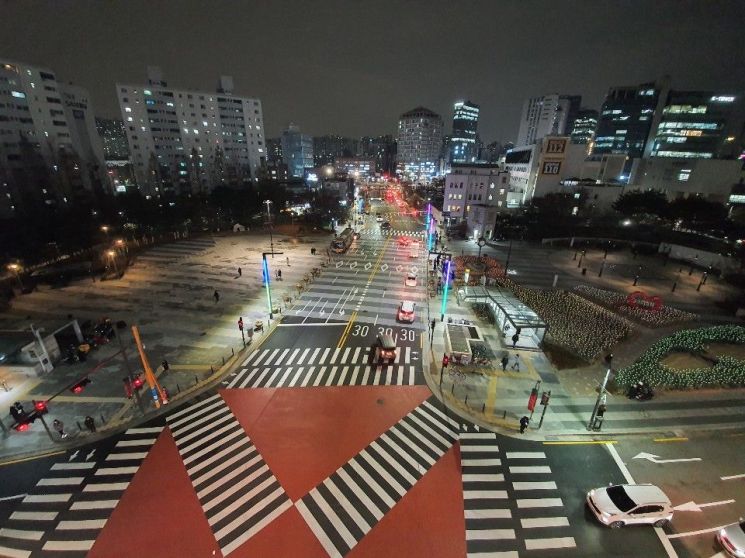 The Wangsimni Square area set to be transformed into a smart transportation town through the '2020 Smart Town Challenge' project
[Asia Economy Reporter Park Jong-il] Seongdong-gu (Mayor Jeong Won-oh) has been selected as the final winner of the Ministry of Land, Infrastructure and Transport’s ‘2020 Smart Town Challenge Main Project.’
The ‘Smart Town Challenge’ is a project that derives solutions to urban problems through living labs based on resident participation and establishes optimized specialized solutions in designated urban areas. It aims to improve daily conveniences such as transportation and energy by applying various smart services to existing urban areas.
In January last year, Seongdong-gu was selected as the preliminary project site among Seoul’s local governments with the ‘Transportation-Centered Wangsimni Smart Transcity’ plan and began establishing a master plan. Through four resident-participation living labs, various opinions were collected to solve transportation issues, and the introduction of smart services such as the installation of ‘Seongdong-type Smart Crosswalks’ was promoted.
With this project selection, the district will embark on creating various smart transportation towns in earnest. A total project budget of 2 billion KRW will be invested, including 1 billion KRW in national subsidies and 1 billion KRW from the district, to provide various smart transportation services such as ‘Seongdong-type Smart Shelter Construction,’ ‘Smart Pedestrian Notification Service,’ and ‘Comprehensive Public Transportation Information Service’ centered around Wangsimni Plaza.
In particular, the ‘Seongdong-type Smart Shelter’ is a specialized facility unique to Seongdong-gu that faithfully fulfills the basic functions of a fine dust shelter by installing fine dust measuring devices, air purification facilities, heating and cooling systems, heated seats, solar power generation devices, and health checkers inside a sealed bus stop structure with automatic doors, while also enabling the use of smart technologies such as Wi-Fi.
Additionally, various projects derived together with residents, such as smart parking sharing services, blind spot traffic notification services, and pedestrian notification services, will be promoted according to the budget.
A district official said, “The Wangsimni area is a transportation hub with various subway lines and a road network connecting in all directions, with a large and complex floating population, so there are diverse voices from residents demanding improvements,” adding, “We plan to devote ourselves to building services that listen carefully to even small opinions and solve problems.”
Jeong Won-oh, Mayor of Seongdong-gu, stated, “To provide transportation services that residents can feel in the Wangsimni area, we planned the project over the past year while deliberating with residents,” and added, “If we enhance the city’s value by applying customized technologies that residents can experience, I believe it will become a good model as a sustainable smart city.”
© The Asia Business Daily(www.asiae.co.kr). All rights reserved.
![User Who Sold Erroneously Deposited Bitcoins to Repay Debt and Fund Entertainment... What Did the Supreme Court Decide in 2021? [Legal Issue Check]](https://cwcontent.asiae.co.kr/asiaresize/183/2026020910431234020_1770601391.png)















