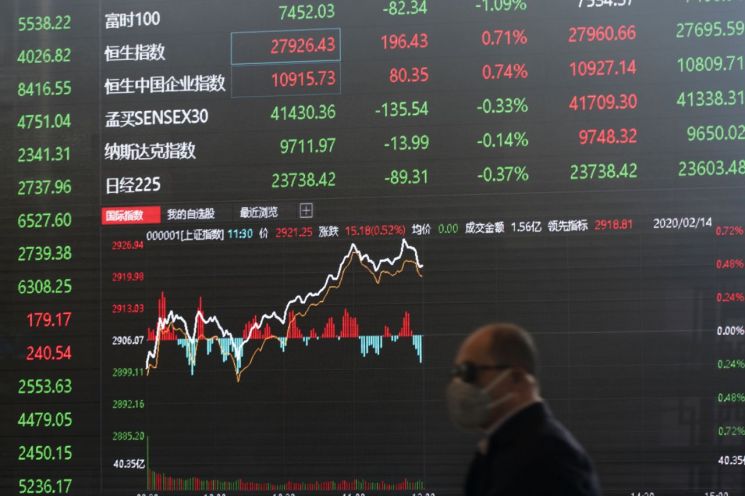
[Asia Economy Reporter Hyunwoo Lee] An analysis has emerged showing that economic activity in China has decreased to about half of its usual level due to the impact of the novel coronavirus infection (COVID-19). As factory operations came to a halt amid the COVID-19 crisis, nitrogen dioxide emissions reportedly dropped to half of the usual amount.
On the 18th, Bloomberg News cited a report from its economic analysis team (Bloomberg Economics), which analyzed data on population movement, industrial demand, and consumption from last week, concluding that China's economic operating rate was estimated to be around 40-50% of normal levels. According to the report, until the early part of last month's Lunar New Year holiday, the number of trips by airplanes, trains, cars, and ships was similar to that of last year's Lunar New Year, but after the holiday, the transportation frequency of these modes dropped to about 20% of the usual level. In particular, the operation rate of long-distance buses, which are heavily used by migrant workers from rural areas, fell to about 50%. This indicates that a significant portion of the estimated over 300 million migrant workers have yet to return from their hometowns to their workplaces.
Furthermore, as factory operations stopped, the emission of pollutants from factories also decreased. According to satellite data from the Energy and Air Research Center (能源和空氣硏究中心), nitrogen dioxide emissions resulting from factory operations after this year's Lunar New Year holiday decreased by 36% compared to last year's Lunar New Year period. It was explained that nitrogen dioxide emissions in regions densely populated with industrial facilities such as oil refining, coal power generation, and steel production dropped by 25-50%. Among 109 U.S. companies located around Shanghai, 70% resumed operations starting last week, and more than 90% are expected to return to work by this week; however, 78% of these companies reported that full operation is difficult due to a shortage of employees.
The State-owned Assets Supervision and Administration Commission (SASAC) also stated in a press briefing that the industrial impact caused by COVID-19 would become more apparent starting in February, especially affecting consumer-related companies and those linked to the global industrial supply chain. However, SASAC noted that central state-owned enterprises in the oil, telecommunications, power generation, and transportation sectors are operating at over 95% capacity.
© The Asia Business Daily(www.asiae.co.kr). All rights reserved.
![User Who Sold Erroneously Deposited Bitcoins to Repay Debt and Fund Entertainment... What Did the Supreme Court Decide in 2021? [Legal Issue Check]](https://cwcontent.asiae.co.kr/asiaresize/183/2026020910431234020_1770601391.png)
















