[Asia Economy Reporter Bu Aeri] As the government unveiled a draft amendment signaling legal regulations on 'probability-based items,' the gaming industry expressed concerns that this would constitute "reverse discrimination against domestic game companies."
Probability-based items refer to a 'gacha-style' purchase method, a concept similar to a lottery where users pay money in a game and cannot know which item they will obtain until they acquire it.
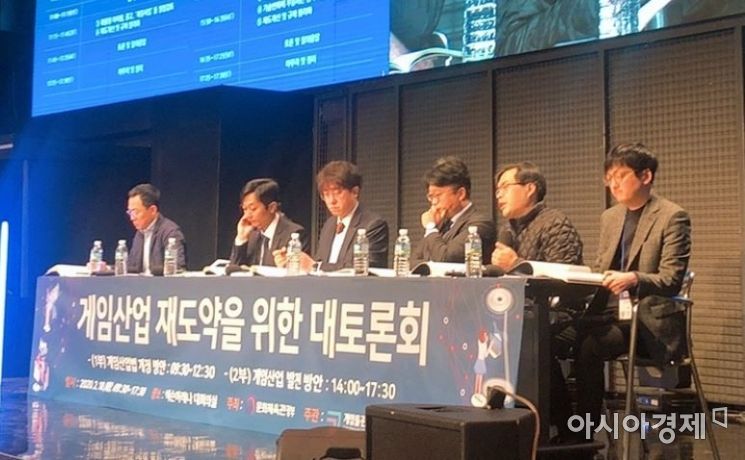
The Ministry of Culture, Sports and Tourism, the Game Rating and Administration Committee, and the Korea Creative Content Agency held a "Great Forum for the Re-advancement of the Game Industry" at Nexon Arena in Seocho-gu, Seoul, on the morning of the 18th, where they revealed the draft of the full revision of the Game Industry Act.
According to the draft released that day, the existing "Act on the Promotion of the Game Industry" will be renamed the "Game Business Act," with new user protection and obligation regulations established, including mandatory disclosure of information on probability-based items and grounds for regulating illegal advertisements.
Kim Yong-sam, Vice Minister of the Ministry of Culture, Sports and Tourism, stated, "We will announce a promotion plan through consultations with related ministries in the first half of the year and aim to submit the new game bill to the 21st National Assembly."
◆Imprisonment if probability is not disclosed= According to Article 64 of the draft full revision disclosed through the presentation paper that day, game developers must display the rating, game content information, types of probability-based items, and supply probability information by type when distributing or providing games for use. Violations will be punishable by imprisonment of up to two years or a fine of up to 20 million KRW.
Until now, the gaming industry has voluntarily announced the types and probabilities of probability-based items through the Korea Game Policy Self-Regulation Organization, to which game companies belong.
Professor Kim Sang-tae of Soonchunhyang University, who conducted the research for the full revision draft, explained at the forum, "Although the Fair Trade Commission has announced the probability-based items, the Game Industry Act has supplemented the obligation to disclose probability-based items."
The government appears to be aware of various controversies surrounding 'probability-based items.' These items have been criticized for causing excessive spending by users. There have been about 70 petitions to the Blue House from users requesting regulation of probability-based items by game companies.
◆Reverse discrimination issue for domestic game companies= The industry shows concern about the full revision draft. An industry insider said, "This will ultimately cause reverse discrimination against domestic game companies."
The insider pointed out, "Foreign game companies, such as those in China, currently do not disclose probabilities, and it will be difficult to punish them even if they do not comply with the future amendment. This means only domestic game companies will face stronger regulations."
The Game Industry Association also issued a statement that day, saying, "Changing the name from the existing Promotion Act to the Business Act only for the game industry raises concerns that the Ministry of Culture, Sports and Tourism views the game industry not as a subject of promotion but as a target for regulation and management."
It added, "We believe this differs from the current government's pledge and policy direction, which stated, 'The game industry is an industry that requires promotion and nurturing, and we will strengthen self-regulation and promote gradual improvement through joint deregulation policies with related ministries.'"
◆Questions about the necessity of codification= Experts also raised doubts about whether provisions related to 'probability-based items' are essential in the bill.
Legislative Research Officer Bae Gwan-pyo of the National Assembly Legislative Research Office said at the forum, "Considering that the business model of probability-based items is continuously changing, we need to consider whether it should be included in the law," and added, "Since the disclosure of information on probability-based items is at a minimum level, there is concern that it might cause misunderstandings that simply disclosing information is sufficient."
Lawyer Nam Hyun-sik of Merit Law Firm said, "Currently, self-regulation has not revealed side effects to the extent that it needs to be completely changed," and added, "As the status of our country's gaming industry is rising globally, it is necessary to maintain the symbolic leadership of the association itself."
© The Asia Business Daily(www.asiae.co.kr). All rights reserved.
![User Who Sold Erroneously Deposited Bitcoins to Repay Debt and Fund Entertainment... What Did the Supreme Court Decide in 2021? [Legal Issue Check]](https://cwcontent.asiae.co.kr/asiaresize/183/2026020910431234020_1770601391.png)















