Cheongdam Apgujeong Residents Oppose Line A
Protests and Lawsuits Intensify Over Line B
Fierce Competition Among Local Governments for Line C
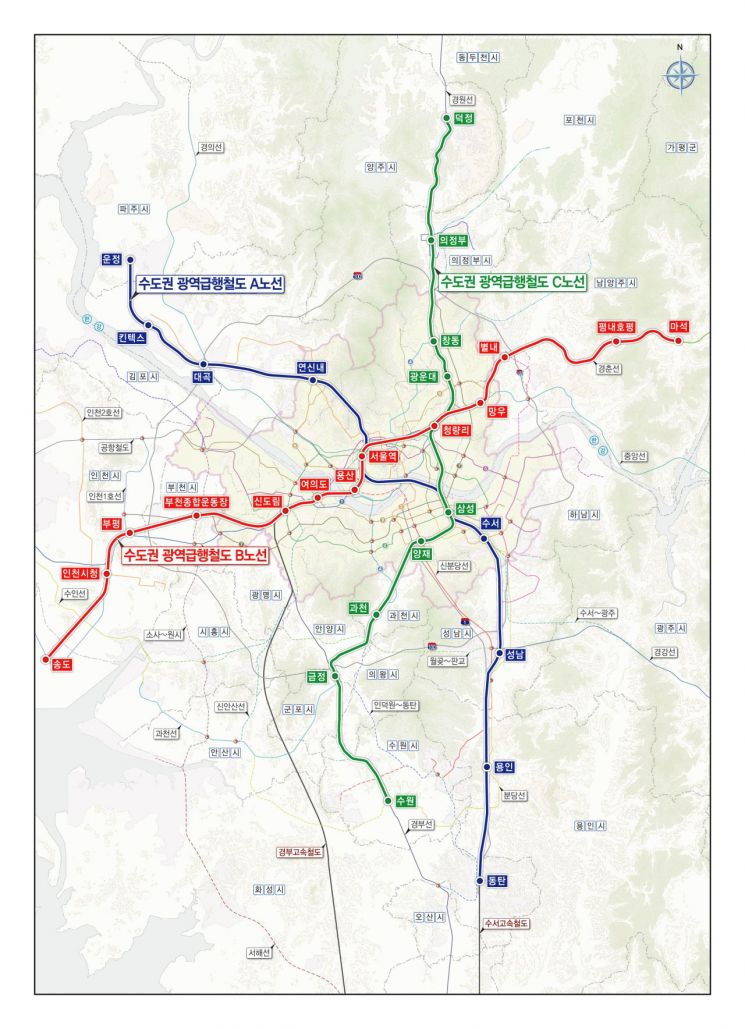
[Asia Economy Reporter Choi Dong-hyun] The metropolitan area’s Great Train Express (GTX) project is suffering from NIMBY (Not In My Backyard) and PIMFY (Please In My Front Yard) issues. As complaints from local residents regarding route decisions surge, the political sphere is also repeatedly including the GTX project in election pledges, raising concerns about disruptions to the project plans.
According to industry sources on the 18th, the GTX A line, which runs from the Unjeong district in Paju, Gyeonggi Province, through Seoul to the new city of Tongtan in Hwaseong, is currently at a standstill due to lawsuits involving the government, local governments, and residents.
Since last year, the Gangnam District Office in Seoul has not granted excavation permits for construction of the A line in the Cheongdam-dong and Apgujeong-dong areas. Residents in this area strongly oppose the route passing beneath their homes. In March last year, residents filed a lawsuit against the Ministry of Land, Infrastructure and Transport seeking cancellation of the approval for the GTX A line implementation plan. As the project faced long delays, SG Rail, the A line operator, filed an administrative appeal with the Seoul Administrative Appeals Commission against the Gangnam District Office at the end of last year. A Gangnam District Office official explained, "We cannot grant project approval because tunneling under densely populated residential areas poses serious safety issues," adding, "We are currently proceeding with administrative appeal procedures, including submitting written materials, but the timing of the outcome is uncertain." If the issue escalates to administrative litigation, long-term delays in the project will be inevitable. Moreover, the A line’s opening in 2023 is uncertain due to opposition from residents in Huam-dong, Yongsan-gu, and the Paju Gyohaji district, where a combined heat and power plant is located.
The B line, which passed the preliminary feasibility study in August last year and began basic planning design services last month, is also facing protests and lawsuits from local residents even before construction starts. The B line connects Songdo in Incheon and Maseok in Gyeonggi Province. The problem is that residents in the Yeouido area of Seoul, through which the B line passes, are opposing the project and have begun collective actions. Residents have protested through signatures by apartment complexes and appealed to district mayors, members of the National Assembly, and the Ministry of Land, Infrastructure and Transport. Recently, they also requested the Yeongdeungpo District Office to file a lawsuit against the Ministry of Land, Infrastructure and Transport to cancel the B line decision. A resident of S Apartment in Yeouido emphasized, "Yeouido’s ground is sandy, and there have been concerns about subsidence since the past," adding, "It will be difficult to handle residents’ opposition if the line passes underground."
The C and D lines are equally contentious. For the C line, which connects Deokjeong in Yangju, Gyeonggi Province, through Samseong in Seoul to Suwon, competition among local governments to attract the line is intensifying. This project passed the preliminary feasibility study at the end of 2018 and began feasibility and basic planning studies in June last year. Uiwang City recently requested the Ministry of Land, Infrastructure and Transport to add a stop at Uiwang Station on the C line, and Shin Chang-hyun, a member of the Democratic Party from the area, stated, "I will do my best in the National Assembly to ensure the Ministry accepts the study results." Anyang City is also conducting research on cost-saving measures such as establishing a new station at Indeogwon and sharing Line 4 facilities, actively competing to attract the line. Most prospective National Assembly candidates in the area have made attracting the C line their top campaign pledge. In response, Gwacheon City and Gunpo City strongly oppose adding new stations, citing increased travel times.
Even the D line, which is still in the project review stage, is already witnessing alliances and conflicts among local governments to secure key points. Gimpo City, Bucheon City, and Hanam City recently signed a business agreement with Gyeonggi Province to promote the D line. They plan to establish a cooperative system for the D line blueprint, which will connect Gimpo as the starting point, through Bucheon and the Seoul Southern Metropolitan Railway (Bucheon Sports Complex?Sillim?Gangnam?Jamsil), to Hanam. On the other hand, Incheon City and Gimpo City are currently in conflict over securing the starting point for the D line. After the Ministry of Land, Infrastructure and Transport announced the plan to establish the D line last year, Incheon immediately allocated a research budget of 400 million won. Gimpo City also plans to conduct a research study within the first half of this year.
© The Asia Business Daily(www.asiae.co.kr). All rights reserved.
![User Who Sold Erroneously Deposited Bitcoins to Repay Debt and Fund Entertainment... What Did the Supreme Court Decide in 2021? [Legal Issue Check]](https://cwcontent.asiae.co.kr/asiaresize/183/2026020910431234020_1770601391.png)
















